
★ In this story 03
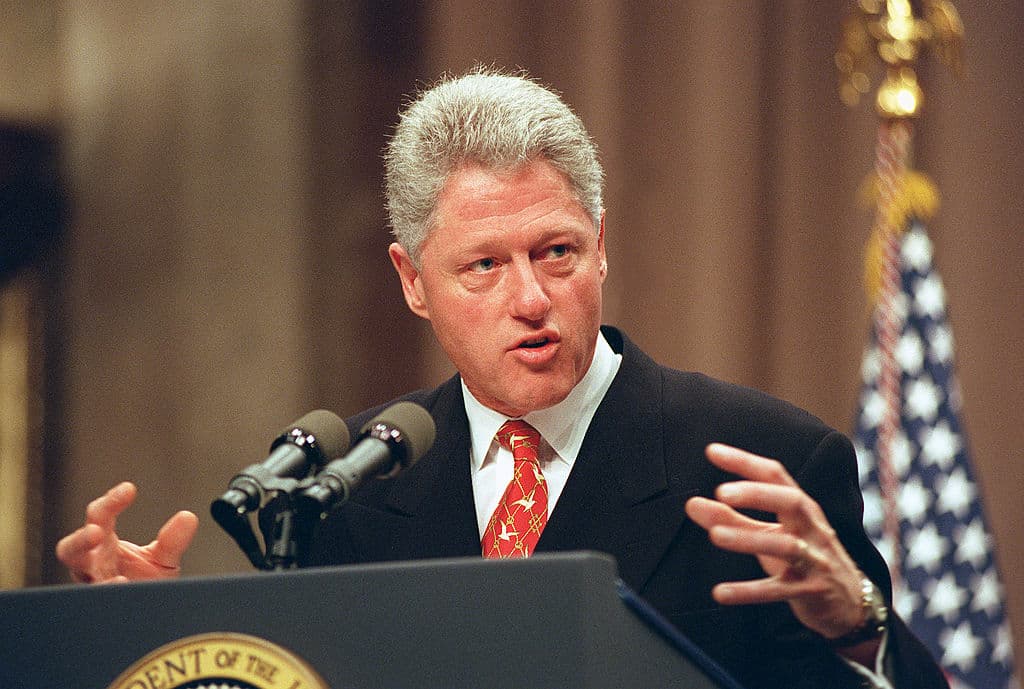
Bill Clinton, the 42nd president of the United States, was born William Jefferson Blythe III on Aug. 19, 1946, in Hope, Arkansas. His father died in an automobile accident just three months before his birth. In high school, he took his stepfather’s surname, which is why we know him as Bill Clinton today. He changed his name at age 15.
As president, Clinton would oversee a period of economic growth, but his administration would also become the center of a political scandal that led to his impeachment. His presidency included major debates over taxes, welfare, international trade, and the role of government in Americans' lives.
Early Years
The future president graduated from Georgetown University in 1968 and was awarded a Rhodes Scholarship to Oxford. In 1973, he graduated from Yale University with a law degree and returned to his home state to teach law at the University of Arkansas. While in college, he met Hillary Rodham, whom he married in 1975.
The couple had one daughter, Chelsea, born in 1980. Clinton's interest in politics began much earlier, and as a teenager he met President John F. Kennedy during a visit to Washington, D.C., as a delegate to Boys Nation, a youth leadership program.
Politics
In 1976, Bill Clinton became the state’s attorney general at the age of 30. In 1978, he was elected governor of Arkansas. He lost his re-election bid in 1980 but was once again elected in 1982. His years in office were noted for progressive programs, especially his determination to improve public education. Still, some of his constituents felt he was too liberal.
During his years as governor, Clinton pushed for higher teacher standards, improved schools, and economic development. He also became active in national Democratic politics, eventually chairing the Democratic Leadership Council, an organization that promoted more moderate positions on economic and social issues.
President Bill Clinton
Bill Clinton won the Democratic nomination and went on to defeat Republican President George H.W. Bush and independent candidate Ross Perot in 1992. The Cold War had recently ended, but people were still suffering from a recession that began in the late 1980s. Between 1980 and 1994, there was a banking crisis that saw more than 1,600 banks close or in need of financial assistance.
During the first two years in the Oval Office, Clinton concentrated on health care reform, the North American Free Trade Agreement between the United States, Canada, and Mexico, and the federal budget. The trade agreement was signed in 1992 and started on Jan. 1, 1994. It lifted tariffs on the majority of goods produced by those nations. However, in 1994, the Republicans won both houses of Congress, the House for the first time in 40 years.

Since Republicans had control, Bill Clinton tried to become more moderate in his politics, and, in 1996, he won re-election, defeating former Senate Majority Leader Robert Dole. He became the first Democrat to win a second term since President Franklin D. Roosevelt (FDR).
One of Clinton's biggest domestic achievements was the 1996 welfare reform law, which introduced work requirements and time limits for many recipients of federal cash assistance. Supporters argued it encouraged employment and reduced dependence on government programs, while critics worried that vulnerable families would lose essential financial support.
Clinton turned his attention to foreign policy and backed NATO bombing in Bosnia to stop ethnic cleansing. He also approved the bombing of Iraq to prevent Saddam Hussein from using weapons of mass destruction, expanded international trade, and worked toward peace in Africa, the Middle East, and Northern Ireland.
When Bill Clinton was elected president in 1992, he vowed to run “the most ethical administration in the history of the Republic.” However, in 1998, Clinton lied under oath, saying he had not had an intimate relationship with a White House intern, Monica Lewinsky. He later apologized for telling the falsehood, but calls came that he should resign or be impeached. The House of Representatives approved two articles of impeachment for perjury and obstruction of justice, but, in 1999, the Senate voted to acquit Clinton.
Clinton became the second president to be impeached; the first was Andrew Johnson in 1868. President Donald Trump became the third president to be impeached, in 2019, and impeached again in 2021.
After apologizing, Clinton promised to keep working as hard as he could for the American people. Despite failing on his health care reform, he had many accomplishments, including creating 22 million jobs, the most ever under a single administration, according to a White House list of achievements. He raised education standards and increased school choice, connected 95% of schools to the internet, and the crime rate was the lowest in 26 years. Some other achievements include the signing of the Family and Medical Leave Act, smallest welfare rolls in 32 years, lowest poverty rate in 20 years, and the deactivation of more than 1,700 nuclear warheads in the former Soviet Union.
Clinton also oversaw the federal government's first budget surplus in nearly three decades, beginning in fiscal year 1998. The surpluses reflected a combination of economic growth, increased tax revenues, and federal budget policies. By the time he left office in January 2001, the country had experienced one of its longest periods of economic expansion, according to the White House.
Try a quiz based on this article
William Jefferson Blythe (Clinton) III, America’s 42nd president, was born on Aug. 19, 1946, in what US state?
Show the answer
Arkansas.
In 1976, to kick off his political career, Bill Clinton, at the age of 30, became a(n) _______ in his home state.
Show the answer
Attorney General.
Which independent candidate ran against Bill Clinton in the 1992 election?
Show the answer
Ross Perot.
During his first two years as president, Bill Clinton focused on health care reform, the federal budget, and the North American Free Trade Agreement between the United States, Canada, and:
Show the answer
Mexico.
The last Democratic president before Bill Clinton to be re-elected for a second term was:
Show the answer
Franklin D. Roosevelt.
While shifting his focus to foreign policy, President Clinton approved both the bombing of Bosnia by NATO and the bombing of:
Show the answer
Iraq.
What did Bill Clinton do to destroy his vow to be the most ethical president?
Show the answer
Lied under oath.
For his actions, Clinton became the fourth president to be impeached.
Show the answer
False.
One of Bill Clinton’s major accomplishments as president was to create ________ jobs.
Show the answer
22 million.
Which statistic was the lowest it had been 26 years under the Clinton administration?
Show the answer
Crime rates.
4 Questions
The story, in brief
Who is Bill Clinton, and how did he get the Clinton name?
Bill Clinton was the 42nd president of the United States. He was born William Jefferson Blythe III in Hope, Arkansas, on Aug. 19, 1946, and his father died in a car accident three months before he was born. In high school, he took his stepfather’s surname and changed his name at age 15.
How did Bill Clinton rise from Arkansas politics to the presidency?
Bill Clinton graduated from Georgetown, studied at Oxford as a Rhodes Scholar, and earned a law degree from Yale before returning to Arkansas to teach law. He became Arkansas attorney general in 1976 and governor in 1978, then returned to the governorship after losing reelection in 1980. In 1992, he won the Democratic nomination and defeated George H.W. Bush and Ross Perot.
What were Bill Clinton's major policies and achievements as president?
During his presidency, Bill Clinton focused on health care reform, the federal budget, and the North American Free Trade Agreement. He also signed the 1996 welfare reform law, backed NATO bombing in Bosnia, approved bombing Iraq, and expanded international trade. His administration reported 22 million jobs created, a budget surplus beginning in 1998, lower poverty and crime, and wider internet access in schools.
Why was Bill Clinton impeached, and what happened after the impeachment?
Bill Clinton was impeached after he lied under oath in 1998 about not having an intimate relationship with White House intern Monica Lewinsky. The House of Representatives approved two articles of impeachment, for perjury and obstruction of justice. In 1999, the Senate voted to acquit him, and he remained in office until leaving in January 2001.