

★ In this story 04
China continues to harass and threaten its neighbors. Claiming broad expanses of the South China Sea as sovereign territory, Beijing has, over the last few years, sent its People’s Liberation Army Navy (PLAN) and Coast Guard to attempt to exert dominance over the Philippines, Vietnam, and Taiwan. The US Navy has routinely conducted freedom of navigation operations (FONOPs), sailing through the South China Sea and the Taiwan Strait, to emphasize to the People’s Republic of China (PRC) that it has no ownership over the international waterway.
China Persists in Territory Grab
The PRC’s persistent presence around the world is no more obvious than in the South China Sea. Looming large on China’s radar for intimidation is the Philippines. According to a recent report by the Associated Press, “President Ferdinand Marcos Jr. and his government on Friday [Nov. 13] protested remarks by China’s ambassador to Manila, calling them ‘a thinly veiled threat of the use of force’ in the latest flare-up in the two Asian countries’ longstanding territorial dispute in the South China Sea.”
According to Fox News, the number of Chinese ships dispatched to contested areas of the South China Sea has nearly doubled. “It comes as a series of increasingly tense encounters raises the risk of confrontation with a US treaty ally [Philippines] located in the disputed waters. The Armed Forces of the Philippines said it tracked 101 different Chinese navy and coast guard vessels around four disputed areas over the course of September, up from 56 in August and 48 in July.”
As a demonstration of American intentions to keep the South China Sea an open international waterway, in mid-October the Independence-class littoral combat ship (LCS) USS Charleston transited close to one of the disputed areas, Sabina Shoal. China protested the action.
Beijing’s Presence Is Persistent
“The PLA Navy, China Coast Guard cutters and China Maritime Militia vessels have maintained Beijing’s presence at Sabina Shoal since a 2024 standoff with Manila…,” according to the US Naval Institute’s USNI News. Because of the American presence in the South China Sea and close operational coordination with the Philippine Navy, maneuvers by US warships in the region often pique the PRC’s ire.
According to USNI News:
“Forward-deployed LCSs under U.S. 7th Fleet regularly patrol the South China Sea and drill with Southeast Asian states. In July and August, USS Santa Barbara (LCS-32) held consecutive maritime cooperative activities with Philippine, Japanese and Australian forces throughout the region. Navy P-8A Poseidon [anti-submarine aircraft] and Marine Corps MQ-9A Reapers also provide intelligence, surveillance and reconnaissance support during these sails.”
The MQ-9A Reaper drone operations are particularly significant since “[t]he service’s unmanned aerial vehicles started operating out of Basa Air Base [Philippines] this spring [2024] at the request of Manila to support intelligence sharing efforts between US Indo-Pacific Command and the Armed Forces of the Philippines, the I Marine Expeditionary Force confirmed last week,” as USNI News observed.
China Challenges Philippine Coast Guard
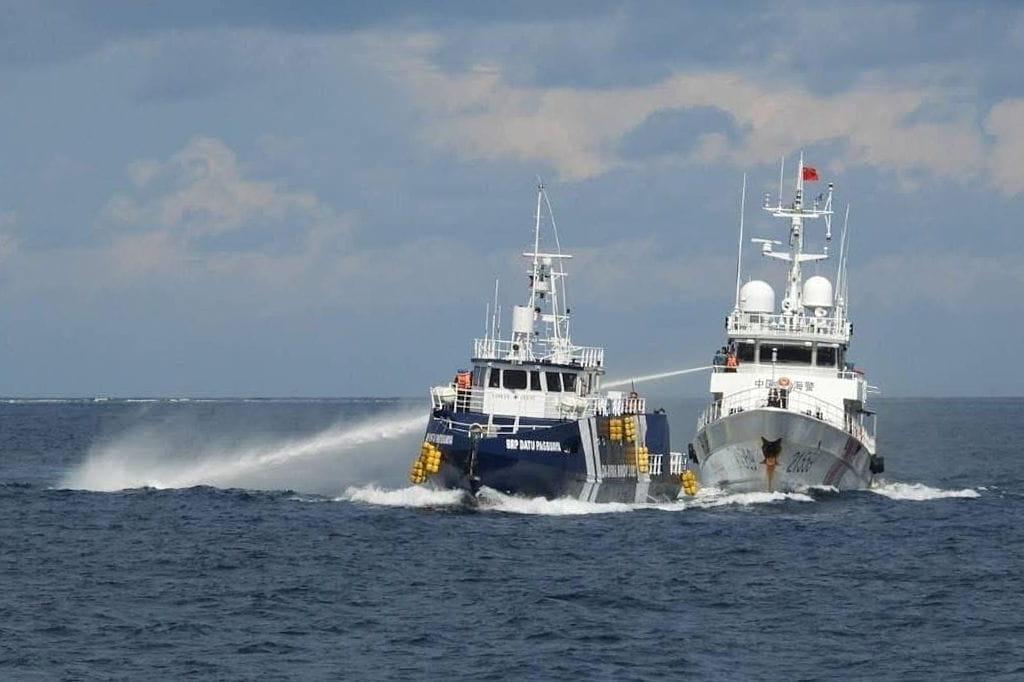
Chinese forces have consistently challenged Philippine Coast Guard and Navy vessels supporting resupply missions to Philippine fishing vessels sailing in contested areas. On one occasion in August 2025 near Scarborough Shoal, a PLAN destroyer and China Coast Guard cutter collided while attempting to pursue and harass the Philippine Coast Guard vessel Suluan. The Chinese Coast Guard ship deployed its water cannon and approached the Suluan from the stern.
The Suluan’s captain took evasive action, and the two Chinese vessels collided. According to The Maritime Executive: “The Chinese cutter hit the Chinese destroyer, crumpling CCG 3104's [coast guard ship] bow in by about 30 feet and rendering it inoperable. The destroyer's hull was dented, but otherwise unharmed.” Two crew members of the cutter were killed.
Though the Chinese actions proved costly this time, the threatening maneuvers were typical of the country’s operations in the region. Chinese Coast Guard warships routinely use water cannons to ward off Philippine vessels.
US Remains a Steadfast Ally
Despite China’s overt threatening behavior toward its neighbors, particularly the Philippines, the US has steadfastly maintained solidarity with the island nation and ally. According to the Philippine News Agency: “United States (US) Ambassador to the Philippines Lee Lipton on Monday reaffirmed Washington’s ‘ironclad’ commitment to Philippine security, citing the longstanding alliance between the two countries and their cooperation in defense, maritime security and regional stability.”
There does not appear to be any letup in Beijing’s bad behavior toward its neighbors. In response, the US will continue its FONOPs to ensure the South China Sea remains open and free to transit.
~
The views expressed are those of the author and not of any other affiliate.
4 Questions
The story, in brief
What is China doing in the South China Sea?
China is asserting broad claims over the South China Sea and sending its navy and coast guard to pressure nearby countries. The report says Beijing has tried to exert dominance over the Philippines, Vietnam, and Taiwan, and has kept a persistent presence around disputed areas such as Sabina Shoal.
Why is the United States sailing warships near Philippine-claimed waters?
The United States says its freedom of navigation operations show that China does not own the South China Sea or the Taiwan Strait. In mid-October, USS Charleston sailed near Sabina Shoal as a demonstration that the South China Sea should remain an open international waterway.
How have Chinese forces challenged Philippine vessels in disputed waters?
Chinese forces have repeatedly challenged Philippine Coast Guard and Navy ships supporting resupply missions and fishing vessels in contested areas. The report says Chinese coast guard warships routinely use water cannons, and in one August 2025 incident near Scarborough Shoal, two Chinese vessels collided while trying to harass the Philippine Coast Guard vessel Suluan.
What happens next in the South China Sea dispute?
The report says there does not appear to be any letup in Beijing’s behavior toward its neighbors. In response, the United States is expected to continue freedom of navigation operations, while Washington has also reaffirmed its ironclad commitment to Philippine security and cooperation on defense and maritime security.

Dave Patterson
National Security Correspondent at LibertyNation.Com and Generation Liberty, Dave is a retired U.S. Air Force Pilot with over 180 combat missions in Vietnam. He is the former Principal Deputy Under Secretary of Defense, Comptroller and has served in executive positions in the private sector aerospace and defense industry. Dave’s articles have appeared in The Federalist and DefenseOne.com.