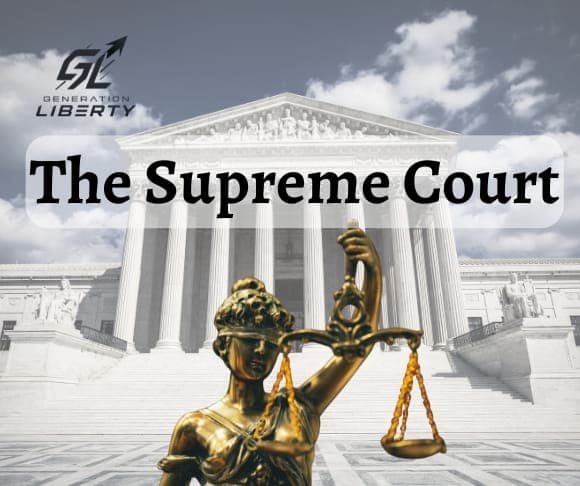

Article III, Section 1 of the Constitution provides that “The judicial Power of the United States, shall be vested in one supreme Court, and in such inferior Courts as the Congress may from time to time ordain and establish.” With that, the First Congress passed the Judiciary Act in September 1789, establishing 13 district courts, three circuit courts, and a Supreme Court made up of a chief justice and five associate justices.
The number of justices has fluctuated over the years, though; it is not fixed or determined by the Constitution. Since 1869, the Court has consisted of nine members: eight associate justices and one chief justice. President Franklin D. Roosevelt proposed expanding the Court in the 1930s, but the initiative failed.
The original Supreme Court convened for only a few weeks each February and August. The Court’s term now starts on the first Monday in October, and its recess begins in late June, sometimes in early July. The Court has met in the Supreme Court building in Washington, DC, since its completion in 1935, but for much of the Court’s history, the justices met in the Capitol building in DC. During its first decade, the Court convened in New York City and Philadelphia.
Along with establishing the Supreme Court, the Judiciary Act of 1789 required justices to “ride the circuit,” meaning twice a year they had to preside over the circuit courts throughout the country. This provision was supposed to ensure that the justices would be more aware of local opinion and state law. Chief Justice John Jay found the practice intolerable and threatened to resign, prompting Congress in 1793 to reduce the requirement to one journey per year. Congress ended the requirement in 1891.
John Jay was the Court’s first chief justice, serving from 1789 to 1795. Over the Supreme Court’s long history, chief justices have generally defined the Court’s different eras. For instance, if someone were to mention the Marshall Court, that person would be referring to the Supreme Court era presided over by John Marshall, the longest-serving chief justice, whose tenure ran from 1801 to 1835.