

Scientists, researchers, and many more have wondered who were the first people to arrive in America?
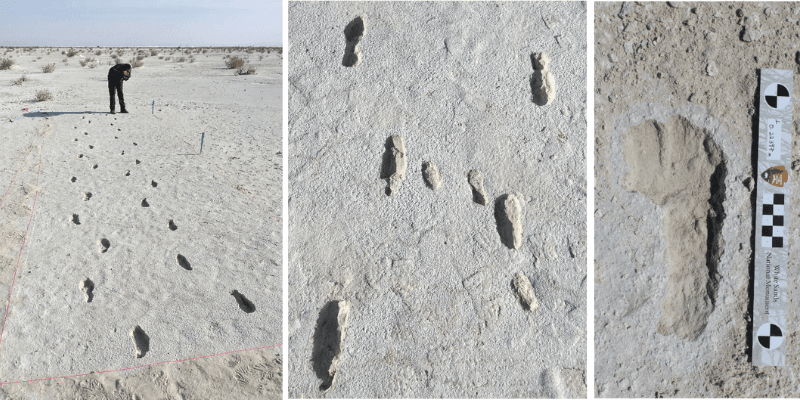
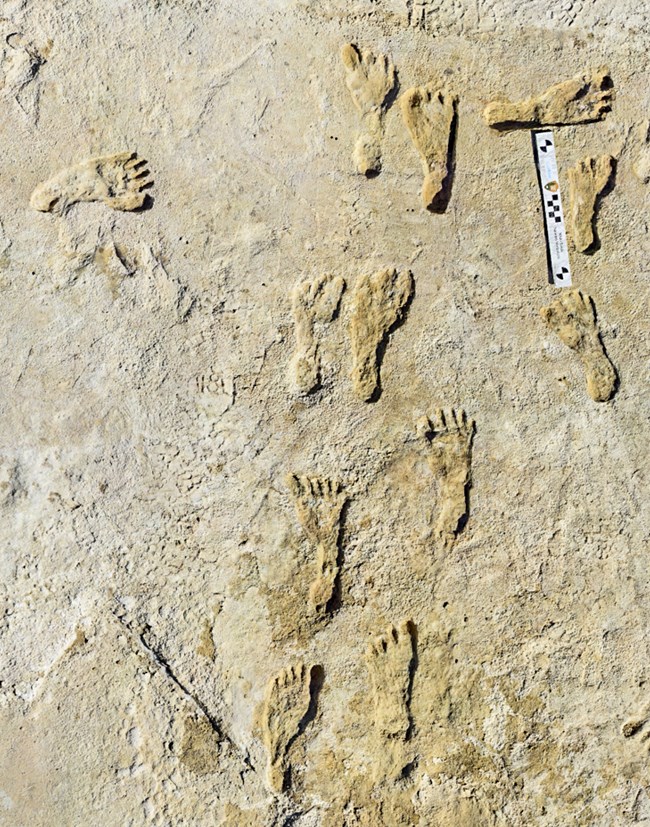
It appears a 2009 discovery in White Sands National Park, New Mexico, is suggesting a timeline of around 23,000 years ago, during the time of the Ice Age. The fossil finds, found in a dry lakebed in the park, show many footprints. It looks like they were those of teenage and child-aged people. Although there have been other findings, such as stone tools and fossil bones, footprints prints are more solid proof of a human presence.
The common thought is that people first came to the Americas from Asia and Africa around 13,000 years ago. One theory is that they crossed over a land bridge, now submerged under the Bering Sea, into what is now the U.S. state of Alaska. However, more and more scientists have begun to doubt this theory as new evidence is found.
The U.S. Geological Survey researchers analyzed seeds embedded in the fossil imprints and believe the age ranges from 21,130 years to 22,800 years ago. The study published in Science claims, “We knew they were old, but we had no way to date the prints before we discovered some with (seeds) on top. What we present here is evidence of a firm time and location.”
The footprints were found in the delicate combination of fine white silt and clay and were too fragile to do much other than preserving. As one archaeologist said, “The only way we can save them is to record them — to take a lot of photos and make 3D models.”
White Sands National Park has also uncovered fossilized tracks left by a saber-toothed cat, dire wolf, Columbian mammoth, and other ice age animals. In addition, a dog femur bone was found in a cave in Alaska, telling another tale of migration and pets in the family setting. The domesticating of dogs began in Siberia 23,000 years ago. The bone fragment indicates the dog was a descendent of the earliest known dogs in Siberia, Russia. Researchers guess the two populations of dog (Siberian/Alaskan) split 16,700 years ago, based on genetic differences. This could account for fossil footprints heading south to warmer climates.
The Americas were the last known areas on Earth to be populated. As such, the rush is on to understand the origins of the continent’s natives. Matthew Bennett, a specialist in ancient footprints at Bournemouth University, knows a thing or two about the subject, saying, “The peopling of the Americas is one of those things that has been for many years very contentious and a lot of archeologistshold views with almost religious zeal.”
Well, one thing is certain, scientists are one step closer to figuring out just when the first Americans arrived.
Try a quiz based on this article
Footprint fossils were discovered in White Sands National Park, in which state?
Show the answer
New Mexico.
Many of the footprints found in the lake bed appear to be from adults.
Show the answer
False.
Though other discoveries like stone tools and fossil bones have been found, the footprints better prove the existence of _____________.
Show the answer
Humans.
The land bridge some believe was used for ancient humans to cross over from Asia into Alaska is now under which sea?
Show the answer
Bering.
What was embedded in the footprints that allowed researchers to determine how old they were?
Show the answer
Seeds.
The femur bone, found in a cave in Alaska, belonged to what type of animal?
Show the answer
Dog.
How many years ago did humans begin domesticating dogs?
Show the answer
23,000.
Many of the fossilized footprints were found to be headed south, likely in search of _______.
Show the answer
Warmer climates.
According to the footprint discovery, humans could have been in America over 20,000 years ago - much earlier than the common theory says.
Show the answer
True.
Since the footprints are fragile, what can archeologists safely do with them? Check all that apply
Show the answer
Record them with photos.