
★ In this story 03
Have you ever attended a baseball game or watched the Olympics? If you have – and likely even if you haven’t – you know the “Star-Spangled Banner,” America’s national anthem. But the ballad is more than just a patriotic song for sporting events; it came from a very real battle at a very real place. That song we sing with hand over heart was inspired by the 25-hour bombardment of Fort McHenry during the War of 1812.
The National Anthem’s National Monument
Many national anthems praise royal dynasties, beautiful landscapes, or victorious armies. But ours focuses on answering one anxious question: “O say, can you see?” It wasn’t written in some cozy study by a famous poet or songwriter. It was scribbled by a worried 35-year-old lawyer pacing the deck of a boat as he watched more than 1,500 iron shells fall upon a tiny brick fort in Baltimore Harbor.
The story takes place in September of 1814. The United States was deep into what we call today the War of 1812. Just weeks earlier, in August, British forces had marched into Washington, DC, and set the White House, the Capitol, and the Treasury ablaze. The president at the time, James Madison, was forced to flee with his government into the countryside.
Meanwhile, Baltimore, Maryland was a bustling port city and home to many American privateers – that is, private citizens and their ships who were licensed to harass and capture British merchant vessels. Basically, they were officially sanctioned pirates. That’s what the British called Baltimore – a nest of pirates – and they intended to crush it.
Francis Scott Key was a prominent Maryland lawyer. He went out to meet the British fleet along with a US prisoner exchange agent to negotiate the release of his friend, Dr. William Beanes, who had been arrested by the British. The fleet agreed to free Beanes – but because they knew an attack was coming and feared the Americans would bring warning, the British officers refused to let the Americans leave until after the attack.
On the rainy morning of September 13, 1814, the attack began. Over the course of 25 hours, the British vessels hurled 200-pound exploding cast-iron mortar rounds and the rocket ship HMS Erebus fired Congreve rockets into the sky. The British ships had a much greater range than the cannons in Fort McHenry, so the Americans had little choice but to hide behind the walls and endure it.
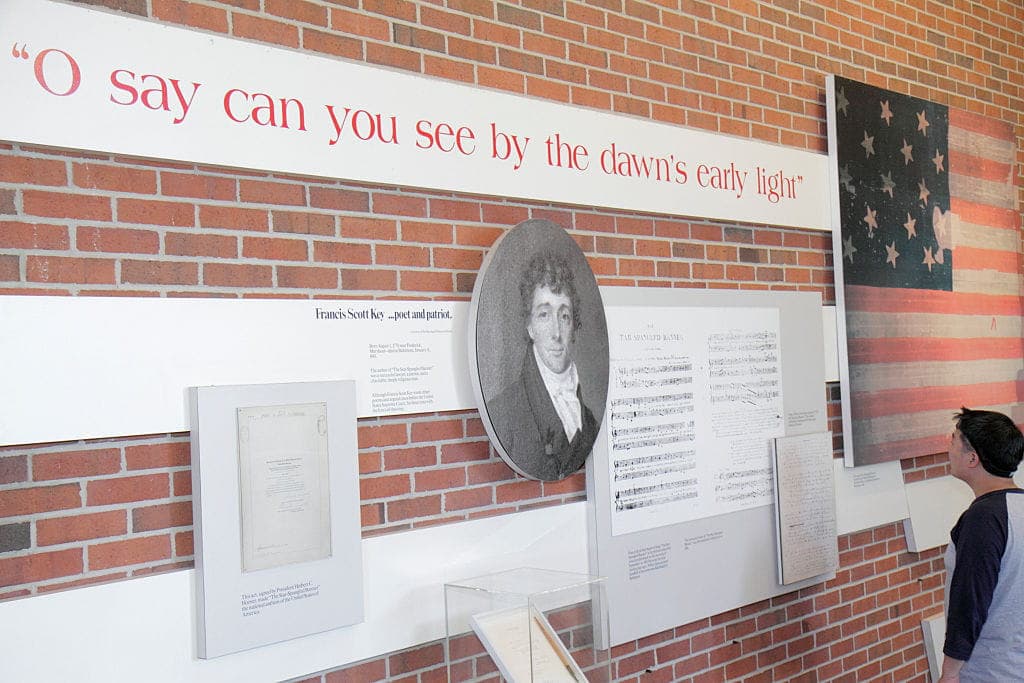
Through the pouring rain and heavy smoke, Key couldn’t see much. But thanks to the rockets and sudden explosions (“by the rockets’ red glare, the bombs bursting in air”), he could see the flag was still there. Finally, by the dawn’s early light, Key could see the British invasion had been repelled and the fleet was unable to get past the ships the Americans sank in the harbor to block them. The fort’s commander, Major George Armistead, took down the smaller storm flag and raised the massive banner he had commissioned. The British gave up. Relieved, Key pulled out an old letter from his pocket and began writing the verses to what he initially called “Defence of Fort M’Henry.”
Fort McHenry: A Star-Spangled Banner and a Star-Shaped Battleground
Fort McHenry wasn’t some towering medieval stone castle. Rather, it was a small, low-to-the-ground fort built of brick and sloping earthen ramparts in the shape of a five-pointed star.
So, why a star? A traditional square fort leaves dangerous blind spots where defenders have to lean out over the parapet at the corners in order to see every place an attacker might be. In a star fort, however, every point of the star is covered by artillery crossfire from the next point, leaving attackers with nowhere to hide.
Armistead had about 1,000 men under his orders. Expecting an attack, he commissioned a local flagmaker, Mary Pickersgill, to sew a massive flag in 1813. What she delivered was 30 feet high and 42 feet long, and each of the 15 stars measured two feet across – so, as he put it, “the British would have no difficulty seeing it from a distance.”
National Monument and Shrine
Today, Fort McHenry is the only site in the National Park System designated as both a national monument and a historic shrine. There are many monuments – but shrines are much rarer. While the monument designation exists to protect the historical or scientific value of a site, shrines commemorate the more intangible patriotic, spiritual, or symbolic meaning of what happened there.
Fort McHenry was officially retired as an active military post by Congress on March 3, 1925, and designated a national park. On August 11, 1939, it was deemed both a national monument to protect the site itself and a historic shrine in honor of the birthplace of the flag’s symbolism and the national anthem. As for the “Star-Spangled Banner” itself, President Herbert Hoover signed an act of Congress in 1931 making it the official national anthem of the United States.
The physical fort remains in Baltimore Harbor, reminding visitors of that rainy night when a young nation’s survival came down to a single flag on a muddy rampart – the night America proved it really was the land of the free and the home of the brave.
4 Questions
The story, in brief
What happened at Fort McHenry in September 1814?
During the War of 1812, British ships bombarded Fort McHenry in Baltimore Harbor for 25 hours on September 13 and 14, 1814. The Americans endured the attack behind the fort's walls, and by dawn the British invasion had been repelled. The fleet also could not get past ships the Americans had sunk in the harbor to block them.
Why was Francis Scott Key on a British ship near Fort McHenry?
Francis Scott Key had gone to meet the British fleet with a US prisoner exchange agent to negotiate the release of his friend, Dr. William Beanes. The British agreed to free Beanes, but they would not let the Americans leave because an attack was coming. They feared the Americans would warn Baltimore.
How did the battle at Fort McHenry inspire the Star-Spangled Banner?
As Francis Scott Key watched the bombardment through rain and smoke, the rockets and explosions let him see that the flag over Fort McHenry was still flying. By dawn, he saw that the British had failed to take the fort. Relieved, he began writing verses on an old letter and first called them Defence of Fort M'Henry.
Why is Fort McHenry both a national monument and a historic shrine?
Fort McHenry is the only site in the National Park System with both designations. The national monument status protects the historical site itself, while the historic shrine honors the patriotic and symbolic meaning of what happened there. It marks the birthplace of the flag's symbolism and the national anthem.