★ In this story 02
Montezuma Castle wasn’t the only national monument named by mistake. In 1906, President Theodore Roosevelt signed into law the Antiquities Act, empowering presidents to establish national monuments. The law began a new American tradition of honoring and protecting historic sites federally – but it also formalized some mistaken names. The first on the list, Devils Tower, is believed to be one of those.
Devils Tower or Bear Lodge?
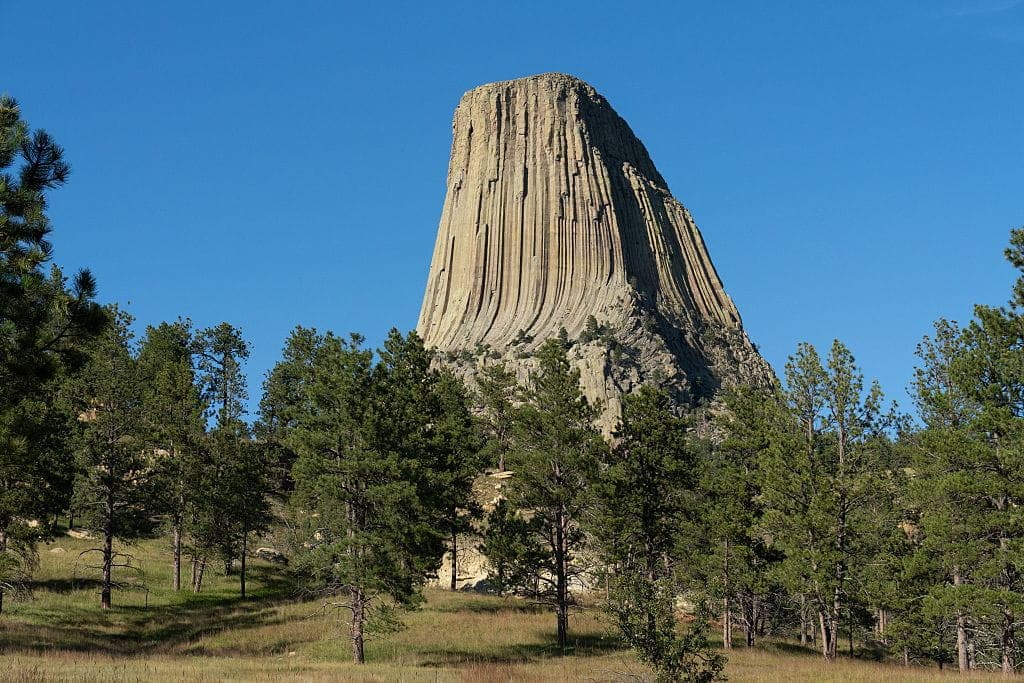
Devils Tower is an igneous intrusion revealed by erosion. Geologists explain that, long ago, magma was pushed upward and cooled underground. Over the ages, wind and water removed the softer rock and dirt around it, leaving what is today a steep formation standing 1,267 feet over the Belle Fourche River in Wyoming.
Indigenous people in the area call it Mato Tipila, which translates to Bear Lodge. Despite this, in 1875, Colonel Richard Dodge recorded the name Devil’s Tower during a military expedition. It’s believed that he misinterpreted a native name translated as “Bad God’s Tower.” Later, the apostrophe was dropped due to a clerical mapping error and never restored.
More than 20 Northern Plains Native American tribes hold the site sacred. The vertical sides of the formation are marked by hexagonal columns and numerous cracks. While these make it unique and interesting to rock climbers today, tribal legend tells the tale of its origin. In the story, giant bears were chasing a group of children. Either a great spirit or the earth itself, depending on the tale, raised the ground to save the children, and the massive columns are the scratch marks left behind by the bears trying to climb up.
It remains a sacred site even today, and visitors can often see colorful prayer cloths and bundles tied to the pine trees near the base. These represent personal prayers and are not to be touched or even photographed by visitors. Furthermore, the National Park Service asks climbers to choose other venues in June, which is a sacred month filled with traditional ceremonies like the Sun Dance.
The Tradition of Preservation
Devils Tower National Monument averages around half a million visitors a year – about 80% of whom show up between Memorial Day and Labor Day. When President Theodore Roosevelt decided to try to protect certain sites of historical interest that were being looted and otherwise abused, he used the phrase “objects of historic or scientific interest.” He was careful in the language of the law, though, so that it could protect large areas and whole ecosystems instead of just smaller archaeological sites. Thanks to that wording, the Antiquities Act doesn’t just protect sites such as Montezuma Castle and Devils Tower – it also extends to massive areas such as the Petrified Forest and the Grand Canyon.
But not everyone has been onboard with this tradition of preservation. Western politicians, ranchers, miners, and loggers often opposed the program. They called it federal overreach and a hindrance to local economic growth and resource use. Roosevelt and his allies pushed through the opposition, though, and created 18 monuments before he left office. Since then, various other presidents have used the Antiquities Act to establish 150 more national monuments, bringing the total to 168.
4 Questions
The story, in brief
Why is Devils Tower believed to have the wrong name?
Indigenous people in the area call the site Mato Tipila, which translates to Bear Lodge. In 1875, Colonel Richard Dodge recorded the name Devil’s Tower during a military expedition, and it is believed he misinterpreted a native name translated as Bad God’s Tower. The apostrophe was later dropped because of a clerical mapping error and never restored.
What is Devils Tower National Monument and how was it formed?
Devils Tower is an igneous intrusion revealed by erosion. Geologists say magma was pushed upward long ago and cooled underground, then wind and water wore away the softer rock and dirt around it. That left a steep formation rising 1,267 feet above the Belle Fourche River in Wyoming.
Why is Devils Tower sacred to Native American tribes today?
More than 20 Northern Plains Native American tribes hold the site sacred. Tribal legend says giant bears chased a group of children, and a great spirit or the earth raised the ground to save them. The massive columns are said to be the scratch marks the bears left behind while trying to climb up.
How did the Antiquities Act affect Devils Tower and other protected sites?
In 1906, President Theodore Roosevelt signed the Antiquities Act, giving presidents the power to establish national monuments. He used careful language so the law could protect large areas and whole ecosystems, not just small archaeological sites. Roosevelt created 18 monuments before leaving office, and later presidents added 150 more, for a total of 168.