

★ In this story 02
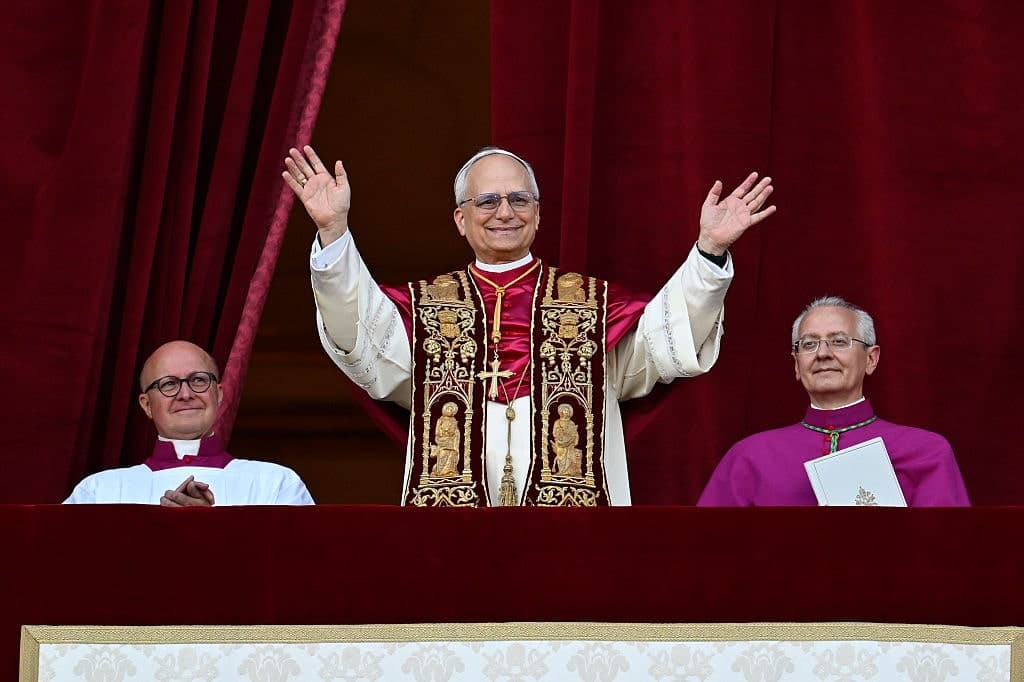
White smoke billowed from the chimney above the Sistine Chapel at 6:07 p.m. at the Vatican (just after noon Eastern) on Thursday, May 8. This signified that a new pope had been chosen. After four or five rounds of voting (the world will never know for sure), the cardinals elected Robert Prevost, a 69-year-old cardinal from Chicago, Illinois, as the new pope. Prevost – the first American to ever be elected pontiff – chose the name Leo XIV.
Prevost was born in Chicago in 1955 to parents of Spanish and Franco-Italian ancestry. He served as an alter boy, and he became a priest in 1982. He moved to Peru three years later and worked with impoverished communities in South America, though he also returned regularly to his home city to serve as a pastor and prior.
Picking a Pope
Pope Leo XIV, as Prevost will now be known, was elected by 133 cardinals sealed in conclave over the course of two days, a vote that required at least two-thirds (89) of the cardinals assembled. As for the vote counts, who voted for whom, or who the options might have actually been, the public will never know. The cardinals and everyone else involved – from cooks and cleaners to drivers and elevator operators – were sworn to secrecy under threat of automatic excommunication should they talk.
As for the process, each cardinal writes on a piece of paper “Eligo in summen pontificem,” which is Latin for “I elect as Supreme Pontiff,” and then the name of their choice. They approach the alter one by one and say: “I call as my witness, Christ the Lord who will be my judge, that my vote is given to the one who, before God, I think should be elected.” Then they place their folded ballots on a round plate and slide them into an oval urn.
After all votes are counted and the outcomes announced, the papers are sewn together with each one pierced through the word “Eligo.” Finally, they are burned with a chemical that will either produce black or white smoke – black for no, white for yes – which billows out of the chimney above the Sistine Chapel, announcing to the world the progress or lack thereof.
Once white smoke rises from the chimney, the cardinal protodeacon then announces from the balcony of St. Peter’s Basilica: “habemus papam,” which is Latin for “We have a pope.” In this conclave, Cardinal Dominique Mamberti, a 73-year-old Frenchman born in Morocco, made the announcement.
How Long It Takes
Pope Francis – born December 17, 1936, and deceased April 21, 2025 – was chosen in March of 2013 after just two days of voting. In fact, Pope Leo XIV’s election was the third time in a row a pope was chosen after just two days of voting. But the process has been known to take much longer – months or, in one case, years.
In 1268, the death of Pope Clement VI created a crisis. There were only 17 cardinals in the conclave to select his successor, but they were split between two factions, the Guelphs and the Ghibellenes. The two groups disagreed on the Investiture Controversy, or whether authority to appoint bishops and abbots rested with the church or secular leaders. This division – along with personal and political issues between the cardinals – resulted in a stalemate that lasted 1,006 days, or almost three years. The people of Viterbo, where that conclave was held, eventually locked down the city and refused to allow the cardinals to leave until a pope was elected.
It was that pope, Gregory X, who declared in 1274 that all future conclaves must be held behind closed doors with the cardinals locked in isolation “cum clave” (with a key) with no outside contact until they complete the process. That’s where the term conclave came from. From then on, the process took anywhere from a couple of days to a few months. The last conclave to take more than a week was in 1831. After 51 days of voting, Pope Gregory XVI was elected.