
★ In this story 03
On July 4, 2026, the 250th birthday of this nation and the anniversary of the signing of the Declaration of Independence, America250 buried America’s Time Capsule at Independence National Historical Park in Philadelphia, PA. The three branches of the US federal government, all 50 states, along with Washington, DC, five US territories, and a group of partner organizations contributed to the contents. This will remain sealed until July 4, 2276, America’s 500th birthday.
The Vessel
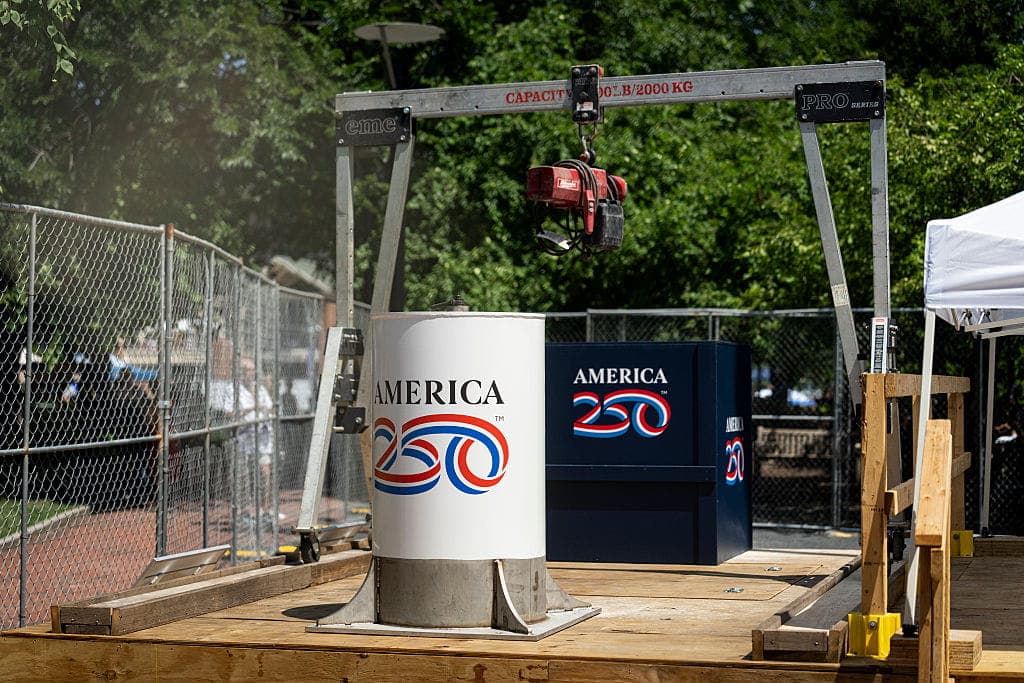
America250, a nonpartisan organization tasked by Congress to lead the 250th anniversary celebrations, made America’s Time Capsule a part of their plans. The container holds a variety of items that represent this country in the year 2026.
The tricky part was creating a vessel that would withstand being underground for 250 years. A group of scientists from the National Institute of Standards and Technology (NIST), led by Michael Berilla, was given the assignment to create a time capsule that could last two and a half centuries underground. Moisture is the greatest concern because it is difficult to prevent and can cause extensive damage to the contents. Berilla and his team chose to build the 900-pound vessel out of stainless steel with indium, a soft metal that filled small gaps and created a watertight seal. They also made the vessel cylindrical rather than in a box shape, an effort to prevent water from flowing into it. A 1,100-pound steel bell bar sits atop the capsule, which serves as an extra layer of protection.
Confident, Berilla stated, “Philadelphia would have to be six feet underwater in order for this time capsule to even possibly take on water.”
Its Contents
The inside of the capsule is lined with circular shelves that hold the contents donated by various contributors. Each item represents the people, places, things, and ideas that reflect the United States of America in 2026. Everything from coins, pins, photos, letters, and poems found a home in the capsule. Utah donated the most items of the 50 states, including two granite disks, a prayer medal, and coins, among others.
The US federal government also joined in the fun. The Library of Congress added a 1GB digital archive as well as some visitor notecards, and the Supreme Court of the United States put in a pocket Constitution signed by the Justices.
Many donations came from sponsors and partners of America250. The National Football League (NFL), the National Basketball Association (NBA), and the PGA Tour provided sports-related objects. Other donors were the Smithsonian Institute, the National Institute of Standards and Technology, the National Endowment for the Arts, and items from five US territories.
Where America’s Time Capsule Calls Home
In 1776, the Declaration of Independence was signed at the Pennsylvania State House, also known as Independence Hall, in Philadelphia, PA. The time capsule is buried within Independence National Historic Park about 15 feet underground. It will remain there for 250 years, when it will be opened and the items revealed on the nation’s 500th birthday.
The first items that will be seen when it is opened are a letter written by Michael Berilla and a photograph of the team that designed the capsule. Berilla’s letter states, “Greetings from the living, breathing hearts and hands of 2026,” he wrote. “We will have long since returned to dust, but our devotion, pride, and unwavering hope for what our world could become are alive right here inside this steel. We built this for you.”
America’s Time Capsule is more than a collection of artifacts — it is a message from the people of 2026 to future generations, preserving items that reflect the nation’s culture, values, and achievements. When it is finally opened on July 4, 2276, it will offer a unique perspective into life in the United States during its semiquincentennial celebration.

Kirsten Brooker
Culture Correspondent for Liberty Nation and Generation Liberty. Kirsten loves to write about culture from the point of view of an everyday American who lives deep in the heart of the Midwest. She is the mother of two adorable girls, likes classic rock, and humbly wears the crown of a former Homecoming Queen with grace and style.