

★ In this story 03
Every year millions of Americans observe daylight saving time (DST) by moving their clocks forward one hour in March and back one hour in November. Behind the simple ritual lies a question: Who decides what time it is? Is it the federal government, state legislators, or someone else entirely? The answer may be more complicated than you imagine, shaped by a mix of history, politics, and law.
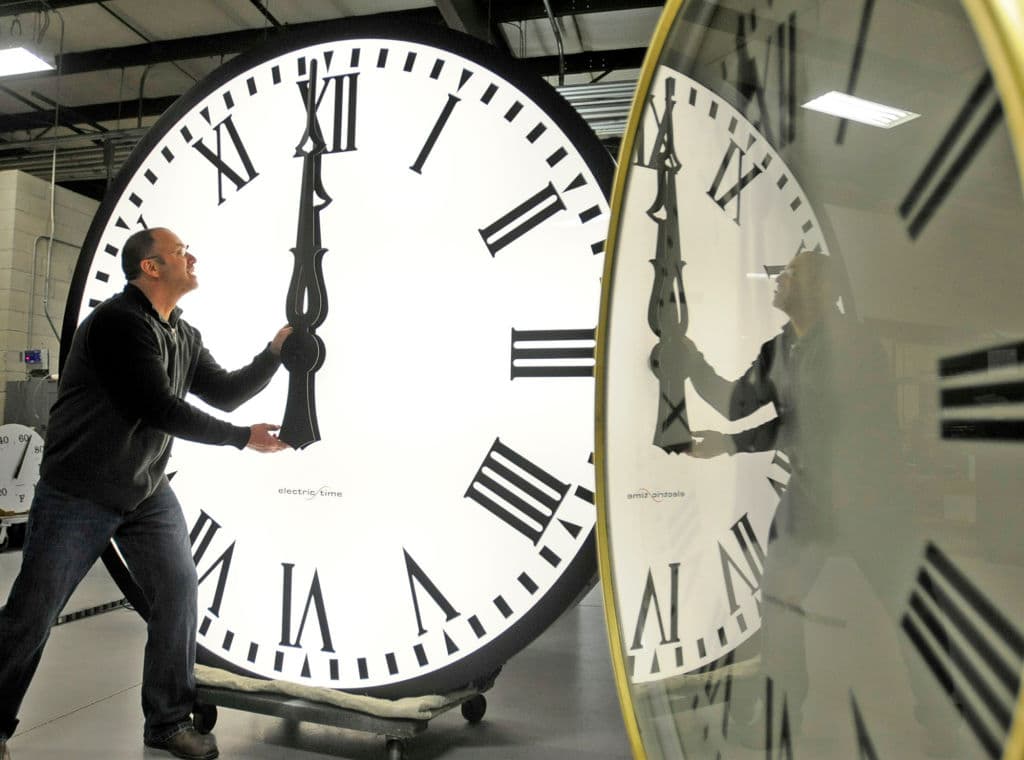
The man in the photo is adjusting the hand of an enormous clock, offering a literal look at the act millions of Americans perform when daylight saving time begins or ends.
The Clockmakers: The Original Rulers of Time
Before time was displayed on microwaves, cell phones, and computers, clockmakers were instrumental in keeping communities on schedule. They designed, built, and regulated all the clocks, whether displayed in homes, businesses, churches, or public buildings. Clockmakers worked carefully and diligently because people depended heavily on clocks to organize their daily tasks.
Clockmakers, while considered the rulers of time, were not quite that. They maintained clocks, but they did not decide how time worked. At first, they set clocks based on local customs, but eventually, time became standardized by railroads, scientists, and governments.
Benjamin Franklin jokingly suggested in 1784 that earlier waking hours could reduce candle use, but he did not propose changing clocks. In 1895, New Zealand entomologist George Hudson presented a serious proposal for shifting clocks, although the idea was not adopted. In 1918, during World War I and following Germany, Austria-Hungary, and Britain, the United States implemented DST. It was widely unpopular and was repealed after the war ended in 1919.
States Play by Different Rules
Though most Americans move their clocks forward each spring and back each fall, not all states follow the same routine. The Uniform Time Act of 1966 established federally mandated dates for beginning and ending DST. States may choose whether to participate or remain on standard time throughout the year. Most of Arizona, excluding the Navajo Nation, and the entire state of Hawaii remain on standard time, as do several US territories.
States cannot simply choose to stay permanently on daylight saving time. Under current federal law, they can opt only for permanent standard time. This division of authority explains why requests to stop changing the clocks often pass in state legislatures but do not take effect without action from Congress.
The Fight to Lock the Clock
For years, Americans have debated whether to end the twice-yearly clock change. Supporters of permanent daylight saving time argue that more evening sunlight would allow people longer time to be outdoors and could benefit business by encouraging customers to be out later into the evening. Those who oppose it tend to prefer the extra light in the morning hours and prefer aligning the clock more closely with the sun.
Nevertheless, the decision ultimately belongs to the federal government. In 2026, under the leadership of President Donald J. Trump, the Sunshine Protection Act of 2025 was passed by the House of Representatives. This move would make daylight saving time permanent, but the US Senate has yet to approve it and has asked the Committee on Commerce, Science, and Transportation to review it. Until the law changes, it remains spring forward and fall back.
4 Questions
The story, in brief
Who decides whether Americans change clocks for daylight saving time?
The federal government sets the rules for daylight saving time. The Uniform Time Act of 1966 established federally mandated dates for when it begins and ends. States may choose whether to participate or stay on standard time year round, but they cannot make daylight saving time permanent on their own.
Why do Arizona and Hawaii not follow daylight saving time?
Federal law allows states to remain on standard time throughout the year. Most of Arizona, excluding the Navajo Nation, and all of Hawaii use that option instead of changing clocks in spring and fall. Several US territories also stay on standard time year round.
How did daylight saving time begin in the United States?
The United States adopted daylight saving time in 1918 during World War I, after Germany, Austria-Hungary, and Britain had done so. Benjamin Franklin had only joked about earlier waking in 1784, and George Hudson made a serious proposal in 1895. The policy was widely unpopular in the United States and was repealed after the war ended in 1919.
What happens next to the Sunshine Protection Act of 2025?
The House of Representatives passed the Sunshine Protection Act of 2025 in 2026. The measure would make daylight saving time permanent, but it has not taken effect because the US Senate has not approved it. The Senate has asked the Committee on Commerce, Science, and Transportation to review it.

Kirsten Brooker
Culture Correspondent for Liberty Nation and Generation Liberty. Kirsten loves to write about culture from the point of view of an everyday American who lives deep in the heart of the Midwest. She is the mother of two adorable girls, likes classic rock, and humbly wears the crown of a former Homecoming Queen with grace and style.