
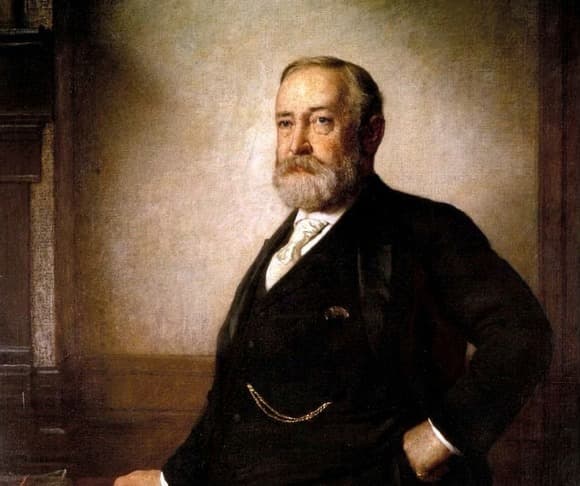
His grandfather, William Henry Harrison, was the ninth president and served the shortest term in history. He was in office exactly one month before dying of pneumonia. Ironically, the elder was known as the “Indian Fighter” while the grandson, Benjamin, fought for Native American rights.
During the Civil War, Benjamin joined the Union Army in the 70th Indiana Volunteer Infantry Regiment and achieved the rank of brigadier general by 1865. He was the last Civil War general to become president.
At the 1888 Republican Convention, he was nominated for the presidency and started the first “front-porch” campaigns, in which he gave short speeches to the delegates that visited him in Indianapolis.
Benjamin Harrison Presidency
Harrison had already demonstrated his belief in equal rights, fighting for homesteaders, Native Americans, and even going against the Republican Party in 1882 to oppose the Chinese Exclusion Act which would prevent Chinese immigrants from entering the United States. He continued to champion veterans’ rights and forest protection as well.
In 1889, the First International Conference of American States was held in Washington, D.C. This would become the Pan-American Union. During this meeting, the state department negotiated terms for an American settlement in the Samoan Islands with Germany and Great Britain. Harrison tried – but failed – to construct a canal in Nicaragua and annex Hawaii.
One of the biggest challenges the new president faced, and which would ultimately cost him the re-election, was economic. He had to manage a large government surplus. For the first time (except during a war), Congress had amassed a billion dollars. In July 1890, Harrison enacted the Sherman Anti-Trust Act, which forbade business practices that tried to create a monopoly. He also signed the Sherman Purchase Act into law in July, which doubled the amount of silver that could be purchased by the Treasury to 4.5 million ounces each month.
On October 1, 1890, Congress passed the McKinley Tariff, a very controversial bill that increased the president’s power in foreign trade. It was hoped this legislation would help Harrison to have more influence over Latin countries so that American export rates would be lowered.
Harrison ran for re-election but was defeated by President Grover Cleveland, who had already served his first term and now started his second.
Try a quiz based on this article
Benjamin Harrison served as the president of the United States from:
Show the answer
First option.
Benjamin Harrison served as the president of the United States from:
Show the answer
1889 – 1893.
Benjamin’s grandfather, William Henry Harrison, was the 9th president.
Show the answer
True.
William was nicknamed the “Indian Fighter,” while Benjamin fought for:
Show the answer
Native American rights.
During what war did Benjamin reach the rank of Brigadier General?
Show the answer
The Civil War.
Benjamin started the first “front porch” campaigns, in which he gave short speeches to the delegates who visited him in Indianapolis.
Show the answer
True.
In 1882, which act did Harrison go against the Republicans to oppose?
Show the answer
The Chinese Exclusion Act.
In 1889, Harrison tried and failed to construct a canal in:
Show the answer
Nicaragua.
Benjamin’s grandfather, William, died one month into his presidency from what illness?
Show the answer
Pneumonia.
The Sherman Purchase Act would double the amount of _____ that could be purchased by the Treasury each month.
Show the answer
Silver.
The McKinley Tariff increased the president’s power in:
Show the answer
Foreign trade.