
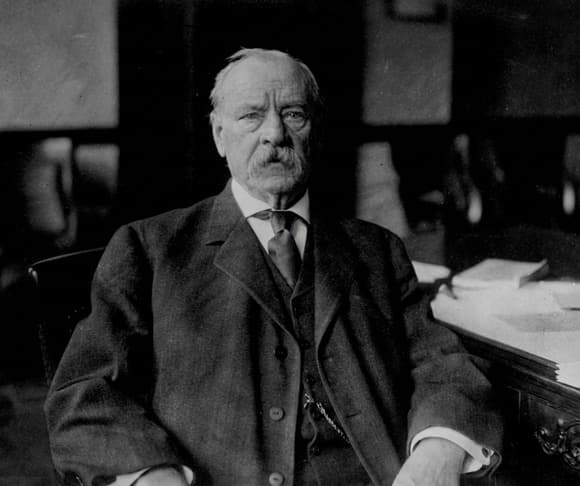
During the Civil War, Cleveland was able to avoid military service by paying $300 for a substitute to take his place. While that may seem shocking now, it was not uncommon at that time. He was the first Democrat after the war to be elected president and the only person to get a second four-year term that wasn’t immediately after the first (1885-1889 and 1893-1897). Cleveland won his presidency with support from the Democrats and reform Republicans, who were referred to as “Mugwumps.”
In 1886, Cleveland married his ward, Frances Folsom. Her father had been Cleveland’s law partner until he died. At the age of 21, Frances became the youngest first lady. Their wedding was the first and only held at the White House.
During the first term of his presidency, Cleveland presided over the dedication of the Statue of Liberty. He became known as the “guardian president” because of his frequent use of the veto power. Cleveland hated subsidies and believed that hardship built character, so he vetoed and barred anything resembling special favors.
In all, he used his veto power 584 times, which was more than double the number by all previous presidents. Franklin D. Roosevelt is the only president with more vetoes than Cleveland, but then he was elected to four terms.
Cleveland also dipped his political hands into the railroads, angering a lot of people when he ordered an investigation of western lands held by government grant. He used his powers to force the railroads to return 81,000,000 acres. Then he signed the Interstate Commerce Act which was the first law that attempted to apply federal regulation of the railroads. In Chicago, railroad strikers violated an injunction and the president sent in federal troops to enforce the order. “If it takes the entire army and navy of the United States to deliver a post card in Chicago,” he said, “that card will be delivered.”
Cleveland directed Congress to reduce high protective tariffs in December 1887. His staff was not too happy with the move and warned that he had just given the Republicans an advantage for the 1888 campaign. “What is the use of being elected or re-elected unless you stand for something?” he retorted, and then lost his party’s nomination for re-election.
In 1893, he ran again and was elected. In March 1897, Cleveland finished his final presidential term, but still remained active in politics.
An interesting fact: On display at the Mutter Museum in Philadelphia is Cleveland’s “secret tumor,” an epithelioma that was removed from the roof of his mouth.
Try a quiz based on this article
How was Grover Cleveland able to avoid military service during the Civil War?
Show the answer
He paid someone to take his place.
What was an alternative term for reform Republicans in the late 1800s?
Show the answer
Mugwump.
Cleveland’s marriage to Frances Folsom was the only president’s wedding ever to be held at the White House.
Show the answer
True.
Cleveland was nicknamed the “guardian president” due to his frequent use of:
Show the answer
Veto power.
Grover was the first to serve terms that were not consecutive.
Show the answer
First option.
Cleveland used his presidential power to demand 81 million acres of land back from:
Show the answer
The railroad.
Which of the following laws was signed by Cleveland?
Show the answer
Interstate Commerce Act.
How many terms did Cleveland serve?
Show the answer
Two.
In December 1887, Cleveland directed Congress to reduce high protective tariffs.
Show the answer
True.
What “part” of Cleveland is on display at the Mutter Museum in Philadelphia?
Show the answer
An epithelioma.