
US President Donald Trump kicked off his trip to Ireland on Sept. 12 with a comment that sparked intense reactions on the Emerald Isle and throughout the United Kingdom. During a meeting with Irish Prime Minister Micheál Martin in Dublin, Trump said the unification of the Republic of Ireland with Northern Ireland “may as well happen now.”
“I don’t want to cause any problems but I’d love to see it unified. I think it would be a fantastic thing,” President Trump said, adding: “The UK will have something to say about it, obviously.” The UK would have quite a lot to say about it, in fact, as would the Republic of Ireland and other interested factions.
A Unified Ireland and the Ever-Changing UK
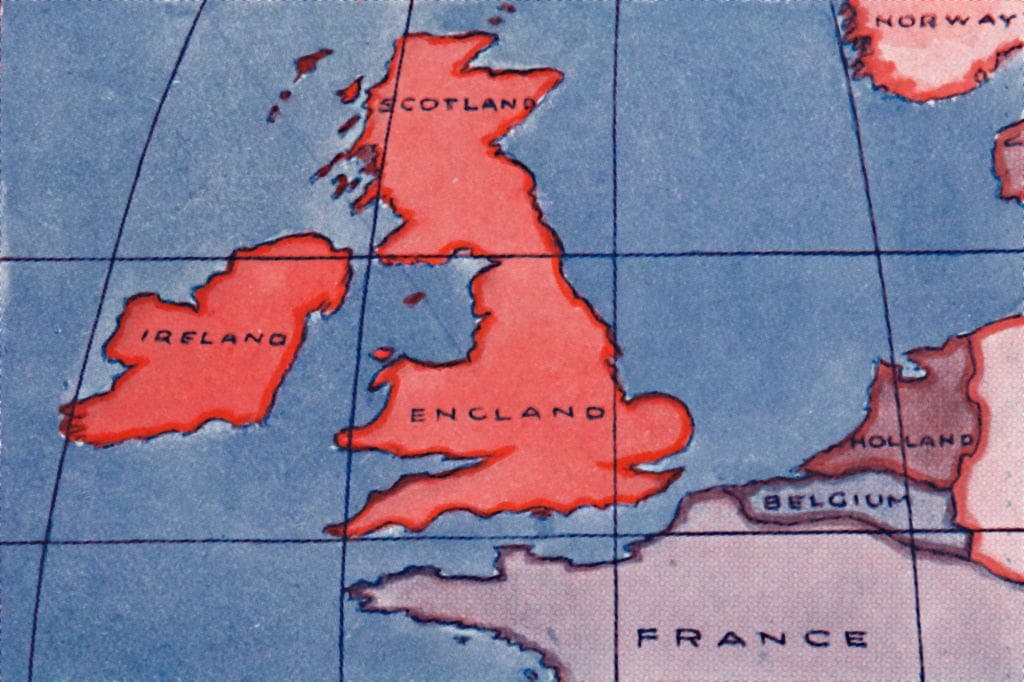
Let’s begin with a bit of geography. The United Kingdom is less a country in the sense the United States is and more a union of smaller countries. Today, it covers the main island known as Great Britain, which includes England, Scotland, and Wales. Additionally, several smaller islands and territories are part of the UK. Ireland is its own island, but six northeastern counties belong to the UK as Northern Ireland, while the remaining 26 counties make up the independent Republic of Ireland.
The geography may make it seem sensible for the two to unify. But it isn’t that simple. Centuries of war and bloodshed, along with political and religious differences, separate the two more than any geographical feature ever could.
We’ll start with England – the core of the kingdom. After Rome withdrew from the region in the fifth century, what later became England ended up split into seven kingdoms – Northumbria, Mercia, East Anglia, Essex, Kent, Sussex, and Wessex. This was called the Anglo-Saxon Heptarchy. But in AD 927, Æthelstan, king of Wessex, conquered the others, and the unified Kingdom of England was born.
Ireland also was divided into various smaller warring kingdoms for centuries. In 1169, Diarmait mac Murchada, the deposed king of Leinster, asked England’s King Henry II for help regaining his throne. Henry’s son, John, was later declared “Lord of Ireland,” and for hundreds of years to come, the English began to take control of various parts of the island. Henry VIII was declared King of Ireland and began the Tudor conquest that his daughter, Queen Elizabeth I, finished in the early 1600s.
In 1707, England and Scotland dissolved their separate parliaments and merged into one single kingdom, called the United Kingdom of Great Britain, which covered the entirety of the main island (England had annexed Wales in the 1500s). In 1801, though, the Kingdom of Ireland was formally abolished, and a new Acts of Union was passed, creating the United Kingdom of Great Britain and Ireland.
The Great Divide
But the term “united” did not necessarily mean friendly. Recall that Ireland was wrapped into the United Kingdom, which one might call the English Empire, by force. And the Irish frequently fought this English control. When England officially rejected Catholicism and banned it outright, that only made matters worse, as much of Ireland was devoutly Catholic.
It took England centuries to conquer Ireland, but even then, the fighting didn’t stop. After more than a century as a forced part of the UK, Ireland sought freedom again. From 1919 to 1921, the Irish Republican Army fought the British in the Irish War of Independence. This was the breaking point. In 1920, the Government of Ireland Act was passed, splitting the island. Then the Anglo-Irish Treaty was signed in 1921; in 1922, the Irish Free State was established and eventually renamed the Republic of Ireland. This separation, of course, resulted in another restructuring: the United Kingdom of Great Britain and Northern Ireland.
Still, there was no peace. From the late 1960s until 1998, Northern Ireland suffered a brutal conflict called The Troubles. On one side were the Republican nationalists. They were mostly Catholic and wanted a unified, independent Ireland. On the other side were the mostly Protestant Unionist loyalists, who wanted to stay British. The peace that finally came out of the Good Friday Agreement of 1998 wasn’t because one side beat the other; it was because both sides couldn’t stand any more death. More than 3,600 people were killed during The Troubles in bombings, street battles, and assassinations before both sides finally laid down their weapons.
What a Merger Requires
For Ireland to reunify, one of two things would have to happen: Either the independent nation would have to give up the freedom it fought centuries for and rejoin the UK, or the smaller portion would have to leave the UK and join the Republic. The mechanism for the second option is built into the treaty. A majority of voters in Northern Ireland would first have to vote to leave the UK, then a majority of voters in the Republic of Ireland would have to vote to accept them.
And neither currently has a majority that wants that. To make matters more complicated, a large faction in Scotland has been trying to leave the kingdom for a long time as well. Northern Ireland has a legal way to leave; Scotland does not. And they have tried, multiple times. In 2014, Scotland held an official independence referendum. The Unionists won, but only 55%-45%. Then, when the UK left the European Union in the 2016 Brexit, Scottish nationalists once again tried to break free, arguing that they were dragged out of the EU against their will.
But Section 30 of the UK’s devolution laws state that constitutional matters of the union can be decided only by the central UK Parliament at Westminster. The British prime minister and UK Parliament must grant a temporary transfer of power for such a referendum to be legal – and they have repeatedly refused to do so. So if Northern Ireland did break free, it would likely ignite a political storm in the UK as Scotland tries once again to break free as well. Essentially, it would break the United Kingdom.
So you see, the history of Ireland and the UK and the division of the Emerald Isle are a lot more complex than just lines on a map. They’re separated by centuries of bloodshed, religious differences, and a tangled bureaucracy that stretches from the obvious issue of the UK’s name to more complicated economic and political realities. Unifying Ireland may sound like a good idea, but it’s almost certainly not going to happen. It’s also somewhat a touchy subject in Ireland and the UK, and now you know why.
4 Questions
The story, in brief
What did Donald Trump say about unifying Ireland in Dublin?
During a meeting with Irish Prime Minister Micheál Martin in Dublin on Sept. 12, Donald Trump said the unification of the Republic of Ireland with Northern Ireland may as well happen now. He said he would love to see Ireland unified and called it a fantastic thing, while also noting that the UK would have something to say about it.
Why are Northern Ireland and the Republic of Ireland still separate?
Northern Ireland and the Republic of Ireland are separated by centuries of war, political conflict, and religious division. Ireland was brought into the United Kingdom by force, and later the Irish War of Independence, the 1920 Government of Ireland Act, and the 1921 Anglo-Irish Treaty led to the island being split.
How could Northern Ireland legally join the Republic of Ireland?
For Northern Ireland to leave the UK and join the Republic of Ireland, a majority of voters in Northern Ireland would first have to vote to leave the UK. Then a majority of voters in the Republic of Ireland would have to vote to accept them, and neither currently has a majority that wants that.
What could happen in the UK if Northern Ireland left the union?
If Northern Ireland broke free from the UK, it would likely trigger a political storm because Scotland has also long tried to leave the kingdom. The change could intensify Scottish independence efforts and, as described, would essentially break the United Kingdom.