
★ In this story 02
After their sweeping success in the midterms, Democrats may now have an opportunity to finally end a longtime party nemesis: the Electoral College. As Liberty Nation News reported last week, with the latest batch of blue state trifectas, Democratic lawmakers could enact an interstate compact that would ensure the national popular vote determines who becomes president.
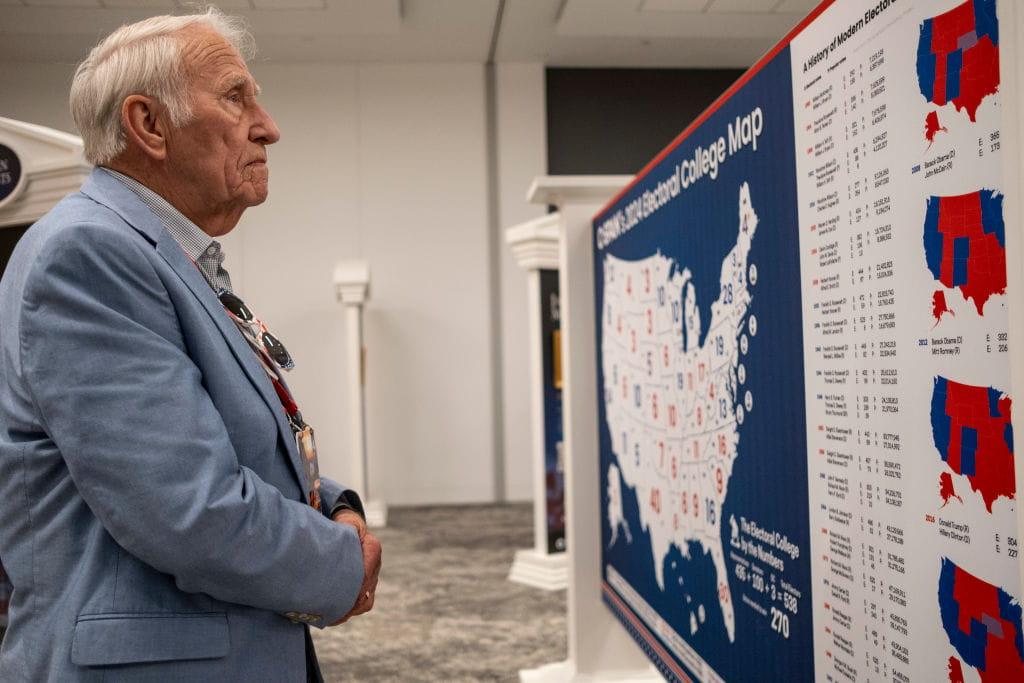
Here’s a quick recap of how the National Interstate Popular Vote Compact works: States that want to join – or leave – can do so by passing legislation declaring so. Once enough states sign on to bring 270 Electoral College votes, the minimum required to win the presidency, the compact goes into effect. Every state in the compact, once it’s live, will back whichever presidential candidate wins the national popular vote, regardless of who wins the statewide popular vote.
There are currently 222 electoral votes in the compact. Democrats won trifectas in five new states that aren’t currently members. If Pennsylvania, Michigan, and any two of the other three pass laws to join, the compact goes live.
But the Constitution clearly lays out how presidents are elected. So is this plan even legal? To quote former President Bill Clinton: “It depends on what the meaning of the word ‘is’ is.” It seems so many things in politics do.
Electoral College vs Popular Vote
To really understand the issue behind this fight, one must comprehend how and why the US electoral system works. This may come as a shock to some, but the United States is not a democracy; it’s a constitutional republic. But that doesn’t mean there aren’t elements of democracy involved. The representatives in the US House, for example, have always been “chosen every second Year by the People of the several States,” as Article I, Section 2 of the Constitution states.
Today, the popular vote also determines who represents each state in the US Senate – but that was not always the case. According to the Founding Fathers’ initial design, the legislators in each state – who were, themselves, selected by popular vote in their districts – voted on the two senators sent to Washington. And this is how it was done until the Seventeenth Amendment in 1913.
As for the presidential election, each state picks a set of electors to vote for the president. This didn’t always happen by statewide popular vote, as other methods have, at times, been used. But by the end of the 1800s, all states had adopted legislation to select electors through a statewide popular vote.
So when you go to the polls on Election Day and vote for president, that’s what you’re voting for: which set of electors get to cast the state’s electoral votes.
The reason behind all of this is that the United States was never supposed to be a powerful, central government that passed thousands upon thousands of federal laws and regulations and meddled in the daily lives of the people. It was, rather, a governing body to represent the separate and sovereign states on the world stage, both in diplomacy and defense, and to mediate disputes between them. Even now, we don’t have a single election – we have individual elections in the 50 states and DC on the same day.
Writing Off the Republic
The Founders established a nation to protect the several states, and the Electoral College was just one of the safeguards they created to protect the Republic. But at least since the 2000 election, when Republican George W. Bush won the presidency despite losing the popular vote by just over half a percent, Democrats have been at war with that system.
How can they change the way presidents are elected, though? Well, under this compact, the states still select a slate of electors to hold the presidential election. That’s all the Constitution requires in Article II, Section 1:
“Each State shall appoint, in such Manner as the Legislature thereof may direct, a Number of Electors, equal to the whole number of Senators and Representatives to which the State may be entitled in the Congress: but no Senator or Representative, or Person holding an Office of Trust or Profit under the United States, shall be appointed an Elector.”
Note the bit that says “in such Manner as the Legislature thereof may direct.” That explicitly allows individual states to pass laws directing the electors to follow the result of the national popular vote. It’s legal for each state, independently, but does that give the compact any teeth?
Proponents say it does: According to the interstate compact itself, any state that joins must make good on the promise, no matter who wins the national popular vote, and if any state wants out, it has to pass a law more than six months before the end of the president’s term. Any withdrawal after that point wouldn’t take effect until the next president and vice president are qualified to serve. And this is where the old Clinton expression comes into play. Both those in support and in opposition to the compact cite Article I, Section 10. It reads, in part:
“No State shall, without the Consent of Congress, lay any Duty of Tonnage, keep Troops, or Ships of War in time of Peace, enter into any Agreement or Compact with another State, or with a foreign Power, or engage in War, unless actually invaded, or in such imminent Danger as will not admit of delay.”
Those who oppose the compact point to the clear wording in “without the Consent of Congress,” with no mitigating language to allow any exception aside from the “imminent Danger” or actual invasion mentioned at the end of the paragraph regarding engaging in war. Those who support it, though, say that Supreme Court precedent in past cases suggest that requirement applies only if the interstate compact in question usurps power rightfully belonging to the federal government.
Of course, the wording of the Constitution doesn’t require that qualification – but, then again, even if federal courts did rule against the validity of the compact itself, the member states would still have their laws obligating their electors to the winner of the national popular vote. At best, such a ruling would likely only prevent the enforcement of the compact should any member state try to pass a law backing out of it past the six-month blackout period.
Either way, should the compact ever go into effect, lawsuits would almost certainly be filed by Republicans and nonmember states challenging it. And should any state try to back out of or refuse to honor the compact, Democrats will have lawsuits of their own to file. As so often is the case, it will fall to the Supreme Court to determine just what the meaning of the word “is” is.
4 Questions
The story, in brief
What is the National Interstate Popular Vote Compact?
The compact is an agreement among states to award their electoral votes to the candidate who wins the national popular vote. It takes effect only when member states together reach 270 electoral votes, the number needed to win the presidency. States can join or leave by passing legislation.
How close is the Electoral College compact to taking effect?
The compact currently includes 222 electoral votes. Democrats won trifectas in five new states that are not currently members. If Pennsylvania, Michigan, and any two of the other three states pass laws to join, the compact would go live.
Why do supporters say the Electoral College compact is legal?
Supporters point to Article II, Section 1 of the Constitution, which says each state shall appoint electors in such manner as the legislature directs. They argue that language lets a state require its electors to follow the national popular vote. They also cite Supreme Court precedent suggesting congressional consent is needed only when a compact usurps federal power.
What happens if the Electoral College compact takes effect?
If the compact goes into effect, member states would back the presidential candidate who wins the national popular vote, even if that candidate loses in a particular member state. Lawsuits would almost certainly follow from Republicans and nonmember states, and Democrats could sue if a member state tried to withdraw or refused to honor the compact. The Supreme Court would likely have to decide the disputes.