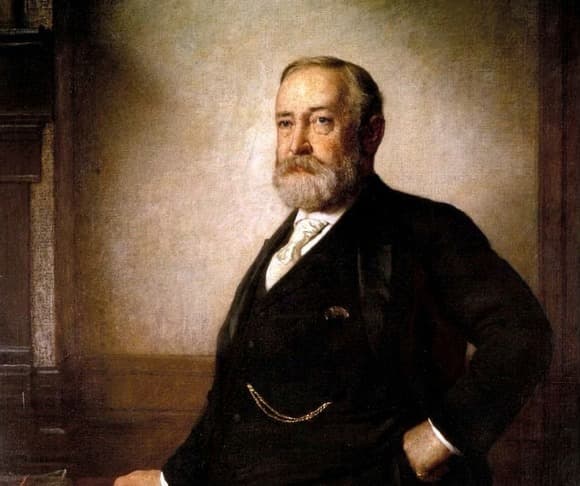

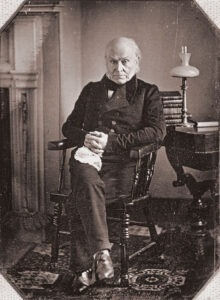
John Quincy Adams (1767–1848) was the sixth president of the United States. He was born on July 11, 1767, in Quincy, Massachusetts – which was called Braintree at the time, not to be confused with the modern small town of Braintree.
John was introduced to politics at a young age. When he was ten, his father John Adams took him on a diplomatic mission to France. He studied at European universities and was fluent in seven languages. In 1785, he entered Harvard College, graduating two years later. He then studied law and was admitted to the bar in 1790. He practiced his trade in Boston.

In 1794, President George Washington appointed John as a U.S. minister to the Netherlands. When John Adams was elected president in 1796, he appointed his son, John Quincy Adams, as minister to Prussia (Germany). When his father lost the presidency to Thomas Jefferson in 1800, young John returned and reopened his practice in Boston. In 1802, he was elected to Massachusetts State Senate, and the following year the U.S. Senate.
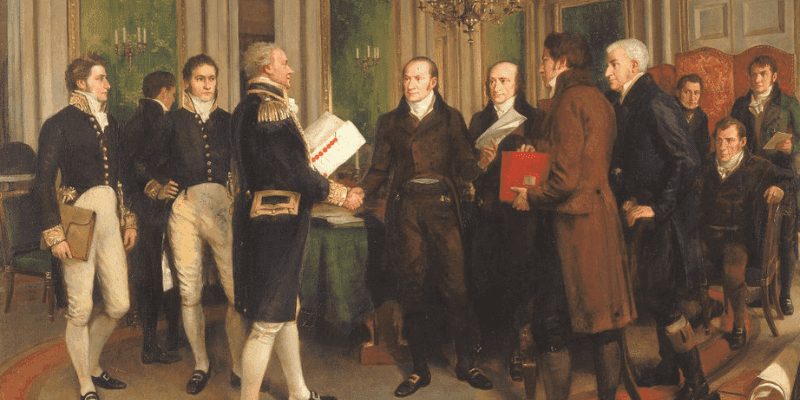
Although John was a Federalist, he began to sour on party politics and even voted against his party on several issues, including Jefferson’s Embargo Act of 1807. Disgusted with the political scene, he returned to Harvard where he had been made a professor. But not for long. The next year, President James Madison appointed John as ambassador to the Russian court of Czar Alexander I. War broke out between the United States and Britain, and, in 1814, John went to Belgium and negotiated the Treaty of Ghent, which ended the War of 1812.
President James Monroe named John his secretary of state in 1817. During that appointment, he helped negotiate the joint occupation of Oregon with England, and to obtain Florida from Spain.
It was time for John to seek his chance at the presidency, and in 1824 he entered a five-way race for the coveted office. Opposing John Quincy Adams were Secretary of War John C. Calhoun, Secretary of the Treasury William H. Crawford, Speaker of the House Henry Clay, and General Andrew Jackson. For the first time, however, no candidate received a majority of electoral votes, so the House of Representatives made the decision.
Although John Quincy Adams ran for a second presidential term, he became only the second president to fail to win; the first had been his father in 1800. He returned home and then in 1830 won an election to the House of Representatives, where he served for the rest of his life. After suffering two strokes, John passed away at the age of 80 on February 23, 1848.
Try a quiz based on this article
John Quincy Adams was born on July 11, 1767, in Quincy, MA, which at that time was called:
Show the answer
Braintree.
John Quincy Adams was the 8th president of the United States.
Show the answer
False.
John Quincy Adams attended Harvard University and was:
Show the answer
Fluent in seven languages.
In 1794, George Washington appointed John as a US minister to:
Show the answer
The Netherlands.
When his father, John Adams, was elected president, John Quincy Adams was appointed minister to Prussia.
Show the answer
True.
John Quincy Adams was elected to serve on the Massachusetts State Senate in:
Show the answer
1802.
Though he grew tired of politics, John was asked to travel to Belgium and negotiate the Treaty of Ghent that ended the:
Show the answer
War of 1812.
In 1824, John Quincy Adams decided to run for president. For the first time, none of the five candidates received a majority of electoral votes, which left the House to decide who won.
Show the answer
True.
In 1830, John won an election to:
Show the answer
The House of Representatives.
John Quincy Adams died on Feb. 23, 1848, after suffering from:
Show the answer
Two strokes.