

★ In this story 03
The moon has long been a source of wonder for people around the world. More than 400 years ago, an Italian scientist named Galileo Galilei used a telescope — that he built himself — to take a closer look at our celestial neighbor. He was not the first scientist to observe the moon, but he was the first to document and publish what he saw — including that the moon had mountains and valleys, much like Earth.
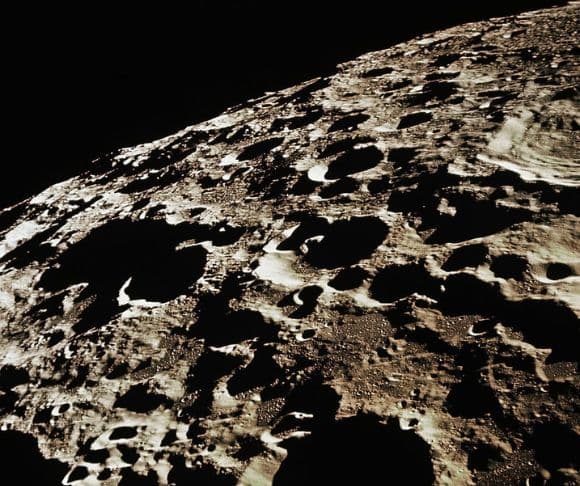
Now, hundreds of years after Galileo first recorded the moon’s rugged landscape, National Aeronautics and Space Administration (NASA) scientist Robert Wagner has made a remarkable observation of his own: a “once-in-a-century” crater on the moon’s surface.
A New Moon Crater
Wagner works with a NASA spacecraft called the Lunar Reconnaissance Orbiter (LRO), which takes detailed pictures of the moon. While checking a large map made from those images, he spotted an unusual bright spot surrounded by a dark ring.
“I just stopped, dropped everything, and started looking into what that spot was,” Wagner said. The scientist began comparing pictures of the moon and quickly realized he had stumbled upon something amazing: the largest newly formed crater ever discovered in the entire solar system.
Located on the moon’s eastern edge, the crater was formed in Spring 2024 after a comet or asteroid about as big as a three-to-six-story building slammed into the moon. NASA explained, “The crash left a crater, 728 feet wide, that spans the length of two football fields. And at 141 feet deep, the crater could fit three vertically stacked yellow school buses.” Scientists say a celestial event like this is incredibly rare and may happen only once in a hundred years or more.
Authorities named the crater McGetchin in honor of Tom McGetchin, a scientist who studied the moon during the Apollo missions and helped us better understand how craters form when objects crash into the moon’s surface.
More Moon Crashes
This isn’t the first time a new crater has been discovered on the moon. The LRO has been taking pictures of the moon for more than 17 years, documenting the topography, temperature, surface composition, and other data points of our closest neighbor in space.
Thanks to the LRO, NASA scientists have found at least 1,000 new craters on the moon and spotted about 100,000 other changes to its surface. Many of these changes happened when space objects crashed into the moon or when pieces of rock and dust were thrown across the surface after an impact.
Why This Matters
In a report published in Science Advances, Wagner and other scientists explained that the moon “serves as an exceptional natural witness plate for contemporary inner Solar System impact processes, preserving the signatures of ongoing modification in the absence of atmosphere, liquid water, and active large-scale tectonics.”
That’s a fancy way of saying that the moon is a great place for scientists to study what happens when objects in space strike a large celestial body, because, without weather, water, or shifting tectonic plates, evidence of crashes stick around for a very long time.
4 Questions
The story, in brief
Who identified the new crater on the moon?
NASA scientist Robert Wagner identified the new crater while working with the Lunar Reconnaissance Orbiter, or LRO. He noticed an unusual bright spot surrounded by a dark ring while checking a large map made from LRO images. After comparing pictures of the moon, he realized it was a newly formed crater.
What is the McGetchin crater on the moon?
The McGetchin crater is a newly formed lunar crater on the moon's eastern edge. It was created in spring 2024 when a comet or asteroid about as big as a three-to-six-story building struck the moon. NASA said the crater is 728 feet wide and 141 feet deep.
Why do scientists say the new moon crater is so important?
Scientists say the crater is important because the moon preserves evidence of impacts for a very long time. Unlike Earth, it does not have weather, liquid water, or active large-scale tectonics that would erase those signs. That makes the moon a valuable place to study how objects in space strike large celestial bodies.
How often do impacts like the McGetchin crater happen on the moon?
Scientists say a celestial event like the one that formed McGetchin is incredibly rare. They estimate it may happen only once in a hundred years or more. Wagner described it as a once-in-a-century crater.