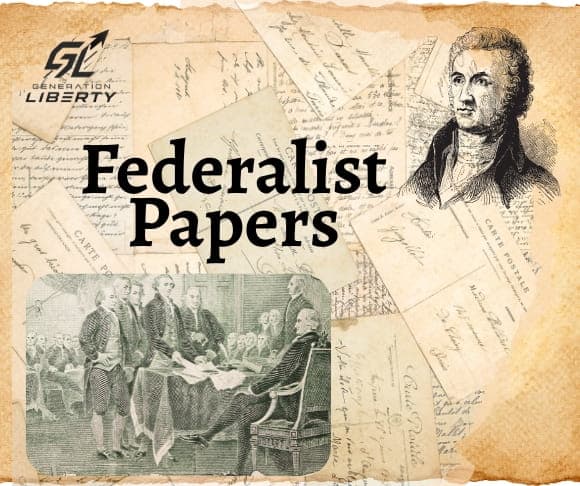

The Federalist Papers are a collection of 85 essays written after the Constitutional Convention in 1787. The plan was to publish a series of essays to convince New York delegates to ratify the newly drafted Constitution and to gain the public’s support. Alexander Hamilton, James Madison, and John Jay wrote the essays under the pseudonym Publius; they were distributed in New York newspapers. At the time, however, most readers didn't know who was producing the published material.
The Framers had to get the Constitution ratified by at least nine of the 13 states for it to take effect. Many people were skeptical about a new government replacing the Articles of Confederation and worried that it would grow too powerful and trample on individual rights. After fighting to gain independence from Britain, the last thing many Americans wanted was another government with too much power.
Each essay tackles a different subject and explains various parts of the Constitution and what they should or shouldn’t do when making the document the law of the land. For instance, James Madison argued in Federalist No. 10 that a large republic would defend against the dangers of “faction”: a group of citizens who unite by a shared passion or interest and go against the rights of others or the good of the community. “Liberty is to faction what air is to fire,” wrote Madison, “an aliment without which it instantly expires.”
In Federalist No. 70, Alexander Hamilton argues for a strong unified executive. “Energy in the Executive is a leading character in the definition of good government,” he wrote. Critics worried that a single powerful executive would turn into a king. Hamilton argued that a single executive could be more accountable and quicker to act; he feared a plurality would bring “the danger of difference of opinion,” leading to “personal emulation and even animosity.” If such sentiments surfaced in a plurality, Hamilton worried “they might impede or frustrate the most important measures of the government.”
The Federalist Papers are now considered one of the best sources for understanding what the Framers were trying to accomplish with the Constitution, how they wanted it to work, and the potential dangers they were concerned about. Judges, lawyers, and Supreme Court justices still reference these essays today when trying to untangle various parts of the Constitution to understand how it was originally supposed to work.