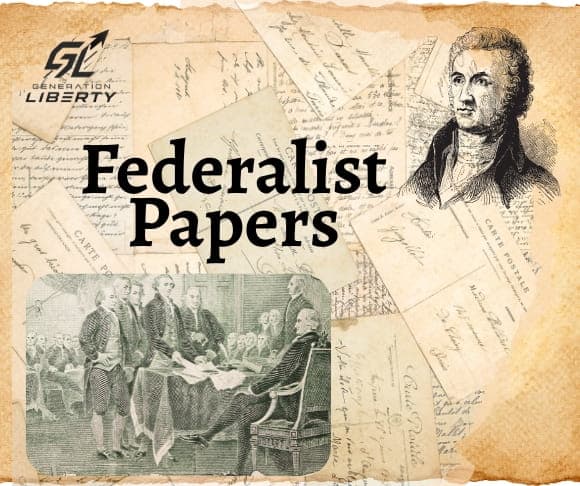

Alexander Hamilton, James Madison, and John Jay wrote The Federalist Papers and published them under the shared pseudonym “Publius.” Hamilton wrote 51; Madison penned 29, and John Jay fell ill after writing five. Hamilton came up with the idea for the essays and recruited Jay and Madison. They wrote them to persuade New York’s delegates to ratify the Constitution and to gain public support.
After the Constitution was drafted in 1787, it had to be ratified by at least nine of the 13 states to take effect. Many people were skeptical about replacing the Articles of Confederation with a stronger federal government, so ratification was far from guaranteed. Anti-Federalists believed a powerful central government would threaten individual liberties and states’ rights, reproducing the tyranny they’d just fought against in the American Revolution.
Each essay, originally published in New York newspapers, made arguments for certain provisions, such as the need for a stronger Union, the structure of Congress, the executive, the judiciary, and safeguards against tyranny.
For instance, in Federalist No. 51, Madison explained the logic behind “checks and balances” and how separating the legislative powers could prevent one branch from becoming too strong and dominating the others. “Ambition must be made to counteract ambition,” wrote Madison.
In Federalist No. 78, Hamilton defended an independent judiciary and introduced the idea of “judicial review.” He also defined the courts as the “least dangerous to the political rights of the Constitution” because they have “no influence over either the sword or the purse.”
The essays remain widely read, explaining the Constitution’s intent and the political philosophy behind America’s government. The Federalist Papers are also frequently cited in Supreme Court cases, helping the justices better understand the Framers’ intentions.