


★ In this story 02
Our Founding Fathers knew when creating this nation, by the people and for the people, that safeguarding freedom should always be what drives government choices. As such, they built into the U.S. Constitution a rule that, every ten years, states should redraw their voting districts. This is meant to ensure that as the populace changes, everyone still has a voice in government.
Changing the voting districts is known as “redistricting,” and it involves redrawing state maps and dividing the territory into different areas. These areas, or districts, are important when it comes to voting for Congress, since each district gets to elect one member of the U.S. House of Representatives. Since the early 1900s, there have usually been a total of 435 congressional districts, each one representing about 700,000 Americans. There are also districts for state legislatures.
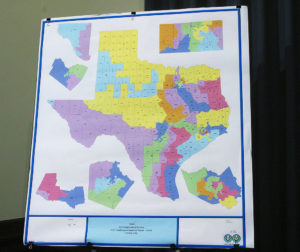
So, how are these districts decided? It is based on population. While the mandate for redistricting is in the Constitution, each state has the responsibility to get the job done and is allowed to do so on its own terms.
Traditional Principles
The location of the mapmaker can make the redrawing more complicated. The mapmakers have to follow the Constitution, but they have to follow state laws, too. Here are some principles common to most states:
- Compactness (people in the district must live as near each other as possible).
- Contiguity (all parts of the district must be connected).
- Following certain pre-existing map divisions (such as city and county lines).
- Preserving communities of interest (such as neighborhoods or regions where the residents have common political interests).
- Keeping the cores of existing districts (so the representation stays similar to before).
- Protecting the representatives already in Congress.
Here are a few less widely known facts. According to the National Conference of State Legislatures:
- Thirty-seven states require districts to be “compact” or fit a specified geometric size and shape.
- Eight states allow maps to be drawn to avoid pitting two legislators against each other.
- Nine states disallow drawing maps that give an advantage to a party or incumbent.
- All people in the United States must be equally represented, meaning legislators in the same body must represent roughly the same number of people.
What Is Gerrymandering?
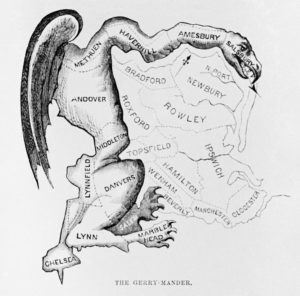
The term “Gerrymander” is used when legislative districts are redrawn to benefit one political party: Republican or Democratic. These are the two major political parties today, and they compete to win as many seats in Congress as possible. Both parties tend to fight over redrawn districts when they believe that the process is unfairly favoring one over the other. It’s a common fight that ends up being taken to court as often as new districts are drawn up – every ten years.
The word “Gerrymandering” is a mix of the word “Gerry” and “salamander.” It was named after former Massachusetts Governor Elbridge Gerry. He was in the Democratic-Republican Party during the early 1800s. Gerry signed a law that allowed the districts in his state to be redrawn for the state senate – but it’s said the map favored his political party. Newspapers at the time coined the negative phrase “gerrymander.” It seems he approved a district in 1812 that looked a lot like a salamander, and it caught the press’s attention. They reported that Gerry was manipulating the boundaries in favor of his cronies.
Both Democrats and Republicans accuse the other of gerrymandering – whether or not it is actually happening. In some cases, the act of gerrymandering has been all too real.
Still today, there are cases being brought to the courts as each party accuses the other of gerrymandering. But the facts remain: Drawing a snake, a salamander, a punctuation mark, George Washington, or any other shape on a map should only be done during redistricting to group residents without bias.
Try a quiz based on this article
To make sure U.S. voters are properly represented, states redraw their voting districts every ___ years.
Show the answer
10.
Each U.S. voting district gets a representative in the _____________.
Show the answer
U.S. House of Representatives.
What is the purpose of redistricting?
Show the answer
To ensure people are fairly represented in Congress, even when the population changes.
The federal government is in charge of redistricting in each state.
Show the answer
True.
The mapmaker must follow certain principles when redrawing the districts. Some locations are more difficult than others.
Show the answer
True.
Gerrymandering occurs when legislative districts are redrawn to benefit one ______.
Show the answer
Political party.
What are the two major political parties today?
Show the answer
Democrat and Republican.
Gerrymandering partially got its name from former Massachusetts Governor Elbridge Gerry.
Show the answer
True.
Often when districts are redrawn, the two parties (Republican and Democrat) accuse one another of gerrymandering.
Show the answer
True.
It was said that Governor Elbridge Gerry approved a district in 1812 that resembled which animal?
Show the answer
Salamander.