
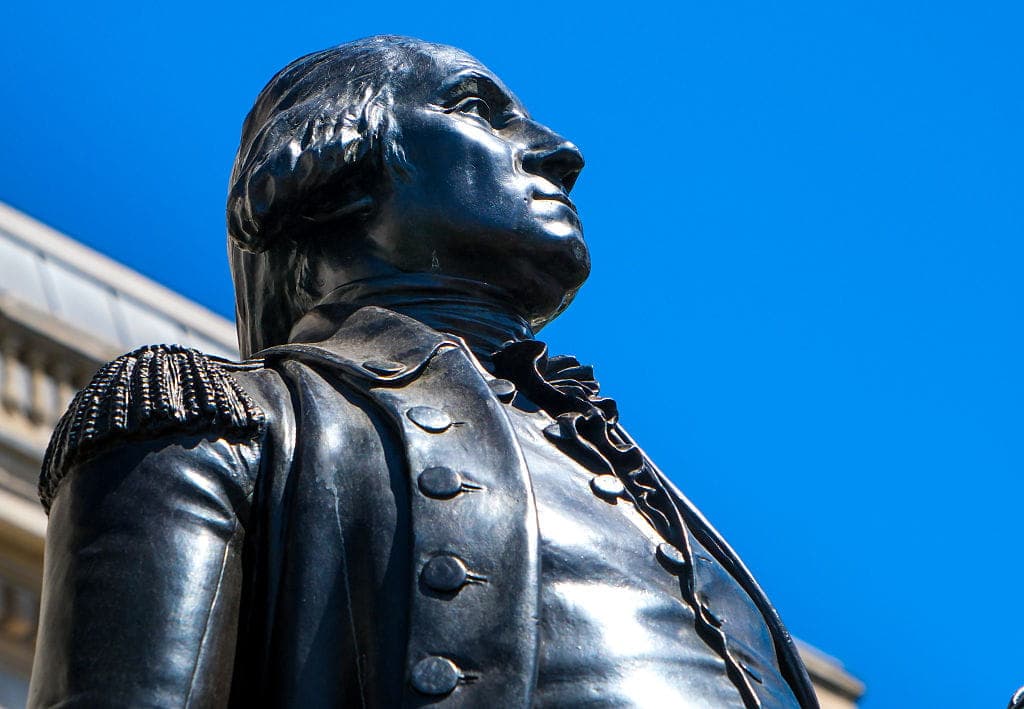
Imagine walking into the National Museum of American History and being welcomed by a statue as tall as a three-story building. That is the idea President Donald J. Trump proposed in a Truth Social post on September 11, when he asked the Smithsonian Institution to install a large statue of George Washington at its entrance.
George Washington, Larger Than Life
Trump is asking for a 30-foot statue of America’s first president and a special exhibit about his role in founding the United States. The display would stay up until February 22, 2032, the 300th anniversary of Washington’s birthday. But something that big takes time to create. So, the president proposed the 11-foot Washington statue featured at the Freedom 250 IndyCar race in August should serve as a stand-in for now.
In his post, Trump praised Washington in dramatic terms, writing that he was “easily America’s Greatest Hero” and claiming that the country’s liberties might not exist without him.
He also wants the recently removed Center for Restorative History to be replaced with a new Center for American Heroes. The idea would be to spotlight people who helped shape the country’s history, from leaders and inventors to athletes, artists, and others who made an impact.
Trump said the museum should tell the stories of Americans who faced major challenges, overcame them, built important things, defended the country, and helped the nation live up to its founding ideals. He also stated that the institution should focus less on what he called “ideological activism” and more on telling America’s story in a way that is fair, accurate, and easy to understand.
The Power of the President
Can Trump force the Smithsonian to do what he wants? That question isn’t easily answered. It isn’t run directly by the Executive Branch. Rather, it is overseen by a Board of Regents that includes Vice President JD Vance, Chief Justice John Roberts, lawmakers from both parties, and nine private citizens. Congress created the institution in 1846 with a clear mission to “increase and diffuse knowledge among men.”
This is not the first time Trump has pushed for changes at the Smithsonian. In March 2025, he signed an executive order targeting its funding programs, saying they promoted “divisive narratives” and “improper ideology.”
In July, Trump also directed his administration to place signs outside the National Museum of American History saying that some exhibits weren’t accurate. His pressure has added to a larger debate about who gets to decide how American history is displayed in tax-funded facilities.
Why Statues Matter
Trump has often expressed the need for monuments that celebrate American heroes. He placed a statue of Washington in the White House’s recently remodeled Rose Garden patio. He has also supported creating a “National Garden of American Heroes” as part of a proposed park along the Potomac River that would feature 250 statues of notable Americans. The list of people he wants honored includes Founding Fathers, military leaders, religious figures, civil rights advocates, athletes, artists, entertainers, and public figures such as Ronald Reagan and Jackie Robinson.
The debate over the proposed Washington statue is about more than one monument. It raises a bigger question: How should museums tell the story of America? Some people want them to focus on national pride and heroic figures. Others believe they should also highlight mistakes, conflicts, and people who were left out of older history lessons. For young visitors, the controversy shows that history is not just something from the past; it’s something people are still passionate about today.
4 Questions
The story, in brief
What did Donald Trump ask the Smithsonian to build for George Washington?
Donald Trump asked the Smithsonian Institution to install a 30-foot statue of George Washington at the entrance of the National Museum of American History. He also proposed a special exhibit about Washington's role in founding the United States, with the display remaining until February 22, 2032, the 300th anniversary of Washington's birth.
Why did Donald Trump propose an 11-foot George Washington statue first?
Trump said something as large as a 30-foot statue would take time to create. Because of that, he proposed using the 11-foot George Washington statue shown at the Freedom 250 IndyCar race in August as a temporary stand-in.
Can Donald Trump force the Smithsonian Institution to install the George Washington statue?
The answer is not simple, because the Smithsonian is not run directly by the Executive Branch. It is overseen by a Board of Regents that includes Vice President JD Vance, Chief Justice John Roberts, lawmakers from both parties, and nine private citizens.
What bigger debate does the proposed George Washington statue raise?
The proposal has added to a broader argument over who gets to decide how American history is presented in tax-funded institutions. It also raises the question of whether museums should emphasize national pride and heroic figures, or also give more attention to mistakes, conflicts, and people left out of older history lessons.

Kirsten Brooker
Culture Correspondent for Liberty Nation and Generation Liberty. Kirsten loves to write about culture from the point of view of an everyday American who lives deep in the heart of the Midwest. She is the mother of two adorable girls, likes classic rock, and humbly wears the crown of a former Homecoming Queen with grace and style.