
★ In this story 03
Generation Liberty is running a special edition on the 50th anniversary of President Richard Nixon’s visit to China. In Part Two, we take a look at Nixon’s reasons for the trip, and how it may have influenced the world we know today. You can read Part One here.
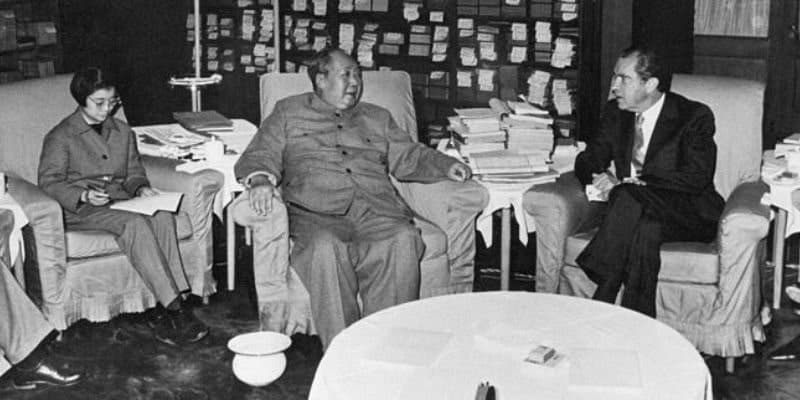
Over eight days, the U.S. president traveled to the cities of Beijing, Hangzhou, and Shanghai, as well as the Great Wall of China. He continued to have meetings with Zhou Enlai.
The media followed the president around, and much of the visit was staged for the public to see.
On the last day of the trip, the two countries issued a joint document – called the Shanghai Communiqué – about each nation’s foreign policy views. It also contained an agreement that both China and the U.S. wished to improve their relations.
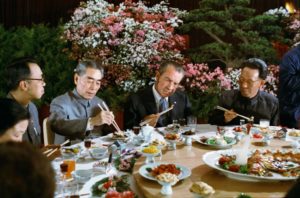
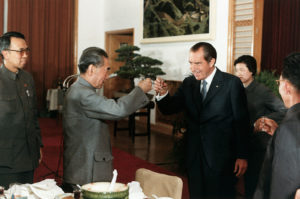
That night, Nixon gave a toast during a dinner. He said:
“This was the week that changed the world, as what we have said in that Communiqué is not nearly as important as what we will do in the years ahead to build a bridge across 16,000 miles and 22 years of hostilities which have divided us in the past. And what we have said today is that we shall build that bridge.”
Why Did Nixon Visit China?
The visit took place against the backdrop of the Cold War. The U.S. was fighting communism around the world; the Soviet Union was its main rival, but other countries were involved too. Communist China and the U.S. had fought on opposite sides of the Korean War in the 1950s. Nixon especially had a reputation for being anti-communist.
In the 1960s, two of the world’s biggest communist nations, China and the Soviet Union, began to have disputes, resulting in what is called the “Sino-Soviet split.”
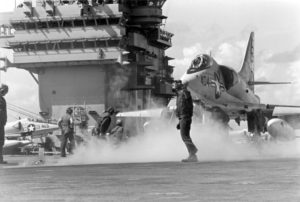
In 1970, the U.S. was embroiled in war in Vietnam, a neighbor of China. America fought alongside the South Vietnamese against the communist North Vietnamese. However, the Vietnam War was not going well, and Americans wanted a way out of the conflict.
While China and the Soviet Union were both considered enemies of America, Nixon thought it would be a good time to drive a wedge between them. The idea was to make friends with China, weakening the Soviet Union. This could force the Soviets to give in to U.S. wishes, such as getting North Vietnam to sign a peace treaty, or reducing nuclear weapons.
Nixon also said that he didn’t want China to become an enemy to America in the future – so by improving their relationship, he hoped to avoid a future war. Nixon wrote in 1967: “We simply cannot afford to leave China forever outside the family of nations, there to nurture its fantasies, cherish its hates, and threaten its neighbors. There is no place on this small planet for a billion of its potentially most able people to live in angry isolation.”
He said another time, “if we do not find a way to, despite our differences to have discussions, we are on a collision course years ahead.”
Criticisms of Nixon’s Approach
While many have lauded Nixon for opening diplomatic relations with China, he also has critics. Some accused him of turning his back on Taiwan, which is where many of the anti-communist Chinese ended up after the Revolution. America had sworn to support them, but getting friendly with the PRC was seen as a betrayal. Today, there is still tension between Taiwan and Mainland China.
Nixon said openly that he didn’t think his visit to China would make the two countries friends or even improve their relationship. He just hoped that it could reduce suspicion between them, and help the two countries understand each other better. Despite Nixon’s caution, some have suggested China took advantage of the help it got from the U.S. and other countries. In the 1960s and 70s, China was desperately poor and had suffered from famines. With the help of U.S. and global trade, it was able to grow into one of the world’s new superpowers. Now, China is a real challenger for power on the world stage. Some suggest Nixon may have given America more than it bargained for when he tried to bring China into the “family of nations.”
Shaping the World of Today
Nixon’s 1972 visit didn’t immediately open up China to the world – but it began a long process that continued over the decades. It helped shape the modern world that we know today, and in the president’s words, it was “the week that changed the world.”
Test your knowledge – try a quiz based on this article!
Try a quiz based on this article
How long was President Nixon's 1972 visit to China?
Show the answer
8 days.
The media was unaware that Nixon went to China.
Show the answer
False.
On the last night of Nixon's trip, the U.S. and China released what document outlining their views?
Show the answer
The Shanghai Communiqué.
What caused the “Sino-Soviet split”?
Show the answer
Disputes between China and the Soviet Union.
President Nixon used the split between China and the Soviet Union to weaken the Soviets.
Show the answer
True.
Nixon felt that by improving relations he could reduce the chances of going to war against China in the future.
Show the answer
True.
Before his visit to China, Nixon was known for being anti-communist.
Show the answer
True.
Where did many of the anti-communist Chinese go after the Revolution?
Show the answer
Taiwan.
Some feel that Nixon’s visit, though cautious, allowed China to take advantage of the U.S. and other countries.
Show the answer
True.
China was very poor in the 1960s and 70s, but is now one of the most _________countries in the world.
Show the answer
Powerful.