
★ In this story 02
The final penny was produced at the US Mint in Philadelphia on Wednesday, November 12, marking an end to over 230 years of American history.
“God bless America, and we’re going to save the taxpayers $56 million,” Treasurer Brandon Beach said moments before the last coin was struck. For many Americans, who viewed the penny as a lucky charm or childhood collectible, the moment struck a sentimental chord.
“It’s an emotional day,” said Clayton Crotty, a 15-year veteran of the mint. “But it’s not unexpected.”
Making Cents of History
Throughout history, the word “penny” referred to any coin or money. After the United States produced the “one-cent piece” – the modern penny’s official name – in 1793, Americans continued to refer to the coin as a “penny” out of habit, and the colloquial name stuck.
Some believe the first penny, made of copper and known as the “Fugio cent,” was designed by Benjamin Franklin, according to History.com. The coin featured a sun, sundial, and the words “Mind Your Business” on one side and a 13-link chain with the message “We Are One” on the other.
An apparent fan of the penny, Franklin reportedly coined the well-known phrase “a penny saved is a penny earned.” Legend has it leaving a penny on Franklin’s grave in Philadelphia is good luck.
In 1857, the penny’s size was reduced, and its composition was changed to 88% copper and 12% nickel. From 1857 to 1909, the penny went through several redesigns featuring a flying eagle, a wreath, and an “Indian Head.”
In 1909, the penny was redesigned once again, this time to honor President Abraham Lincoln’s 100th birthday. Lincoln was the first president to be featured on an American coin.
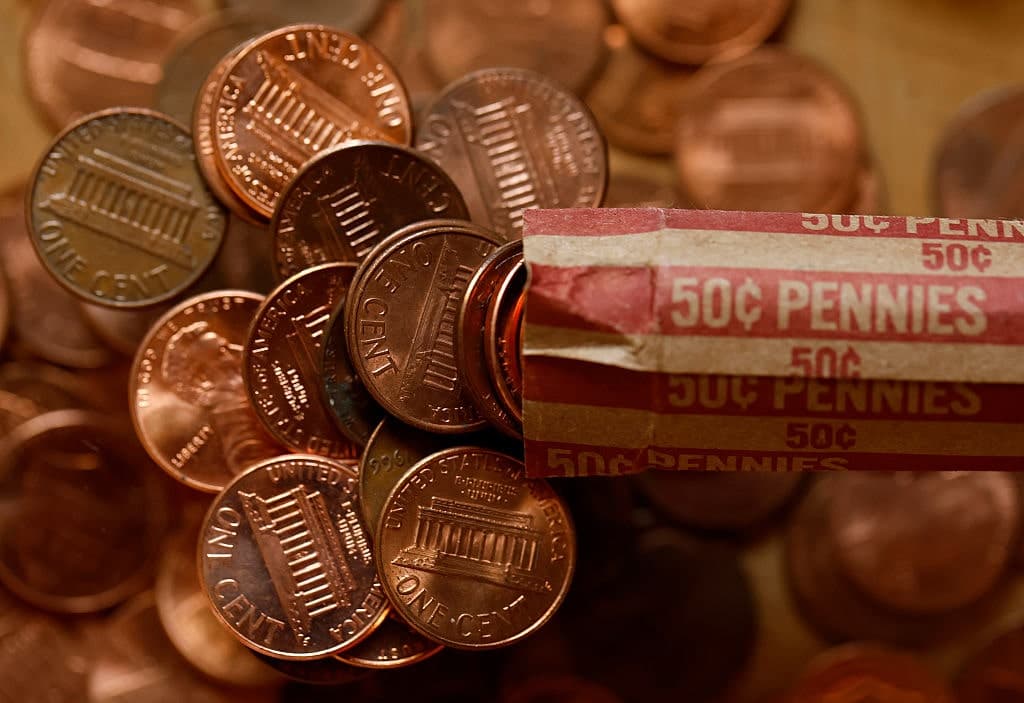
Until 1958, the Lincoln penny featured two sheaves of wheat on the reverse side of the coin. This design was then changed to a depiction of the Lincoln Memorial from 1959 to 2008.
In 2009, the Mint produced four different penny designs in recognition of Lincoln’s 200th birthday. In 2010, a “Union Shield” theme was added to the coin’s back. The shield represented “Lincoln’s preservation of the United States as a single country.”
The original Lincoln penny featured Victor David Brenner’s portrait of the assassinated president, a design that remained in use until 2025.
Unlike early pennies, modern pennies were made of copper and zinc – but during World War II, the one-cent pieces were made of steel due to copper shortages. The coins, referred to as “steelies,” quickly rusted and were often confused with dimes.
End of an Era
The penny’s historic end comes after President Donald Trump directed the US Treasury to halt production on the coin, calling it “wasteful.” Despite being worth one cent, each penny cost 3.69 cents to make.
“For far too long the United States has minted pennies which literally cost us more than 2 cents. This is so wasteful! I have instructed my Secretary of the US Treasury to stop producing new pennies. Let’s rip the waste out of our great nations budget, even if it’s a penny at a time,” Trump said earlier this year.
A lot has changed over the two-century life of the penny. In the late 19th century, supporters could donate a penny, known as “one-cent pledges,” to suffragettes campaigning for women’s right to vote. In the early 20th century, a copy of the New York Tribune cost just one penny.
What does the end of the penny mean for modern prices? One immediate change is that consumers may see fewer $19.99-style price tags. As the penny faces extinction, many businesses are already rounding up or down to the nearest nickel, or dime, or even dollar.
“Some businesses are asking cash-paying customers to voluntarily round up for donations to avoid needing pennies to make change and to stay compliant with state and local laws, while other places are rounding down for everyone (not just cash payers),” said Elon University Associate Professor of Economics Brandon Sheridan.
Businesses are already adjusting to the change, but with 250 billion pennies still in circulation, the coin won’t completely disappear from wallets and cash registers any time soon.