
★ In this story 02
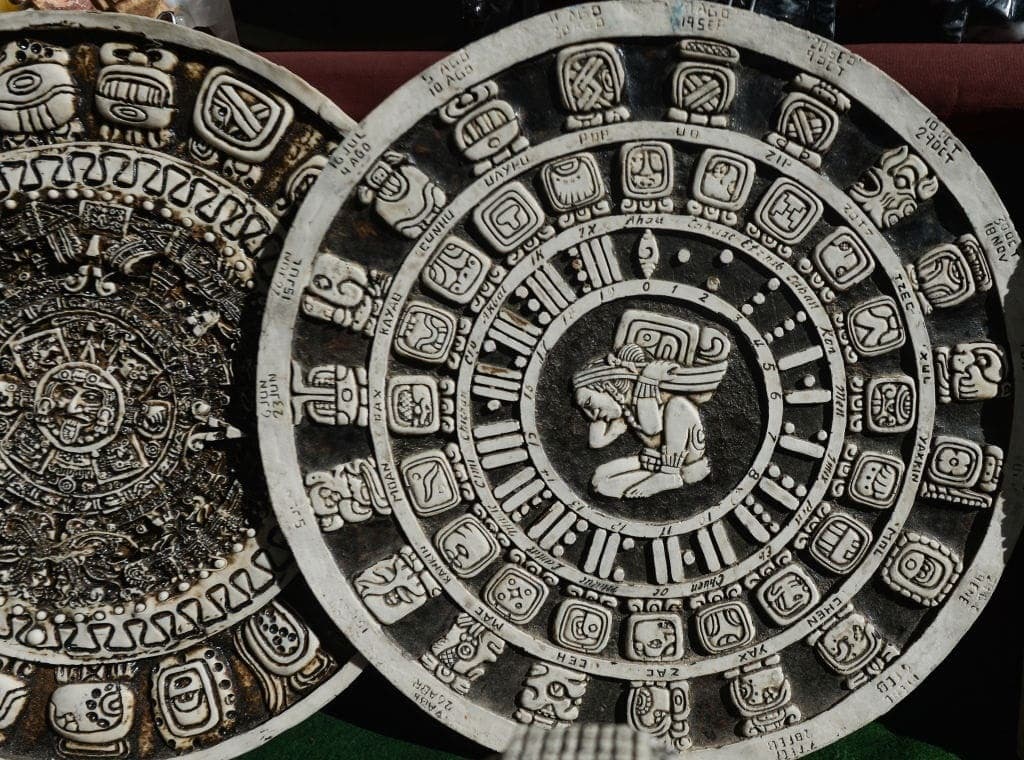
Wikipedia defines a calendar as “explicit schemes used for timekeeping.” Basically, a calendar is a series of days, weeks, and months that repeat themselves every 365 days, with a leap year every four years. But how long have people used them? The first recorded use of timekeeping dates back 11,000 years during the Bronze Age. Since then, several calendars have been identified, though they differ based on the period and location. Worldwide, the Gregorian Calendar is the most used today. It was implemented in 1582 and was based on the Julian calendar created by Julius Caesar.
An Ancient Tomb Reveals a Chinese Celestial Calendar
A 2,000-year-old tomb in the Wulong District of China revealed 23 wooden pieces etched with symbols related to an ancient Chinese astronomical calendar known as Tiangan Dizhi. This form of timekeeping originated during the Shang Dynasty, which ranged from 1600 BC to 1050 BC.
Each wooden piece measures about one inch wide and four inches in length. Experts are not completely clear about how each piece functioned, though the inscriptions signify a relation to the Tiangan Dizhi calendar, also known as “10 Heavenly Stems and 12 Earthly Branches.”
Though not involved in the study, Astronomer Ed Krupp commented: “The wooden slips with calendric notations are significant as the first and only known example of that kind of inscription on that kind of object.” Krupp does not believe that the wooden pieces are a part of the calendar but instead reference points for the 60-year-cycle timekeeper.
The scientists who reviewed the discovery feel that one of the pieces represents the year it was placed in the tomb, while the other 22 represent different, specific years. Each rectangular section contained small, circular punctures that researchers believe indicate that the segments were once connected, though it remains unclear why. Research will continue to learn more about the unique, well-preserved material.
Other Relics Found in the Tomb
The ancient burial contained far more than the wooden calendrical pieces. Up to 600 other valuables include bronze and copper pots, bowls, jars, plates, bamboo utensils, spears, cooking tripods, musical pipes, and wooden figurines. The quality of the relics and the quantity of items signify that the person buried was likely of high status.
The project leader, Huang Wei, feels that the tomb and its contents were part of China’s Western and Eastern Han dynasties called the “golden age,” between 206 BC and AD 200, when many of China’s traditions were established.
Test Your Knowledge – Take the Quiz
Try a quiz based on this article
Wikipedia defines calendar as “explicit schemes used for:”
Show the answer
Timekeeping.
A calendar is a series of days, weeks, and months that repeat themselves every ____ days.
Show the answer
365.
What takes place every four years that changes the layout of a traditional calendar?
Show the answer
Leap Year.
The first recorded use of a calendar dates back 11,000 years to the:
Show the answer
Bronze Age.
What calendar is the most commonly used worldwide?
Show the answer
Gregorian calendar.
A 2,000-year-old tomb was located in the Chinese _______ District.
Show the answer
Wulong.
The calendar found in the tomb comprises 23 _____ pieces etched with ancient Chinese symbols.
Show the answer
Wooden.
The Chinese astronomical calendar Tiangan Dizhi is also known as “10 Heavenly Stems and 12 Earthly Branches.”
Show the answer
True.
Aside from the calendar, the ancient tomb was empty.
Show the answer
False.
The details of the discovery lead researchers to believe that the person buried in the tomb was of:
Show the answer
High-status.

Kirsten Brooker
Culture Correspondent for Liberty Nation and Generation Liberty. Kirsten loves to write about culture from the point of view of an everyday American who lives deep in the heart of the Midwest. She is the mother of two adorable girls, likes classic rock, and humbly wears the crown of a former Homecoming Queen with grace and style.