
★ In this story 03
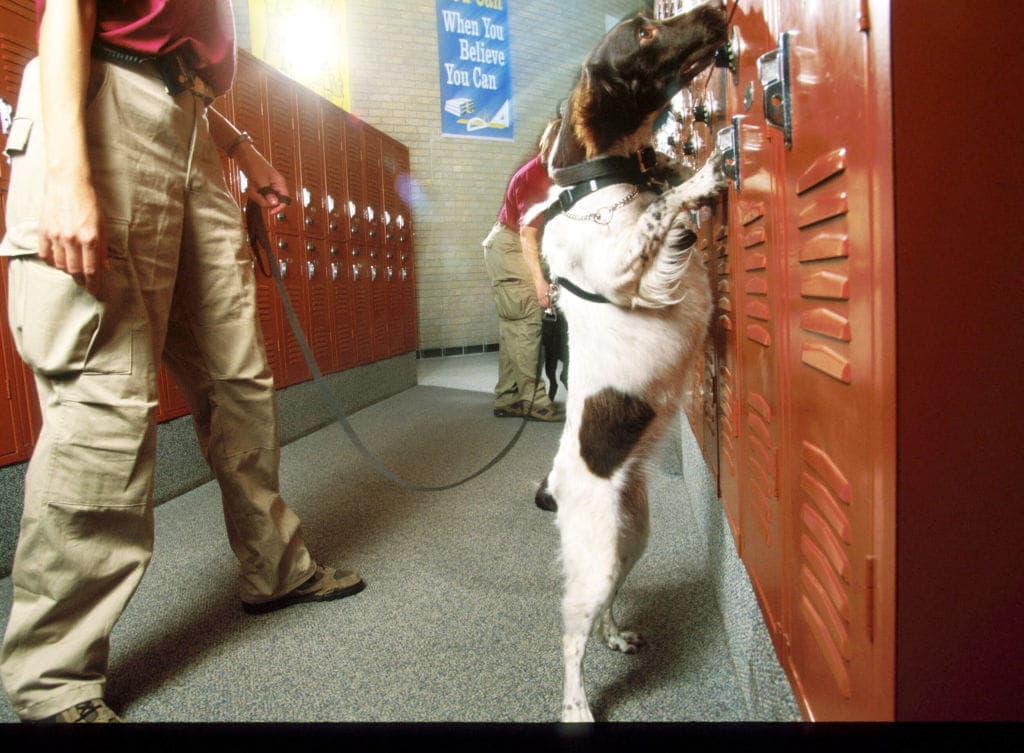
What are this curious dog and his handler doing on a school campus? If you guessed the canine is sniffing lockers, you’d be right. We don’t know what he’s looking for - presumably contraband such as drugs - but that brings up an interesting question: Does the Fourth Amendment protect students from a school locker search?
You might think public school lockers and personal effects are considered private. Indeed, the Fourth Amendment does protect public school students against unreasonable searches and seizures, but what are the rules?
In 1985, the US Supreme Court decided how a search could take place on school grounds. The Court held in New Jersey v. T.L.O. that school officials generally do not need a warrant or probable cause to search a student, although the search must be reasonable at its inception and in scope. This case concerned a student’s purse rather than her locker, and the same general framework can govern a locker search when the student has a reasonable expectation of privacy.
New Jersey v. T.L.O.
The US Supreme Court considered a case involving a 14-year-old student identified as T.L.O. and her companion, who were caught by a teacher smoking cigarettes in a girls’ restroom. Smoking in the restroom violated school rules, but T.L.O. denied that she had been smoking and claimed that she did not smoke at all.
An assistant vice principal searched T.L.O.’s purse and found a pack of cigarettes and evidence of illegal drug paraphernalia. School officials contacted the police, and T.L.O. later admitted that she had been selling illegal drugs at school. She sought to exclude the evidence in juvenile proceedings on the grounds that the search violated her Fourth Amendment rights.
The case moved through three levels of New Jersey courts before reaching the Supreme Court. The Court held that obtaining a warrant was not necessary to search T.L.O.’s bag because the search satisfied a reasonableness standard.
Under the Court’s two-pronged test of reasonable suspicion, a search must be justified at its inception and reasonably related in scope to the circumstances that prompted it. In practical terms, officials need reasonable grounds to suspect that a search will uncover evidence that a student violated the law or a school rule, and the measures used must not be excessively intrusive in light of the student’s age, sex, and the nature of the suspected wrongdoing.
When Are Searches Allowed?
Whether a school may conduct a school locker search depends on the student’s reasonable expectation of privacy, the school’s published policies, and applicable state law. A policy stating that lockers remain school property and may be inspected can reduce a student’s expectation of privacy.
Reasonable suspicion must rest on specific facts indicating that a search is likely to uncover evidence of a law or school-rule violation. Relevant facts may include abnormal behavior observed by a teacher or an administrator, blatant rule-breaking, information from credible sources, and a student’s record, among other factors. All are considered when deciding whether a search is permissible.
Scope is the second part of the reasonableness analysis. The items or areas searched must be reasonably related to the suspected violation and the object of the search. For example, if officials reasonably suspect Sally of possessing a prohibited item, that does not automatically justify searching her best friend Emily’s belongings. Officials would need separate grounds related to Emily.
Urgent safety concerns such as credible bomb or shooting threats may justify immediate and broader action because the danger can affect many students and leave little time for delay. Even in an emergency, the reasonableness of a search depends on the circumstances. Whatever the reason for a search, clear documentation and reporting are essential in case the matter is reviewed by a court.
State vs Federal Law on a Student School Locker Search
As with many situations, a school locker search is governed not only by constitutional standards but also by state law. Some states have statutes or regulations that specifically address searches on public school property, while others rely on the federal constitutional standards. Regardless of the applicable framework, school administrators, teachers, and other employees should understand the legalities and policies that govern searches in their state or district.
4 Questions
The story, in brief
What did the Supreme Court rule in New Jersey v. T.L.O.?
The Supreme Court ruled that school officials generally do not need a warrant or probable cause to search a student on school grounds. Instead, the search must meet a reasonableness standard, meaning it must be justified at its inception and reasonably related in scope to the circumstances that prompted it.
When can a public school search a student's locker?
A public school may search a student's locker when the search is reasonable under the circumstances. Whether that is allowed can depend on the student's reasonable expectation of privacy, the school's published policies, and applicable state law, along with specific facts suggesting the search will uncover evidence of a law or school-rule violation.
How do school locker policies affect student privacy rights?
A school policy stating that lockers remain school property and may be inspected can reduce a student's reasonable expectation of privacy. That matters because the general framework for locker searches can apply when a student has a reasonable expectation of privacy, along with the reasonableness rules described by the Supreme Court.
What factors make a school search reasonable in scope?
A school search is reasonable in scope when the items or areas searched are related to the suspected violation and the object of the search. The measures used also must not be excessively intrusive in light of the student's age, sex, and the nature of the suspected wrongdoing, and separate grounds are needed to search another student's belongings.

Kirsten Brooker
Culture Correspondent for Liberty Nation and Generation Liberty. Kirsten loves to write about culture from the point of view of an everyday American who lives deep in the heart of the Midwest. She is the mother of two adorable girls, likes classic rock, and humbly wears the crown of a former Homecoming Queen with grace and style.