

★ In this story 04
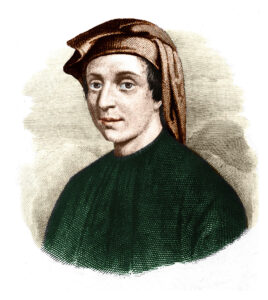
Leonardo Fibonacci (1170-1240) may have been the most talented Western mathematician of the Middle Ages. He was born and raised in the Italian city-state Pisa. As a boy, he traveled the Mediterranean region with his father and brought back new knowledge that would revolutionize science: the Hindu-Arabic numbers.
Islam
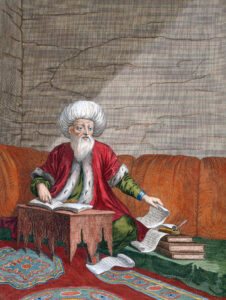
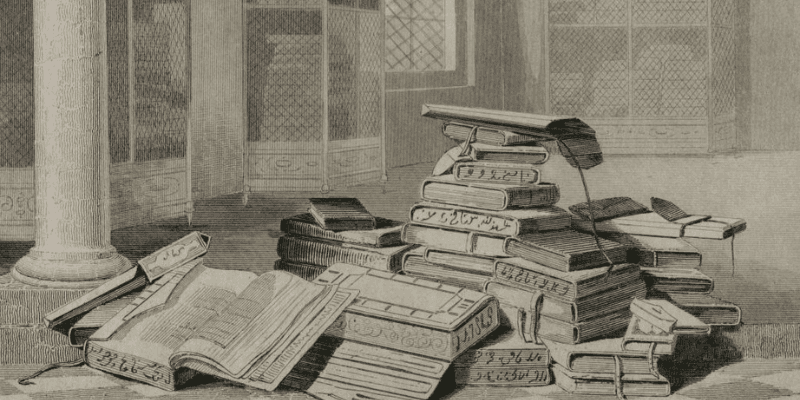
When Fibonacci was born, an Islamic Empire controlled large parts of the Mediterranean, having taken over sections of the former Roman Empire. The Arab society gathered and concentrated knowledge. Scholars were required to collect the knowledge they had gained around the world in one place to be translated and recorded. This gathering of knowledge led to significant advancements.
From the Assyrians and the Greeks, the Islamic Empire acquired knowledge of astronomy and mathematics, and from the Hindus in India, they got an innovative number system, which we today call the Hindu-Arabic numbers.
Numbers
Fibonacci’s father was a customs official stationed in Algeria with his son. There the young boy encountered the Hindu-Arabic numbers and other mathematical knowledge from the Muslims. In Europe, people were only accustomed to the Roman number system, which was hard to master for calculations.
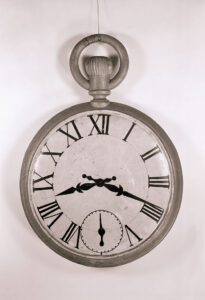
Hindu-Arabic numbers are still used in the modern world; they include the digits 1, 2, 3, 4, 5, 6, 7, 8, 9, and 0.
Roman numerals, on the other hand, used letters of the alphabet to represent different units. For example:
I = 1
V = 5
X = 10
C = 100
M = 1,000
The Hindu-Arabic number system had two features that made it extremely easy to use. First, it included the number zero. Second, it only had ten different symbols that were reused and given new values depending on their position in the number.
Liber Abaci
Since Indian society had built its mathematics in a strictly rule-based pattern, calculation became much easier. Fibonacci recognized this and wrote a book about these numbers called Liber Abaci.
He included a description of the Hindu-Arabic numbers and gave many practical examples of how they could be used for accounting by merchants. With math more accessible, people could start banks and trading companies. It created economic growth in Europe.
The Scientific Revolution
Fibonacci was also a talented mathematician. Later in life, he published another book, which made significant contributions to algebra. Over several hundred years, mathematicians incorporated these new numbers and made innovations in solving algebraic problems.
By the 16th century, mathematics was so well-developed that scientists could use it to study the natural world. People like Nicolaus Copernicus, Tycho Brahe, Johannes Kepler, Galileo Galilei, and Isaac Newton used this tool to formulate theories about the motions of the planets.
Without the Hindu-Arabic numerals, it would have been near impossible to make this progress.
Combining knowledge from other civilizations with Aristotle’s philosophy in Europe was a formula for scientific revolution in the West. Aristotle had brought back confidence in reason’s ability to investigate and understand the natural world throughout Europe.
Aristotle’s philosophy supercharged the Hindu-Arabic numerals first formulated in ancient India and helped make them some of the most powerful tools that the world had ever seen.