
★ In this story 03
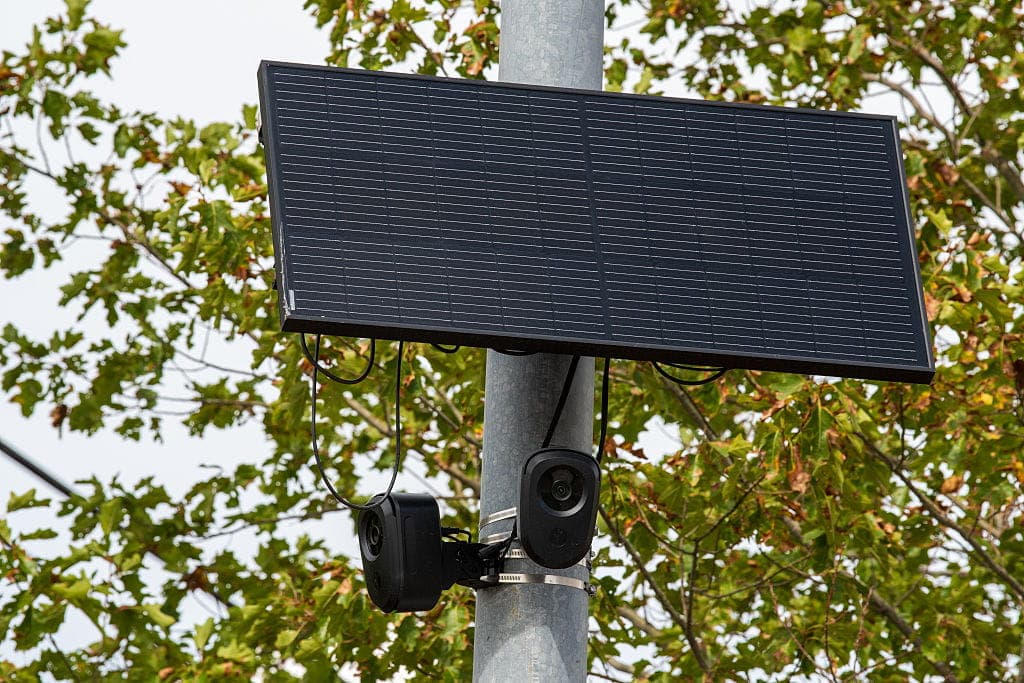
Flock cameras – they’re just about everywhere these days. Folks often drive right by those little boxes mounted under solar panels on utility poles and street signs without even noticing them. But the cameras see all, and they record it. That’s the issue that led a federal judge in Oklahoma to rule against the warrantless use of these AI-powered surveillance cameras on Oct. 2. If the police aren’t allowed to follow you around for months without a warrant, can a network of cameras and an AI-powered database do it for them?
Flock for Safety
Automated license plate readers are manufactured by companies like Flock Safety and leased to businesses and municipalities. They snap a picture every time a vehicle passes them, then upload information such as year, make, model, color, and license plate number. Even features, such as roof racks, are cataloged.
Police departments love them. Law enforcement can search the database and map out where certain vehicles have been and where they might be currently hidden or headed. They’ve been used to track down missing children and seniors, recover stolen cars, and catch fleeing suspects. But there’s just one problem: the basic human rights of American citizens.
Flock cameras don’t just track criminals – they track everyone. And, of course, the vast majority of people aren’t committing a crime when they drive by one. Still, the cameras record and the database files it away for later.
Surveillance and the Fourth Amendment
“Freedom from persistent, dragnet-style surveillance while in public is not a foreign concept in our society, and it is a reasonable expectation that society already accepts,” US District Judge Sara Hill, who was appointed by former President Joe Biden in 2024, wrote in her ruling. “But it becomes constitutionally problematic when law enforcement can indiscriminately and passively catalog your whereabouts over an extended period of time and then use that information for any purpose whenever convenient.”
The case came before the court after a Tulsa County deputy sheriff stopped a driver and searched her vehicle. The deputy began to follow the driver after noticing she had an out-of-state license plate. That was the suspicion: The driver wasn’t from Oklahoma. The officer, who had access to both Flock and VehicleManager systems, typed in the plate number and within seconds had a map of more than 50 locations across multiple states. Eventually, the deputy tailed her till he noticed a lane-shift infraction.
The deputy pulled over the woman and used the traffic pattern to justify a search. He found roughly 91 pounds of methamphetamine. The traffic stop over a minor infraction – really, over having out-of-state plates – resulted in a massive drug bust.
Defense attorneys called it a bad stop, saying the lack of warrant for that database search or any legitimate probable cause for the vehicle search ruins the case, no matter how guilty the driver was of trafficking illegal drugs.
Judge Hill agreed, saying the situation likely violated the Fourth Amendment. A spokesperson for Flock disagreed, telling The Hill: “The ruling goes against the overwhelming weight of authority in similar cases across the country, including multiple recent decisions in Oklahoma, and we expect it will be appealed and ultimately overturned.”
Why It Matters
Catching drug traffickers is just one example of precisely why many argue these Flock cameras work and are necessary. But the stop itself was, many would argue, a violation of someone’s Fourth Amendment rights. And that’s a problem. The Fourth Amendment reads:
“The right of the people to be secure in their persons, houses, papers, and effects, against unreasonable searches and seizures, shall not be violated, and no Warrants shall issue, but upon probable cause, supported by Oath or affirmation, and particularly describing the place to be searched, and the persons or things to be seized.”
It’s a fundamental right established by the Founding Fathers more than 200 years ago. Americans have a right to privacy – even from the government – unless there’s a reasonable belief that they’re committing a crime. In this case, the person was committing a crime – but the only reason the officer was suspicious was that she wasn’t a local.
It may be tempting to point to this example and say: “See? It works!” But the simple truth is even criminals are people, and all people have certain rights. That’s why everyone is entitled to a fair trial before sentencing and why every crime has a sentencing guideline as opposed to simply locking up or executing anyone accused – rightly or wrongly – of any crime.
But just as importantly, what about all the times this happens, and there isn’t a crime being committed? Do you figure this was the only time an officer searched a vehicle on the database or even engineered a traffic stop for a search just because someone was from another state? Or does it seem more likely that this is happening all the time and we just don’t see it in the news because, most of the time, there’s no crime to report?
Whatever rights criminals may or may not – or should or should not – have, every single person ever followed by the police or pulled over and searched because he or she wasn’t local had their rights violated by the police. And for law enforcement to be able to track law-abiding citizens without a warrant just to satisfy their curiosity or suspicion seems like precisely what the Fourth Amendment protects against.
4 Questions
The story, in brief
What did Judge Sara Hill rule about Flock camera searches in Oklahoma?
Judge Sara Hill ruled against the warrantless use of AI-powered license plate reader cameras to track people over time. She said it becomes constitutionally problematic when law enforcement can indiscriminately and passively catalog a person's whereabouts over an extended period and then use that information whenever convenient. She said the situation likely violated the Fourth Amendment.
How did a Tulsa County deputy use Flock cameras in the methamphetamine case?
A Tulsa County deputy sheriff noticed a driver with an out-of-state license plate and began to follow her. Using access to Flock and VehicleManager, the deputy entered the plate number and quickly got a map showing more than 50 locations across multiple states. He later used a lane-shift infraction to justify a stop and search, which turned up about 91 pounds of methamphetamine.
Why are Flock cameras controversial under the Fourth Amendment?
Flock cameras record passing vehicles and store details such as make, model, color, plate number, and even features like roof racks. Police can search that database to map where vehicles have been and where they may be headed. Critics say that means law enforcement can track everyone, not just criminals, without a warrant, which raises concerns about unreasonable searches and seizures.
What could happen next after the Oklahoma ruling on Flock cameras?
A spokesperson for Flock said the company expects the ruling to be appealed and ultimately overturned. The spokesperson argued that the decision goes against the overwhelming weight of authority in similar cases across the country, including multiple recent decisions in Oklahoma. That suggests the legal fight over these camera searches is likely to continue.