

★ In this story 03
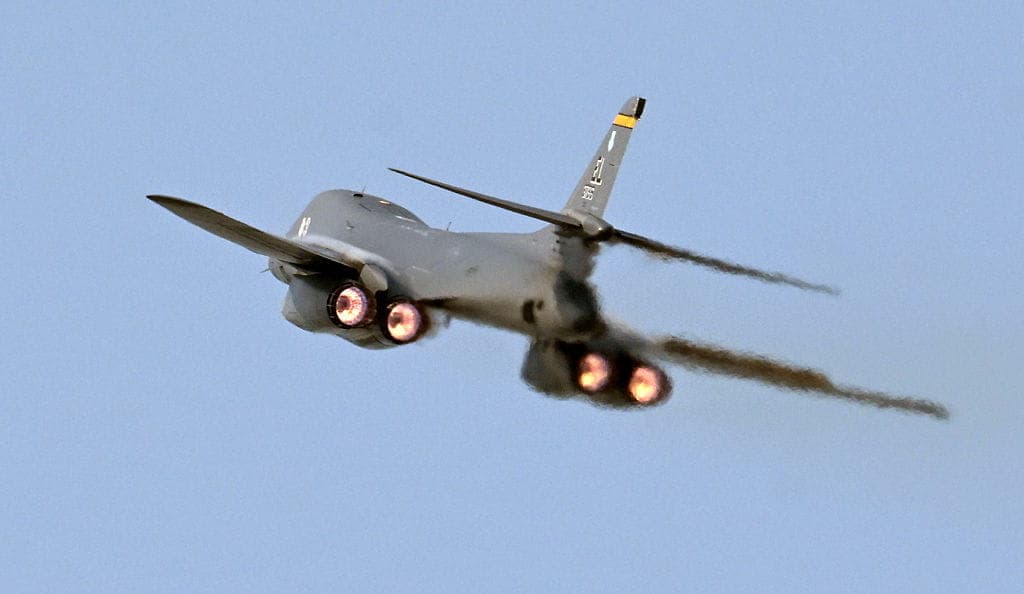
The Pentagon has removed its deployed B-1B bombers from the United Kingdom’s RAF Fairford air base. On October 4, the B-1B Lancer, nicknamed the BONE after the phonetic reading of “B-One,” bomber unit was evacuated rapidly. Some reports say several aircraft were diverted to their home bases while returning from operational missions. The departure was prompted by intelligence information that terrorists were planning to use drones to attack the aircraft. British law enforcement arrested seven individuals believed to be the would-be perpetrators.
Iran Behind Potential Terror Plot Against B-1B Bombers
Iran, in its attempt to strike back at the US, is believed to be behind the potential drone attack on UK base in Gloucestershire. British Counter-terror police responded after being notified of three suspicious vehicles close to the air base. Six British nationals in their twenties were arrested for allegedly preparing to carry out “explosive offenses and terrorism,” The Irish Times reported. All six were released on bail. A seventh individual was also arrested. “UK police said they have arrested a 22-year-old British man on suspicion of preparation of terrorist acts in relation to the alleged attempt to attack RAF Fairford late last month. The move marks the seventh arrest relating to the incident at the Gloucestershire air base,” The Financial Times explained.
Intelligence information suggested that the suspected drone attack was ordered by the Iranian Islamic Revolutionary Guard Corps (IRGC). “The suspected attack was part of a complex, multipronged Iranian plot to strike aircraft and kill some of the several hundred American personnel stationed at the base, R.A.F. Fairford, the officials said, speaking on the condition of anonymity to discuss operational matters,” The New York Times reported. Some accounts suggested that the drone attack scheme was to resemble one used in a Ukrainian strike on a Russian air base well within Russia. That drone attack destroyed or damaged a dozen or more of the Kremlin’s “nuclear-capable strategic bombers, on runways in Siberia and Russia’s Far North,” The NYT said.
The B-1B Lancer, being based in the UK, was a valuable operational capability in the US attacks on Iran. Using RAF Fairford greatly reduced the distance the bombers had to fly to reach targets in Iran. Although they could reach its targets from US home bases with several mid-air refuelings, basing in the UK allowed more missions over time. With supersonic speed and heavy munitions loads, the B-1B was ideal for its Middle East mission.
The Bone Performs a Valuable Strategic Mission
Despite being one of the older platforms in the US bomber inventory, the B-1B performs remarkably well as a conventional bomb truck. The Mach 1.2-capable plane can carry the largest payload of guided and unguided weapons the US Air Force employs, up to 75,000 pounds in three internal bomb bays. The US Air Force information sheet explains the B-1B is “the backbone of America’s long-range bomber force. It can rapidly deliver massive quantities of precision and non-precision weapons against any adversary, anywhere in the world, at any time.”
Furthermore, the ability to launch the Joint Direct Attack Munition (JDAM) and the Joint Air-to-Surface Standoff Missile (JASSM) allows the B-1B to engage and destroy Iranian air defense systems with precision without having to fly within their range. The JDAM has a GPS and inertial guidance system and can steer itself to the target. The JASSM is also a precision-guided weapon. It’s what allowed the US Air Force to render the Iranian air defenses useless in the first few days of the war.
Potential Terrorist Attack Raises Issue
However, the potential for terrorist attacks on deployed B-1Bs raises the risk-to-operational-value issue. Does the capability to have the B-1B, or any weapon system, in a high-risk environment outweigh the potential of destruction or damage?
The US leadership elected not to take the chance. Vice President J. D. Vance spoke to reporters at Joint Base Andrews on Monday, October 5, as he boarded an airplane heading to Alaska. He explained: “So, what you saw there is the Secretary of War, out of an abundance of caution, trying to protect our guys.” Vance also observed that the Iranians are doing what they have “done for 49 years, which is engaged in acts of terrorism against the United States (and others), so we are being extremely cautious, and that’s all I’d say about that.”
~
The views expressed are those of the author and not of any other affiliate.
4 Questions
The story, in brief
Why did the Pentagon remove B-1B bombers from RAF Fairford?
The departure was prompted by intelligence information that terrorists were planning to use drones to attack the aircraft at RAF Fairford. Vice President J. D. Vance said the move was made out of an abundance of caution to protect American personnel. US leadership decided not to take the chance in a high-risk environment.
Who was arrested in the alleged RAF Fairford drone attack plot?
British law enforcement arrested seven individuals believed to be involved in the alleged plot. Six British nationals in their twenties were arrested for allegedly preparing explosive offenses and terrorism, and all six were released on bail. A seventh arrest involved a 22-year-old British man on suspicion of preparation of terrorist acts.
Why were B-1B bombers based in the United Kingdom important for Iran missions?
Basing the B-1B Lancer at RAF Fairford greatly reduced the distance to targets in Iran. Although the bombers could fly from US home bases with several mid-air refuelings, operating from the UK allowed more missions over time. The aircraft's supersonic speed and heavy munitions load made it well suited for the Middle East mission.
How does the B-1B Lancer support US air operations against Iranian defenses?
The B-1B can carry up to 75,000 pounds of guided and unguided weapons in three internal bomb bays. It can launch JDAM and JASSM weapons, which let it strike Iranian air defense systems with precision without flying within their range. Those capabilities helped the US Air Force render Iranian air defenses useless in the first few days of the war.

Dave Patterson
National Security Correspondent at LibertyNation.Com and Generation Liberty, Dave is a retired U.S. Air Force Pilot with over 180 combat missions in Vietnam. He is the former Principal Deputy Under Secretary of Defense, Comptroller and has served in executive positions in the private sector aerospace and defense industry. Dave’s articles have appeared in The Federalist and DefenseOne.com.