
★ In this story 02
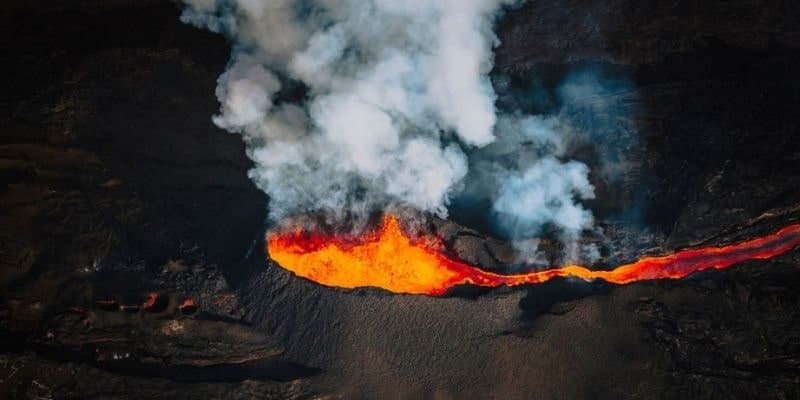
The November 27, 2022, eruption of Mauna Loa, the world’s largest active volcano located on Hawaii’s Big Island, marks the first time since March 1984. Lava shot over 200 ft from top and continues to flow closer to one of Hawaii’s main highways. Officials have reassured that, as of now, residents are safe from the lava flow. However, the National Guard is on the scene in case things become dangerous to people.
What is a Volcano and Why Do They Erupt?
A volcano is an opening in the Earth’s crust. The lava, volcanic ash, and gases under the Earth’s surface use the open space to escape – this is known as an eruption. When a volcano erupts, the pressure on the gases becomes so great that it bursts through the surface of the Earth. The amount of silica in the lava determines how the trapped gases will escape. For example, lava with low levels of silica can flow freely, and gas bubbles can clear out as needed. In contrast, high levels of silica do not allow the easy removal of gas bubbles, leading to more explosive eruptions.
Earthquakes, ground deformation, gas emissions, and heat anomalies are signs of a coming volcanic eruption. Many tools are used to detect these changes, such as seismographs, GPS equipment, surveying equipment, and satellite imagery. Unfortunately, it is difficult to determine when an eruption will happen and how severe it will be. Therefore, scientists use the data from each volcanic explosion to help improve the accuracy of their predictions.
Mauna Loa – The World’s Largest Active Volcano
Mauna Loa erupted for the first time in nearly four decades on Monday, November 27, 2022. The flowing lava from Mauna Loa’s most recent eruption is moving closer and closer to the Daniel K. Inouye Highway (Saddle Road), the main roadway that links Hawaii’s east and west sides. Officials are not currently concerned about how far the lava is moving. However, there are still precautionary measures, like safe houses and the presence of the National Guard, which is in place to ensure the safety of Hawaiian residents.
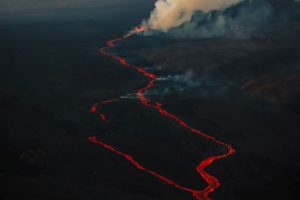
The event has sparked interest and attracted onlookers drawn to the volcano’s smells and sounds. Although, spectator interest has led authorities to prohibit parking on Saddle Road between mile markers 16 and 31 unless parked in designated spaces. Those who want to see the action up close are more likely to get the best view after dusk, as the designated viewing areas only show some smoke and some orange lava tendrils during the daytime hours.
Millions have opted to view the eruption and up-to-date videos online. Several cameras around the site provide the best views to look at the phenomenon safely from home. Locals and tourists can also see an aerial view via helicopter, though it’s a little costly. The 60 to 75-minute tour would cost $549 and require a minimum occupancy of three riders.
Test your knowledge on this article: Take the quiz.
Try a quiz based on this article
Mauna Loa erupted on what date in 2022?
Show the answer
November 27.
When was the last time the volcano erupted?
Show the answer
March of 1984.
Volcanoes with high levels of silica make more explosive eruptions.
Show the answer
True.
Along with ground deformations and gas emissions, _________ signify potential volcanic eruptions.
Show the answer
Earthquakes.
Scientists are able to identify exactly when a volcano will erupt.
Show the answer
False.
Mauna Loa is the world’s _______ active volcano.
Show the answer
Largest.
Why has the National Guard been called to the eruption site?
Show the answer
The lava is flowing towards a major highway in Hawaii.
Spectators are forbidden to enter between mile markers ___ and ____ for their own safety.
Show the answer
16, 31.
The best view of the volcanic activity is after dusk.
Show the answer
True.
Arguably, the best view of the action is via _______, though it can be costly.
Show the answer
Helicopter.

Kirsten Brooker
Culture Correspondent for Liberty Nation and Generation Liberty. Kirsten loves to write about culture from the point of view of an everyday American who lives deep in the heart of the Midwest. She is the mother of two adorable girls, likes classic rock, and humbly wears the crown of a former Homecoming Queen with grace and style.