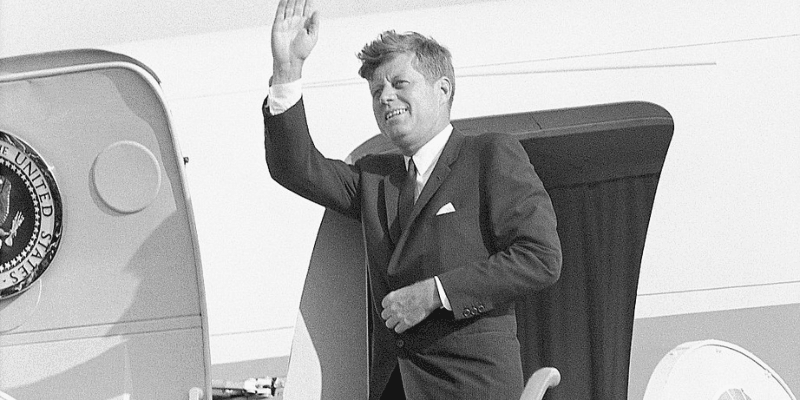
Not only was he the youngest president to be elected and the youngest to be assassinated, but he was also charismatic, good-looking, and popular. A line from his inauguration speech, “Ask not what your country can do for you – ask what you can do for your country,” is one of the most famous presidential quotes in history.

Early Years
Born on May 29, 1917, in Brookline, Massachusetts, JFK was known as “Jack” and was the second of nine children. His father, Joseph Kennedy, was an early supporter of Franklin D. Roosevelt. In 1937, the elder Kennedy became ambassador to Great Britain. While a student at Harvard University, JFK traveled and served as his father’s secretary.
In 1941, JFK joined the Navy and fought during World War II. A Japanese destroyer struck his Patrol-Torpedo (PT) craft in August 1943. The young Kennedy was seriously wounded, but he helped some of his crew back to safety. He was awarded the Navy and Marine Corps Medal for heroism. His older brother, Joe, was killed while on a secret mission against a German rocket-launching site. The father, Joe Sr., told JFK that he had to fulfill his brother’s destiny to become the first Catholic president of the United States.
Road to the White House
JFK had wanted to be a journalist, but he left the Navy to pursue a career in politics. He ran for Congress in 1946. With his father’s fortune backing him, he won the election and entered Congress. He was 29 years old at the time.
On September 12, 1953, JFK married journalist Jacqueline Lee (Jackie) Bouvier.
On January 2, 1960, JFK announced he would run for president, and won the race against Richard Nixon.
JFK Presidency
On January 20, 1961, the new president gave his inaugural address, asking Americans to work together to end poverty and to fight the Cold War and against communism.
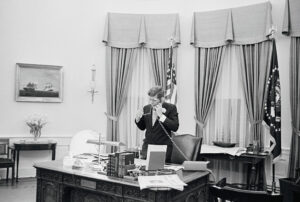
Kennedy was president during two key events in the Cold War, both in Cuba – the Bay of Pigs Invasion and the Cuban Missile Crisis. Kennedy wanted to end communism and his efforts in Southeast Asia led to more United States’ involvement in the Vietnam War. It was also Kennedy who first suggested man could go to the moon, even though he died before his vision came true.
Though late to react, the president also wanted equal rights and was a supporter of the Civil Rights Movement. He sent federal troops to the University of Mississippi to help with desegregation efforts. The next summer, he announced he was proposing a civil rights bill.
On November 22, 1963, JFK and his wife went to Texas. After speaking in Austin, Fort Worth, and San Antonio, they went to Dallas for the next speech. The family traveled in a motorcade to the Dallas Trade Mart. At 12:30 p.m., the motorcade was passing through downtown Dallas when Kennedy was struck twice by bullets in the neck and head. He was pronounced dead at a nearby hospital.
Test your news knowledge
Who discovered the oldest human remains found in North America?
Show the answer
Phil Orr. Read: The First Americans and the Kelp Highway Theory
What does the Arabic word safar mean in English?
Show the answer
Journey. Read: Arabic – An Eastern Trade Language That Transformed the West
John Deere was born in 1804 in what US state?
Show the answer
Vermont. Read: John Deere: An Agricultural Inventor