
★ In this story 03
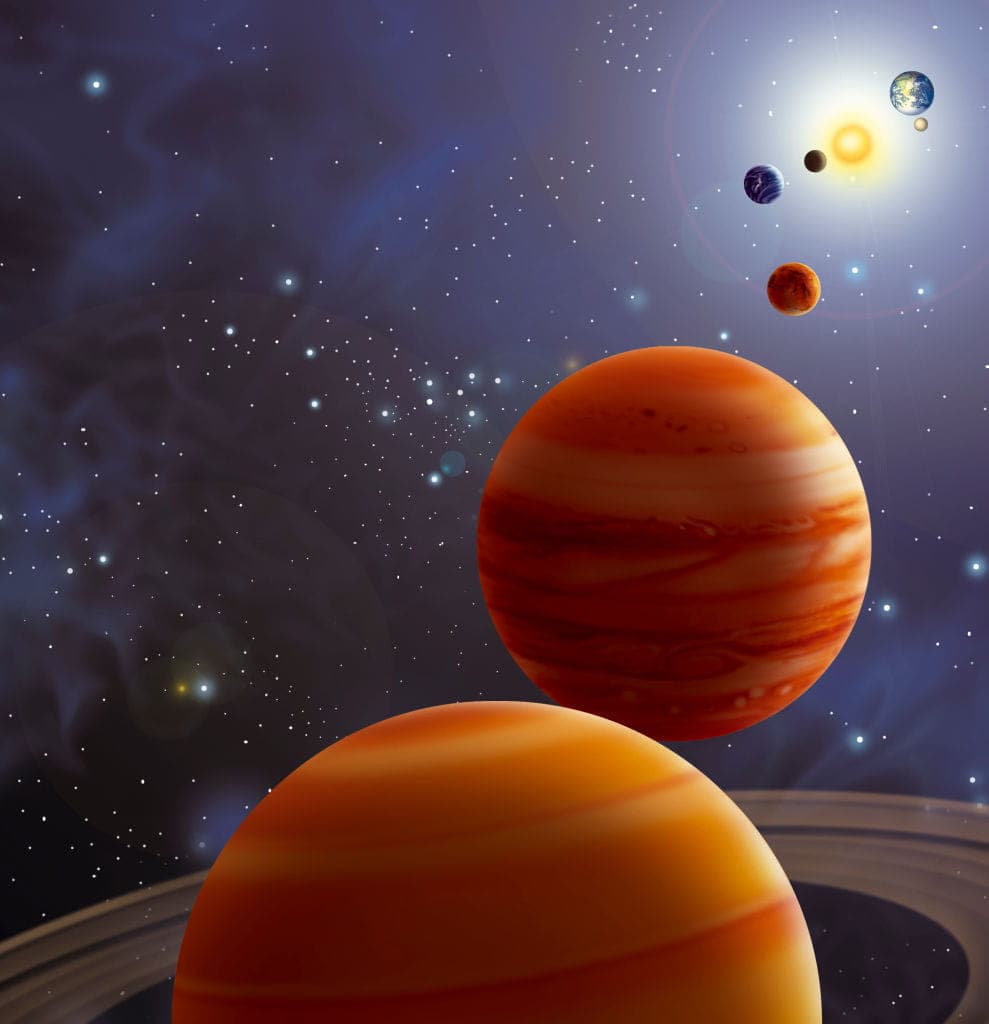
Earth may be the biggest of the inner planets, but it has nothing on the giants of the outer solar system. And there’s no planet in the system bigger than the fifth from the sun, Jupiter. But that isn’t the only difference between this massive world and Earth. Out past the asteroid belt, it’s a whole different kind of system.
Inside the Belt, or Out?
As unique as Earth is from the rest of the system, it shares some traits with its fellow inner-system planets. Mercury, Venus, Mars, and Earth are all rocks – though some have more liquid or gas surrounding that rock than others. Out past Mars, however, is an asteroid belt that separates the inner planets from the outer. All the outer planets – Jupiter, Saturn, Uranus, and Neptune – are either gas giants or balls of ice, as best as we can tell, and they’re all much bigger than Earth.
Earth, the largest of the inner planets, has a surface area of 196.6 million square miles. Neptune, the smallest of the outer planets, has a surface area of 2.941 billion square miles. Jupiter, the fifth planet from the sun and the first of the outer planets, is largest of all at 23.71 billion square miles.
Jupiter sits an average of 484 million miles from the sun. Light travels from the sun to Earth in about eight-and-a-half minutes. But the trip to Jupiter at light speed takes 43 minutes! Jupiter takes about 12 Earth years to go all the way around the sun, but it has the shortest day in the system, at about 9.9 hours.
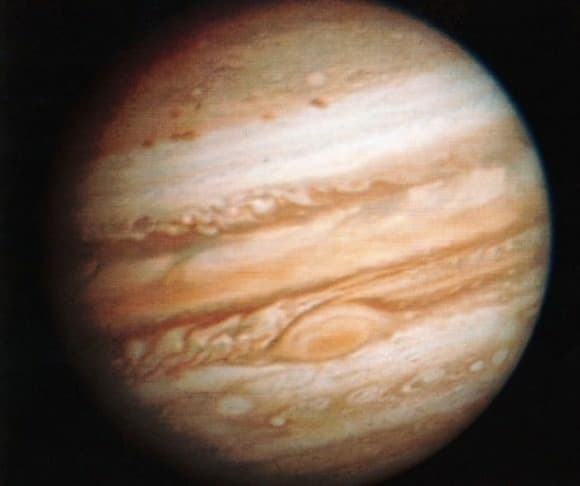
The giant of our solar system is mostly gas. The atmosphere is made of about 75% hydrogen and 24% helium by mass, with the remaining 1% being trace amounts of other elements and compounds like methane, water, and ammonia. The atmosphere is full of massive storms that often appear as white ovals to observers from Earth. But its most famous storm is the Great Red Spot, a persistent high-pressure region that produces an anticyclonic storm. It’s the largest storm in the solar system. At more than 10,000 miles wide, it’s even bigger than Earth.
It’s believed that, deep inside Jupiter, the pressure causes hydrogen to take a liquid and, farther in, metallic form, and that there’s a small core of rock and ice at the very center. That’s all a guess, though, because we don’t have any probes that can survive that far through the planet’s atmosphere. The pressure where the hydrogen turns liquid is believed to be about three million times that of earth’s atmospheric pressure – and it could theoretically be 50 to 100 million times as much at the solid surface, if there is one.
Today, scientists believe Jupiter was one of the first planets to form in our solar system. They think this because it’s made mostly of hydrogen and helium, just like the sun.
Jupiter and Its Many Moons
Jupiter is one of the planets visible in the night sky. As such, its discovery predates written history. The planet was one of the first, however, to be observed through a telescope. In 1610, Galileo Galilei looked through is long distance lens and saw that Jupiter has moons: Io, Europa, Ganymede, and Callisto. Before this, people didn’t know other planets had moons, and the discovery led to the shift away from the geocentric model of space – the idea that everything revolved around Earth – and to the heliocentric theory – the idea that object in our solar system revolve around the sun.
Today, we know of 95 confirmed moons for Jupiter, though there are plenty of other objects that we don’t consider true moons orbiting around the gas giant. Still, Jupiter doesn’t have the highest moon count – that honor belongs to Saturn. It does, however, have the largest moon. Ganymede is bigger than Mercury and is the only moon in our system to have its own magnetic field. Jupiter’s fourth largest moon – the smallest that Galileo discovered – is Europa. It’s about 90% the size of Earth’s moon, but it’s believed to have subsurface oceans of salt water and, therefore, could possibly harbor life!
In Myth and Music
To the Romans, Jupiter was the king of the gods, ruling over the skies and thunder. His Greek name was Zeus. When the ancient people looked at this giant planet, they thought of power, authority, and storms.
In 1916, Gustav Holst wrote a suite called “The Planets.” Jupiter was the fourth in the collection, it’s composition is titled “Jupiter, the Bringer of Jollity.” Holst imagined the planet as jolly, and his music captures a joyful energy.
Modern people don’t think of Jupiter as a god anymore, but the gas giant does, in a way, protect Earth and the other inner planets. Thanks to its massive size and gravitational influence, Jupiter either deflects or captures most comets and asteroids that get close enough they might otherwise strike our planet.
Try a quiz based on this article
Which of the following statements is true:
Show the answer
Jupiter is the biggest planet in our solar system.
What trait do Mercury, Venus, Mars, and Earth share?
Show the answer
They are all made of rock.
Beyond Mars, there is an asteroid belt that separates the inner from the outer planets.
Show the answer
True.
Earth is the largest of the outer planets.
Show the answer
False.
About how many minutes does it take for light to travel from the sun to Jupiter?
Show the answer
43 minutes.
Jupiter takes about 12 Earth years to travel around the sun but has the shortest day in the solar system at about:
Show the answer
9.9 hours.
What is Jupiter primarily made up of?
Show the answer
Gas.
Which is Jupiter’s most famous storm?
Show the answer
The Great Red Spot.
Scientists believe that Jupiter was one of the first planets to form in our solar system.
Show the answer
True.
How many moons have been confirmed to exist on the planet Jupiter?
Show the answer
95.