

★ In this story 02
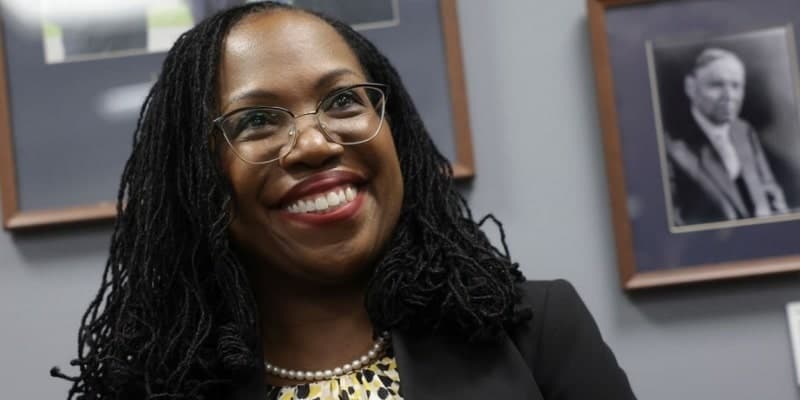
Judge Ketanji Brown Jackson has been confirmed to the United States Supreme Court. The Court is one of the most powerful parts of the US government, as it heads the judicial branch. It is the highest court in the country and makes important legal rulings.
When a judge joins the Supreme Court, he or she is called a justice. There are nine justices on the court. Judge Jackson was nominated for the job after Justice Stephen Breyer announced plans to retire at the end of the current term. Judge Jackson is expected to become the first black woman to join the court, but she will not officially become a justice until Breyer leaves and she is sworn in to replace him.
Who Is Ketanji Brown Jackson?
Judge Jackson was born in Washington, DC, but she grew up in Miami, Florida. Her parents worked as teachers, but her father also became a lawyer. He sparked Ketanji’s interest in the law. An ambitious young woman, she studied law at Harvard University, then served as a clerk to Justice Breyer and several other judges.
She went on to work as a lawyer for various places, including private law firms and the US government. For two years, she took a job as a public defender, representing people charged with a crime who couldn’t afford to pay for a lawyer to defend them. Her experience as a public defender is unique among today’s Supreme Court justices. The last person with much criminal defense experience to serve on the Court was Justice Thurgood Marshall, but he retired in 1991.
Eventually, in 2013, Jackson became a judge. She worked as a District Judge for the District of Columbia, before being promoted to the federal Court of Appeals in DC. She didn’t have long to settle into that job, though, as only a year later President Joe Biden nominated her to join the Supreme Court.
A nomination isn’t enough to get that kind of job, though. Lots of high-level government positions, including judges, need to be confirmed by a legislature. The US Senate is in charge of confirming or rejecting Supreme Court nominees. Senators vote on the decision, but before that, they get to investigate and interview the nominee.
Supporters and Opponents
During the Senate confirmation hearings, most members of the Republican Party opposed Judge Jackson joining the Supreme Court, while the Democrats supported it.
According to her critics, Judge Jackson has been too lenient with some criminals in the past, giving them light sentences during her time on the lower courts. Republicans quizzed her on how much time criminals should serve in prison, and how crime should be handled in general.
Another complaint was Judge Jackson’s reluctance to talk about her judicial philosophy – the beliefs that shape how she sees the law and the legal system. Since these ideas will affect her future rulings, some weren’t happy that she avoided answering questions on this topic.
On the other hand, members of the Democratic Party supported the judge, saying she has lots of legal experience and a good record. They also hoped to confirm the first black female justice to the Court.
In the end, Judge Ketanji Brown Jackson was confirmed to the Supreme Court by a vote of 53-47.
Try a quiz based on this article
The United States Supreme Court is one of the most powerful parts of the US government.
Show the answer
True.
What is a judge called when they join the Supreme Court?
Show the answer
Justice.
How many justices are on the Supreme Court?
Show the answer
9.
Ketanji Brown Jackson will take the place of Justice Stephen Breyer when he retires.
Show the answer
True.
Judge Jackson was born in Washington DC, but grew up in _________.
Show the answer
Miami, Florida.
Where did Judge Jackson earn her education?
Show the answer
Harvard.
Who nominated Jackson to join the Supreme Court?
Show the answer
President Joe Biden.
Republicans were mostly against Judge Jackson joining the Supreme Court.
Show the answer
True.
Her critics feel that she was too ________ with some of the criminals she judged in the past.
Show the answer
Lenient.
The judge avoided answering questions regarding her judicial philosophy during the interview process.
Show the answer
True.