
★ In this story 03
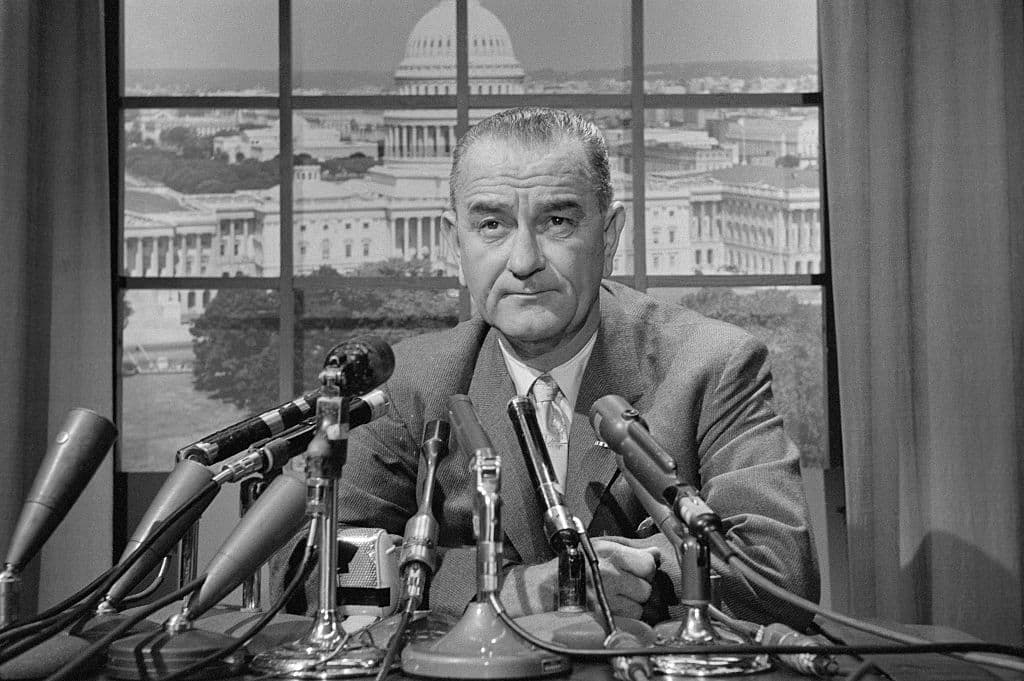
In 1964, Johnson was elected president in his own right.
He was commander-in-chief during the Vietnam War, a very unpopular conflict among Americans, which led to his choice not to run for re-election in 1968. He wanted to improve the nation into a “Great Society” and strove to end poverty.
Early Years
LBJ was born on August 27, 1908, in Texas, not far from Johnson City, which his family had helped to settle. He understood rural poverty because of the area where he grew up, but it was when he went to Southwest Texas State Teachers College (now Texas State University-San Marcos) that he really saw how being poor affected lives. While there, he taught poverty-stricken Mexican students. This inspired so much compassion for the poor, Johnson’s presidential career would be aimed at ending hunger and destitution.
On November 17, 1934, LBJ married Claudia Alta “Lady Bird” Taylor. Lady Bird Johnson was a well-educated woman who would play a critical role in Johnson’s political success.
LBJ Enters the Political World
In 1935, Johnson became the director of the National Youth Administration which was a New Deal program of President Franklin D. Roosevelt, who just happened to be LBJ’s political hero. The program helped young people find jobs during the Great Depression.
Two years later, in 1937, he was elected to the House of Representatives as a Democrat. LBJ was so popular, he was re-elected five times. In 1941, he became the first member of Congress to volunteer for active military duty just when the U.S. entered World War II.
In 1960, Kennedy asked Johnson to be his vice-presidential running mate. The team was able to win the Oval Office. However, less than a year into the term, Kennedy was shot and killed on November 22, 1963, in Dallas, Texas. Later that day, LBJ was sworn in as president aboard Air Force One.
LBJ as President
Johnson immediately took over and worked on completing measures Kennedy had put into place, such as a new civil rights bill and a tax cut. He sought, more than anything, a remedy for the poverty-stricken. He urged citizens “to build a great society, a place where the meaning of man’s life matches the marvels of man’s labor.”
In 1964, Johnson won the presidency with the widest margin in American history; 61% of the vote. He began working on his “Great Society” program which included education, Medicare, conservation, the fight against poverty, and more. In 1965, LBJ signed the historic Civil Rights Act of 1964 and the Voting Rights Act of 1965.
Johnson was worried that America’s security depended on stopping the spread of communism. Trying to stop communism in Asia, he escalated the Vietnam War. American troops in Vietnam rose from 16,000 when he first took office to 500,000 six years later, in 1968.
In March 1968, the president slowed the bombing of North Vietnam while trying to start negotiations to end the war. He also surprised everyone when he didn’t seek re-election. When he left office, peace talks were happening, but on January 22, 1973, LBJ died from a sudden heart attack without seeing the peace happen.
The war badly damaged Johnson’s reputation, and he lost popularity. He is still condemned today for his role in the conflict. Still, his efforts in equal rights and helping the poor are a big part of his legacy.