
★ In this story 03
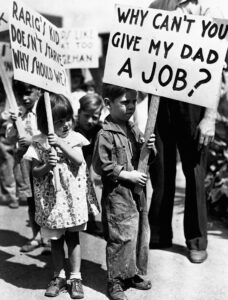
The Great Depression is perhaps the most studied and talked about economic event in the nation’s history. It was a terrible time for the country. But the question is: Will the United States ever see this level of depression again? America has come close to falling into a depression, from the 2008-2009 financial crisis to the 2020 coronavirus-induced collapse. Perhaps understanding how the Great Depression came about and how terrible conditions were could offer some insight into what needs to unfold before the U.S. mirrors the 1930s – and how it responds.
The Great Depression: A Primer
The Great Depression lasted from 1929 to 1939 and had a lot of contributing factors:
- The economy contracted 50%.
- The unemployment rate skyrocketed to 25%.
- One-third of the nation’s banks failed, and depositors lost $140 billion.
- International trade crashed 66%.
- The Dow Jones Industrial Average cratered 85%.
The national debt as a proportion to the gross national product (GNP) was above 40% and climbed to 120% when the U.S. joined the Second World War. Federal spending tripled, adding to the national debt that soared to nearly half of the gross domestic product by 1939, which conservative economists today believe prolonged the depression. Indeed, the New Deal and the Second New Deal weighed heavily on America’s finances, causing Republican critics to worry about the country turning into a socialist state.
Conservatives joined together to abandon the so-called alphabet soup of federal agencies, including the Reconstruction Finance Corporation (RFC), the Works Progress Administration (WPA), and the Civilian Conservation Corps (CCC). But they were unsuccessful in ending Social Security. Following the depression and the war, the public debt was finally on a steady decline until the 1980s.
The national economy also started to level out in the 1940s, although many Americans continued to struggle. Consumer spending, personal income, price inflation, and agricultural production were on the rise again.
What Caused the Great Depression?
The Wall Street Crash of 1929, also known as Black Tuesday, was the start of the Great Depression.
More than 16.4 million shares were traded in a single day and billions of dollars were wiped out. This led to the many other economic disasters that were prevalent throughout the United States at the time.
Following the First World War, the Federal Reserve slowed down money-supply growth and raised interest rates to fight inflation that had swelled to as much as 20%. However, in the following years, the U.S. central bank expanded the money supply rapidly and cut rates, flooding the market with freshly created dollars. The institution then ended this easy money policy in 1929 and allowed the total supply of U.S. dollars to decline by one-third, resulting in the downturn.
In addition to Fed policy, other factors contributed to the historic economic downturn:
- A housing bubble in the major metropolitan areas.
- A decline in foreign lending and international trade (protectionism).
- Credit expansion, loose credit, and over-indebtedness.
- Rampant deflation that impacted rural America.
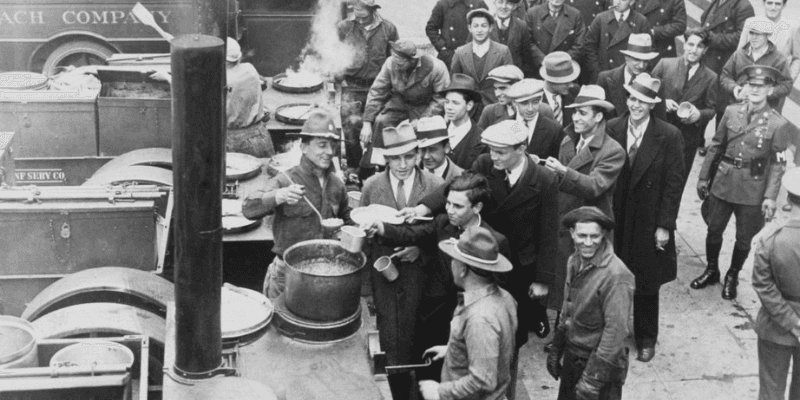
Even for Americans who kept their jobs and earned a decent living, life was still tough. The motto of the time was: “Use it up, wear it out, make do or do without.”
Can It Happen Again?
The economy and the political fallout of the 1930s have been intensely studied by academia for decades. People disagree on what caused the Great Depression, but presenting different reasons does give us more to think about when trying to figure out how to prevent another depression. Can it happen again? As legendary economist Hans F. Sennholz explained in 1962, economic law says it has to if we repeated the errors that caused the Great Depression.