
★ In this story 03
The last time the United States suffered an economic depression was in the 1930s. Since the nation has not suffered one in nearly a century, does this mean the country is safe from such a significant collapse? First, it is crucial to understand what it is and the history of depressions.
What Is an Economic Depression?
It is first essential to define what a recession is in the economy. This is when the gross domestic product experiences two back-to-back quarters of contraction. A depression can be summarized as being more intense than a recession. While there is no standard definition for a depression, it is commonly accepted that it is defined using two metrics: a decline in the GDP by 10% and a recession that lasts two or more years.
Economists also use a joke to describe the difference between these economic cycles: “When your neighbor loses their job, it’s a recession. When you lose your job, that’s a depression!”
Put simply, recessions and depressions have the same start dates but different durations and ending times.
What Causes a Depression?
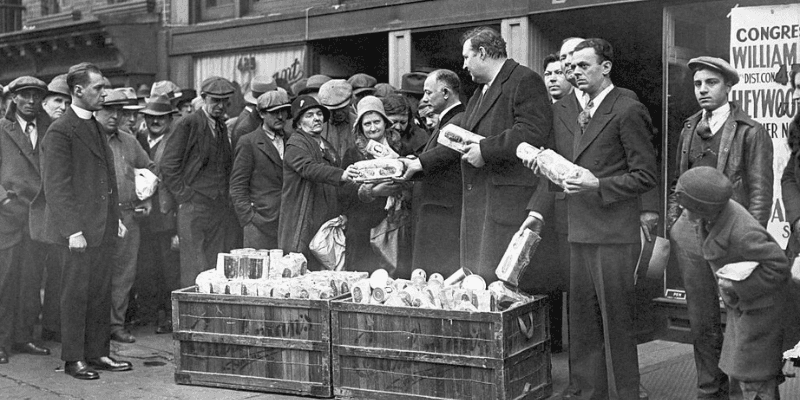
Many factors could trigger a recession and then a depression. For example, in the Great Depression, the stock market crash of 1929, banking panics, monetary contraction, and falling international lending and tariffs led to one of the nation’s worst economic periods in history.
But many economic factors can lead to a downturn that lasts for two years or a decade:
- A spike in unemployment.
- A decline in available credit.
- Household and corporate bankruptcies.
- A bear market in the stock market.
- Reduce international trade and commerce.
Ultimately, an economic depression can be initiated by deteriorating consumer confidence, resulting in shoppers no longer purchasing goods and services. This prompts businesses to scale back their budgets, terminate staff, or shut down operations. And this is what sparks the domino effect throughout the entire economy.
The History of American Depressions
The U.S. and the rest of the world have experienced numerous economic depressions. Here are some of the steep downturns that the world’s largest economy lived through for the last 200 years:
- Panic of 1837: A financial crisis that lasted for seven years when New York City temporarily ended specie payments (gold and silver) and would not redeem commercial paper at full face value. This caused bank failures, business shutdowns, deflation, and high unemployment.
- The Long Depression: The U.S. and the rest of the world went through a severe contraction that lasted 65 months (1873 to 1879) that saw 18,000 businesses going bankrupt, banks declaring insolvency, and joblessness climbing to around 15%.
- The Forgotten Depression (1920-1921): Following the end of the First World War, the U.S. economy witnessed dramatic changes: an enormous surge in the civilian labor market, adjustments to fiscal and monetary policy, and shrinking monetary policy. Economic historians will say that the U.S. faced a tremendous shock transitioning from a wartime economy to a peacetime one.
But can it happen again? As the eminent economist Hans F. Sennholz wrote in October 1969: “Can it happen again? Inexorable economic law ascertains that it must happen again whenever we repeat the dreadful errors that generated the Great Depression.”