
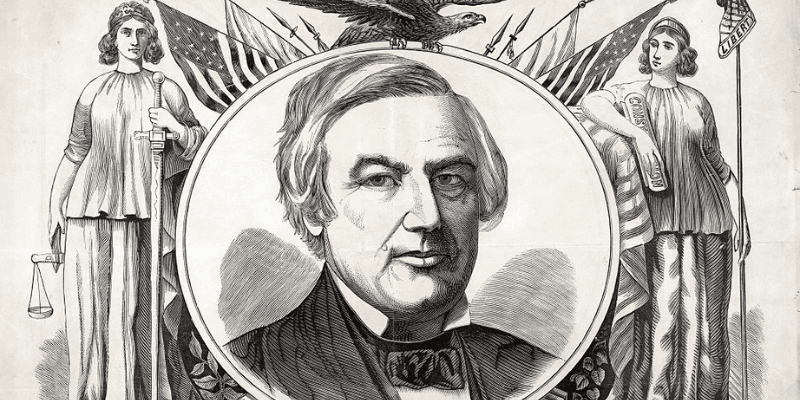
In 1828, Fillmore began his political career as a member of the Democratic and Libertarian Anti-Masonic Movement and Anti-Masonic Party. In 1834, he transferred over to the Whig Party and became recognized as an outstanding leader of the party’s northern wing.
In 1848, at the national Whig convention, Mexican War hero Zachary Taylor was nominated as president with Fillmore on the ticket as vice. Taylor was adamant about ending slavery, but his term was cut short when he died just months into his presidency. Fillmore became chief executive in 1850 after the president’s death.
Because the Whig Party had such success at the polls, Fillmore thought a new national party was rising and that they would be able to find a middle ground in terms of slavery. Clay’s Compromise of 1850 was an attempt to appease both the North and the South while finding a way to preserve the Union. The legislation was passed just two months after Taylor’s death and Fillmore strayed from the former president’s desire to end slavery by signing the Fugitive Slave Act of 1850, a provision that required the federal government to aid in the capture and return of runaway slaves to their owners. He publicly announced that, if necessary, he would call upon the military to aid in the enforcement.
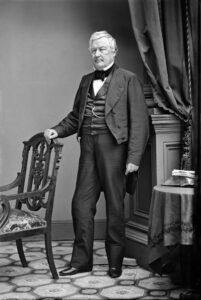
While this somewhat appeased the Southerners and was partially responsible for delaying the Civil War for another decade, the move destroyed Fillmore’s political career because of the extreme unpopularity with the North over his support and actions towards the institution of slavery.
In 1852, Fillmore decided to run again for president. He was one of three candidates of the Whig Party in its last national election, which it lost. He tried again in 1856, this time as the candidate of the Know-Nothing Party, also known as the American Party. He finished in third behind Democrat James Buchanan and Republican John C. Fremont. Fillmore retired to Buffalo after the loss and became a leader in the city’s civic and cultural life.
Test Your Knowledge – Take the Quiz
Try a quiz based on this article
Millard Fillmore was the last to hold office who wasn’t affiliated with either the Democratic or Republican parties.
Show the answer
True.
Fillmore started his career as a member of the Democratic and Libertarian Anti-Masonic movement and later, in 1834, transferred over to what party?
Show the answer
The Whig Party.
Who ran for president with Fillmore on the ticket as the Vice-Presidential nominee?
Show the answer
Zachary Taylor.
Fillmore signed a provision that required the federal government to aid in the capture and return of runaway slaves, called:
Show the answer
The Fugitive Slave Act of 1850.
The signing of the aforementioned Act is partially responsible for delaying:
Show the answer
Civil War.
Fillmore lost popularity among the North due to his position on:
Show the answer
Slavery.
Fillmore ran for president two more times, once in 1852 and again in _____, and lost both times.
Show the answer
1856.
After losing his final presidential election, Fillmore retired to:
Show the answer
Buffalo, New York.