
★ In this story 04
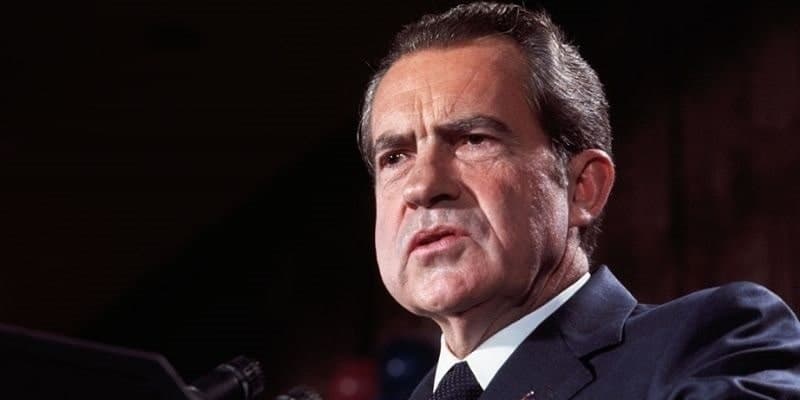
The 37th president of the United States is the only commander-in-chief to resign while in office. Richard Milhous Nixon (1913-1994) did not have an easy presidency due to the Vietnam War, as well as strained relations in China and the Soviet Union. While he did accomplish some worthy goals, the Watergate scandal forever haunted his reputation and life.
The Early Years
Born on January 9, 1913, Nixon grew up in a working-class family, which helped shape his political choices and career. In 1937, he earned a law degree from Duke University and then returned to California to begin working as an attorney. When America joined World War II (1939-1945), Nixon enlisted in the Navy and served as a Navy lieutenant commander in the Pacific.
Political Beginnings
In 1946, after the war, Nixon’s political career began when he won a seat in the House of Representatives for his California district. He made his name as a congressman while he served on the House Un-American Activities Committee and led a controversial investigation of Alger Hiss, an official who was accused of being a spy for the Soviet Union in the 1930s.
In 1952, Dwight D. Eisenhower chose Nixon, who was 39 at the time, to be his vice-presidential running mate. Nixon became the target of a negative campaign that accused him of accepting gifts that he shouldn’t have. With a laugh, he said the only gift he ever received was “Checkers,” the name of a puppy for his daughter. That “Checkers” speech gained him a lot of support.
Eisenhower and Nixon won the 1952 election and were also re-elected in 1956. For the next term, Nixon wanted to run for the job of president. He got the Republican presidential nomination but lost to John F. Kennedy in the closest election in U.S. history. Nixon blamed the loss on the fact that Kennedy was tanned and good-looking during the first-ever nationally televised presidential election while he had been pale, sweating, and nervous.
His losing streak continued when he ran for governor of California in 1962. Acting the sore loser, he believed his career was over and told reporters, “You won’t have Nixon to kick around anymore.”
Nixon as President

Six years after losing the governor’s election, Nixon decided to run for president again. He claimed the Republican nomination once again, and in 1968, he beat Democrat Hubert Humphrey, winning the presidency.
His time as president was fraught with problems. The American people were greatly divided over the Vietnam War (1954-1975), and women were marching for equal rights while racial violence was breaking out across the nation.
Nixon’s plan to achieve “peace with honor” in Vietnam was to be accomplished by the “Vietnamization” strategy. This idea would gradually withdraw troops from Vietnam while also training the U.S.-supported South Vietnamese army to be more effective. In 1973, Nixon reached a peace agreement with Communist North Vietnam, and the last American troops left in March of that year.
In 1972, he was able to reduce tensions with China and the Soviet Union, which helped America to communicate with China, especially. Nixon also signed treaties that limited the production of nuclear weapons.
Watergate Scandal
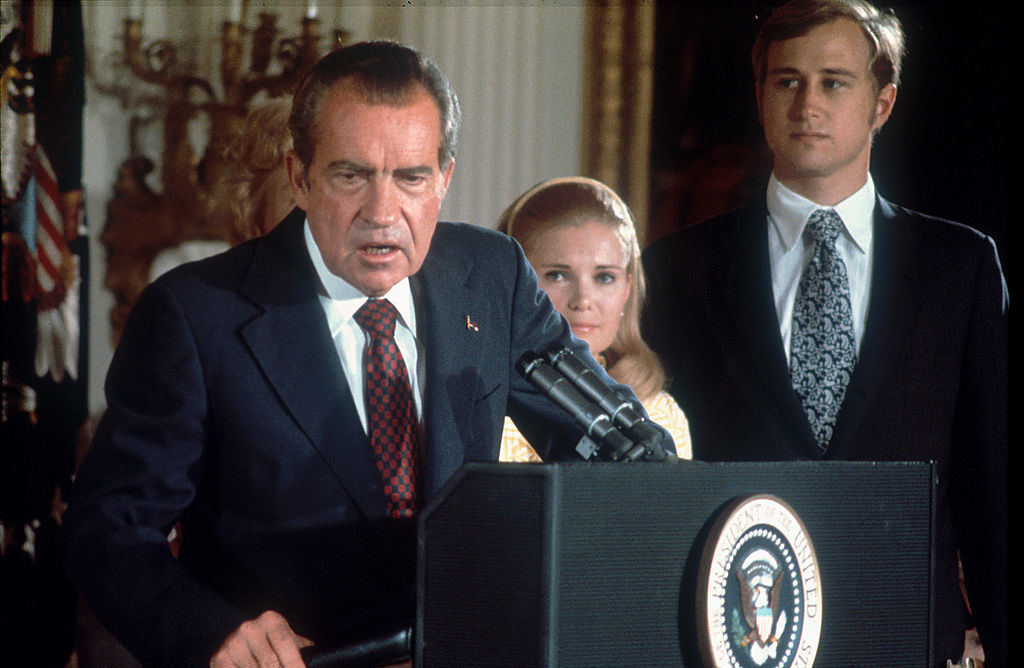
All of his good work would be for naught, though, for many Americans. In 1972, Nixon ran for re-election, but a scandal soon began that ruined his reputation.
Some people linked with his campaign broke into the headquarters of Nixon’s political rivals (the Democratic National Committee) at the Watergate buildings in Washington, D.C.
Several of Nixon’s officials knew of the break-in, but the president denied having known about it. However, the courts forced him to give up tape recordings of his conversations in the Oval Office. The tapes were submitted with 8 1/2 minutes missing, which put Nixon under heavy suspicion.
Because of the scandal, Vice President Spiro T. Agnew resigned in 1973. Nixon then nominated Gerald R. Ford to take the VP position and Congress approved. Nixon knew he was likely facing impeachment, so rather than go through that process, he decided to resign on August 9, 1974. He made that choice so “that process of healing which is so desperately needed in America” could begin, he said. A month after Nixon’s resignation, Ford pardoned him of any wrongdoing, but the damage had been done.
Nixon died from a stroke on April 22, 1994, at the age of 81 in New York City. While many Americans still see him negatively, some others appreciate his accomplishments, which include ending the draft, a broad environmental program, and appointing several judges to the Supreme Court.
Test your knowledge with a quiz based on this article!
Try a quiz based on this article
The _______ scandal is ultimately what forced the president to resign.
Show the answer
Watergate.
Nixon earned a(n) _________ degree from Duke University in 1937.
Show the answer
Law.
To begin his political career, Nixon won a seat in _________.
Show the answer
The House of Representatives.
Nixon served on the controversial House Un-American Activities Committee, where is investigated someone accused of...
Show the answer
Being a spy for the Soviet Union.
Nixon and Eisenhower lost the 1952 election.
Show the answer
False.
Nixon won the presidency in ______.
Show the answer
1968.
Nixon came across many problems as president, including the Vietnam War and tensions with China and the Soviet Union.
Show the answer
True.
Nixon denied any knowledge of the break-in at the Watergate building.
Show the answer
True.
With taped evidence, Nixon couldn’t prove that he was unaware of the Watergate break-in and resigned from his presidency in ______.
Show the answer
1974.
Nixon was part of the first-ever nationally televised presidential election.
Show the answer
True.