
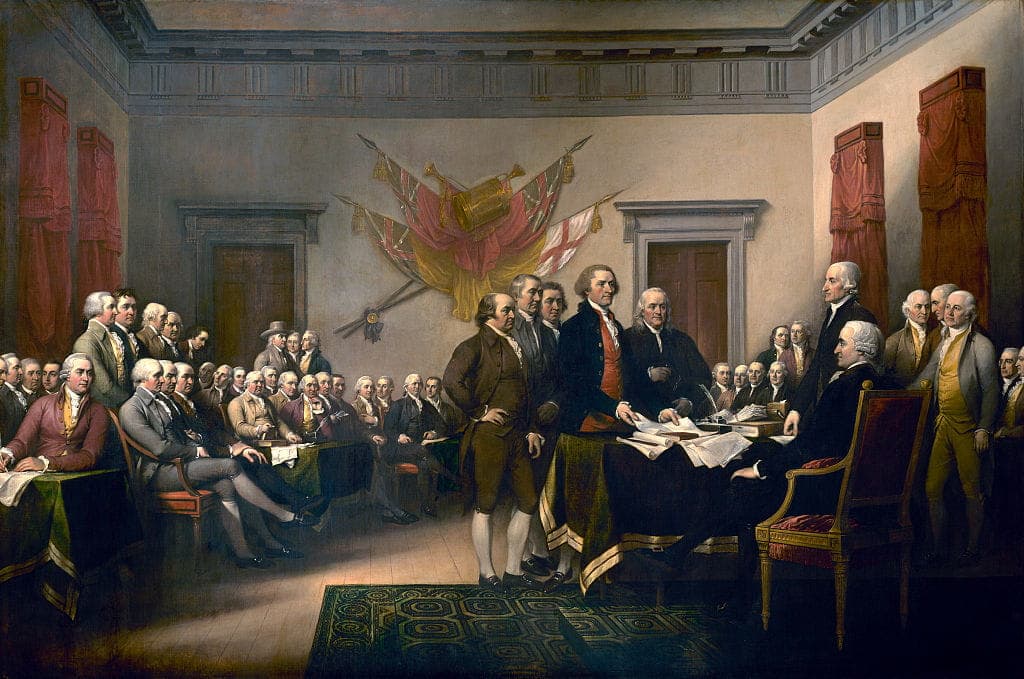
From writing the Declaration of Independence to guiding the Continental Army to victory, George Washington, Thomas Jefferson, and John Adams – three of America’s Founding Fathers – played critical roles in the fight for American independence.
On April 19, 1775, the first shots of the American Revolution rang out at Lexington and Concord, sparking a nearly eight-year war in which Americans fought for independence from Great Britain and its monarch, King George III. With help from Spain, the Netherlands, and France, America defeated the British, and the war officially ended on September 3, 1783, with the signing of the Treaty of Paris.
But winning independence was just the beginning. Once the war was over, what did the Founding Fathers do next?
George Washington: Leader of the Founding Fathers
After the war, George Washington helped create the US Constitution and became the first President of the United States – a position he reluctantly accepted. He served eight years in the powerful office before voluntarily stepping aside, setting a two-term precedent followed by nearly every president elected after him. In 1797, Washington retired to Mount Vernon, his estate in northern Virginia.
Washington spent his twilight years improving Mount Vernon until he became ill on December 12, 1799, after “riding his horse through rain and sleet,” according to the National Museum of the US Army. Washington’s health never recovered, and on December 14, 1799, he passed away at the age of 67.
During the first president’s funeral, Maj. Gen. Henry “Light Horse Harry” Lee reflected on Washington’s legacy, stating that he was “first in war, first in peace, and first in the hearts of his countrymen.”
John Adams
John Adams retired from public office after serving as the nation’s second president, returning to his family farm in Quincy, Massachusetts, with his wife, Abigail.

Adams spent much of his retirement writing, including an autobiography and hundreds of letters – many of which were sent to his long-time political rival, Thomas Jefferson. “Nothing seemed too trivial or too weighty for him to address, from the nature of his manure piles at the farm to history and political philosophy,” according to the University of Virginia’s (UVA) Miller Center.
Adams died on July 4, 1826, fifty years after delegates to the Second Continental Congress adopted the Declaration of Independence. Before passing away at the age of 91, Adams uttered his final words: “Thomas Jefferson survives.” In a tragic and poetic twist unknown to Adams, Jefferson had died that same morning.
Thomas Jefferson
Author of the Declaration of Independence and third president of the United States, Thomas Jefferson retired to his Virginia plantation, Monticello, after the inauguration of his successor, James Madison.
During his retirement, Jefferson’s focus shifted from politics to science, natural history, and philosophy. He served as the president of the American Philosophical Society until 1815 and “tackled Plato’s Republic in the original Greek as well as Greek versions of the Bible,” the Miller Center explained, adding that perhaps his biggest project after the war and presidency was UVA: “Jefferson designed all of its campus buildings, set up its curriculum, selected its faculty, and joyfully nurtured it into existence. He proudly thought his work on the university a fitting conclusion to his life of public service.”
Jefferson became ill in 1826, suffering from rheumatism and an enlarged prostate that made it difficult to move. On July 4 of that year, Jefferson’s doctor notified him that it was the fiftieth anniversary of the Declaration of Independence. Shortly thereafter, Jefferson slipped into a coma and later died.
While the Founding Fathers are best remembered for their role in securing the blessings of liberty for the American people, they continued to shape their legacies long after the Revolutionary War had ended.
4 Questions
The story, in brief
What did George Washington do after the Revolutionary War ended?
After the war, George Washington helped create the US Constitution and became the first President of the United States, a role he reluctantly accepted. He served for eight years and then voluntarily stepped aside, setting a two-term precedent that nearly every later president followed.
How did John Adams spend his years after serving as president?
John Adams retired from public office and returned with his wife, Abigail, to the family farm in Quincy, Massachusetts. He spent much of his retirement writing, including an autobiography and hundreds of letters, many of them exchanged with his long-time political rival, Thomas Jefferson.
What major work did Thomas Jefferson pursue after politics?
After the inauguration of James Madison, Thomas Jefferson retired to Monticello and turned his attention from politics to science, natural history, and philosophy. His biggest later project was the University of Virginia, where he designed the campus buildings, set the curriculum, selected faculty, and helped nurture the school into existence.
When did George Washington, John Adams, and Thomas Jefferson die?
George Washington died on December 14, 1799, after becoming ill in the final days of his life. John Adams and Thomas Jefferson both died on July 4, 1826, the fiftieth anniversary of the Declaration of Independence. Adams's final words were, “Thomas Jefferson survives,” though Jefferson had died earlier that same day.