
★ In this story 04
Is the US economy a tale of two cities? On the one hand, inflation is still a challenge for millions of Americans, forcing households to take on debt to keep their heads above water. On the other hand, the economy is still expanding while consumption continues to be strong. What is the deal with the world’s largest economy anyway? The only way to determine this is to look at the data.
US Economy Headlines
Since the technical recession in the first half of 2022 – defined as back-to-back quarters of negative growth – the US economy has been chugging along, even in an environment of high inflation and rising interest rates.
In the second quarter, the gross domestic product (GDP) growth rate – a measurement of the total value of all finished goods and services produced in the United States – was 2.1%. Early estimates suggest that the country could report an impressive 4.1% in the third quarter, although other models project as high as 5%.
Why is the US economy missing a recession and potentially on the brink of a so-called soft landing? The consumer is keeping things intact. While consumer spending slowed in the April-June period, consumption trends have been solid in the three months ending in September. Retail sales rose 0.6% in July, 0.8% in August, and 0.7% in September.
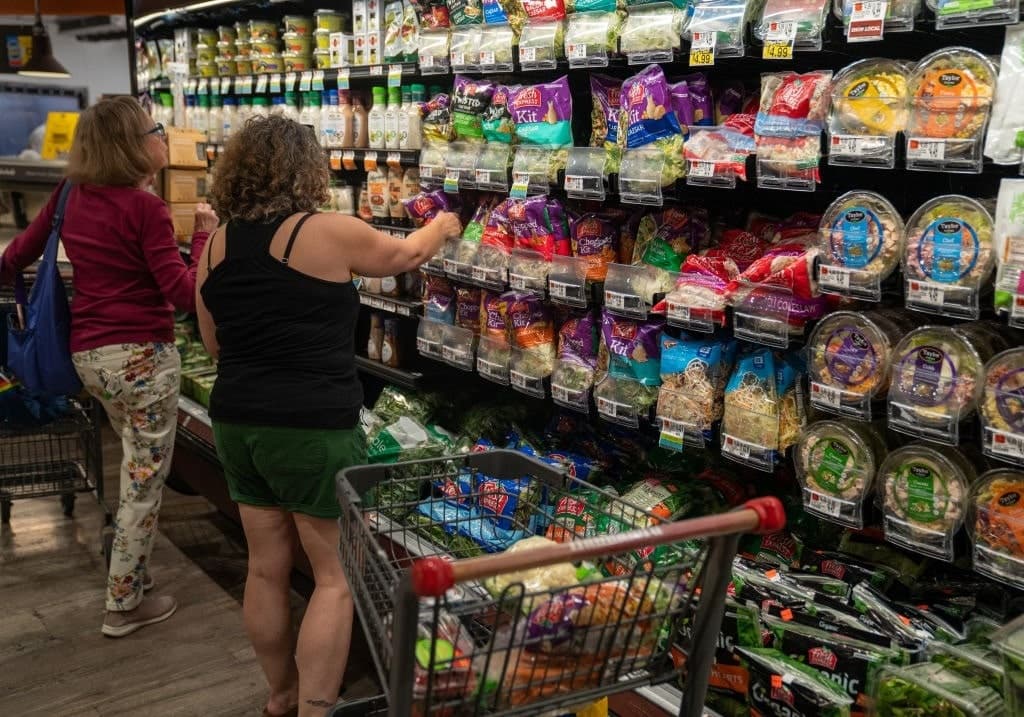
At the same time, some of the statistics show consumers are spending with credit. A recent Federal Reserve report showed that total credit card debt surpassed $1 trillion for the first time on record. Other surveys suggest that consumers depend more on debt to fund their food or clothing purchases.
Meanwhile, looking under the hood paints the picture of a more tepid US economy. As factory activity has contracted, the manufacturing sector has been stuck in a recession for all of 2023. Credit conditions have tightened, making borrowing money harder. Business and consumer sentiment has considerably weakened.
Of course, the big-ticket item in the US economy is inflation.
Inflation: A Never-Ending Story
Since July, inflation has reaccelerated, fueled by rising energy costs and growth in the money supply. In September, the consumer price index (CPI) remained steady at 3.7%, higher than economists’ expectations of 3.6%. The monthly CPI rose 0.4%. Core inflation, which omits the volatile energy and food components, eased to 4.1% from the same time a year ago and climbed 0.3% from August to September.
While this is an improvement after hitting a 9.1% peak in June 2022, it remains high above the trend of the last 25 years. Meanwhile, producer prices have skyrocketed since the summer. The annual producer price index (PPI) surged to 2.2% and rose 0.5% monthly in September. The PPI is viewed as a precursor to the CPI because it measures the cost that domestic producers receive for their goods and services.
The latest upward movement in prices has lifted inflation expectations. The University of Michigan’s one- and five-year consumer inflation expectations rose to 3.8% and 3%, respectively.
The US economy is grappling with higher energy prices. A barrel of oil is around $90, a gallon of gasoline is about $3.70, and natural gas prices are above $3. Additionally, utilities have become so costly for households that millions of Americans are behind on their energy bills.
Got Work?
Despite some softening this past summer, the US labor market continues to defy economists’ forecasts.
In September, the US economy created 336,000 new jobs, and the unemployment rate remained below 4% for the 20th consecutive month. However, some concerns are forming beneath the surface:
- Government jobs have accounted for approximately 22% of all employment growth this year.
- Part-time jobs have outpaced full-time work.
- The number of people working two or more jobs is about eight million.
- Real (inflation-adjusted) wage growth is still negative and has fallen 3% since 2021.
- The U-6 unemployment rate, which assesses people who want to work but have abandoned the job hunt and individuals working part-time because they cannot find full-time employment, was still 7%.
Ultimately, the headline numbers in the labor market are impressive. Unfortunately, for millions of Americans struggling in the present climate, the jobs arena is not as strong as the leading data indicate.
What About That Recession?

Since the Federal Reserve initiated its quantitative tightening campaign – a blend of raising interest rates and cutting its $8.9 trillion balance sheet – economists have been routinely forecasting a recession. These projections were amplified following the banking crisis earlier this year. However, the US has averted a downturn so far, much to the surprise of economic observers.
What are the latest recession odds? According to Bankrate’s latest quarterly survey of economists released in September, the recession probability is 46%, down from 59% in the second quarter.
“It is quite remarkable that we’ve gone close to two years now where we’ve been on high alert for a recession, and yet one has yet to materialize for the broader U.S. economy. Unfortunately, the odds of an economic contraction remain elevated,” said Mark Hamrick, the senior economic analyst at Bankrate.
As the saying goes, a recession is always six months away.
Try a quiz based on this article
What challenge faced by millions of Americans is causing increased personal debt?
Show the answer
Inflation.
Back-to-back quarters of negative growth in the US economy meant that the US was in a recession in the first half of 2022.
Show the answer
True.
What is the measurement of the total value of all finished goods and services produced in the US?
Show the answer
GDP.
___________ decides whether or not the economy remains in check.
Show the answer
Consumer spending.
Recent surveys suggest consumers are more dependent on _______ to purchase necessities.
Show the answer
Credit cards.
One contribution to inflation other than rising energy costs is ___________.
Show the answer
Increased amount of printed money.
A barrel of oil in October of 2023 is approximately $___.
Show the answer
90.
What type of job has accounted for about 22% of employment growth in 2023?
Show the answer
Government.
Approximately eight million people work at least two jobs.
Show the answer
True.
Economists have been predicting a recession all year; however, following the latest quarterly survey, the probability of one is down from 59% to ____.
Show the answer
46%.