

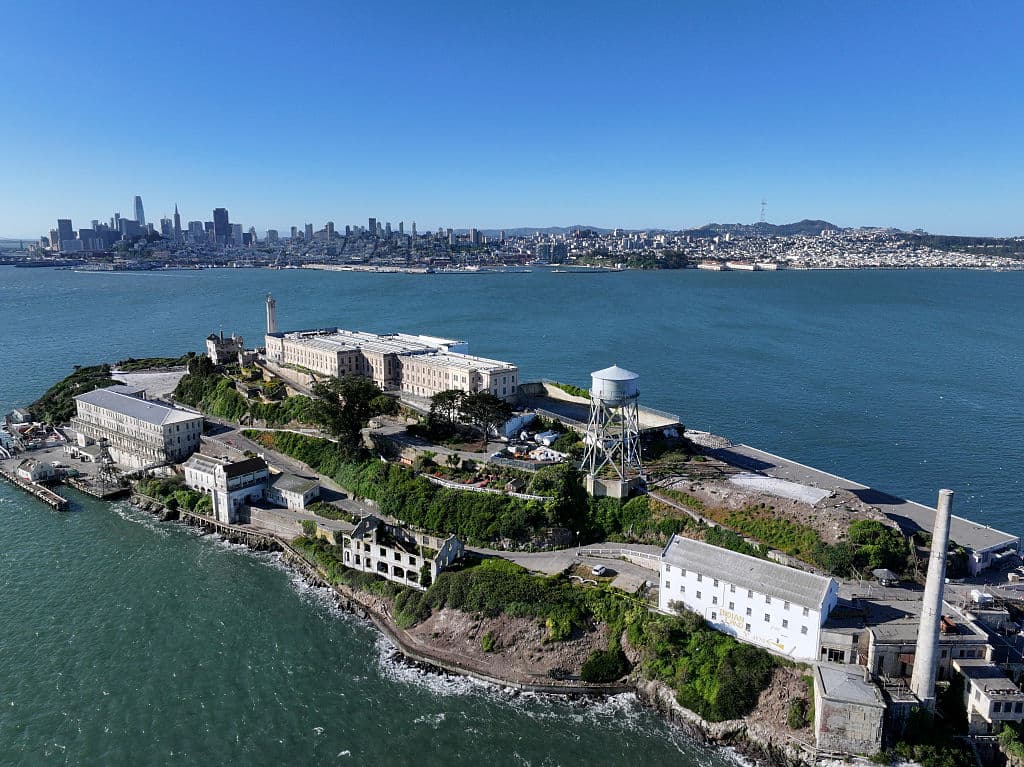
On Sunday (May 4), President Donald Trump took to social media and announced plans to reopen Alcatraz, the island prison in the San Francisco Bay that closed down in the 1960s. As expected, the internet was flooded with criticism and concern, but is he really considering turning the now-tourist attraction back into a prison?
Alcatraz — The Rock
Located 1.25 miles away from shore on a 22-acre rock, Alcatraz was built between 1910 and 1912, first as an Army military prison; later, in 1934, it became a maximum-security federal prison. It housed some of America’s most famous prisoners, including Al Capone, George “Machine Gun” Kelly, the infamous “Birdman of Alcatraz” Robert Stroud, and “Public Enemy No. 1” Alvin Karpis. Anyone who’s taken a tour will remember walking around with headsets or earbuds, listening to recorded tapes of the inmates in their dining room or conversations held in dreary cells. If you really want the experience, you could be locked in solitary confinement for a few minutes. It’s all an eerie but interesting experience.
The Rock, as it is appropriately called, was a very effective prison with 36 men in 14 known escape attempts. One of those endeavors remains a mystery today. On June 11, 1962, brothers John and Clarence Anglin and Frank Morris escaped, never to be seen or heard from again. The FBI decided the three drowned. But the questions still linger: Did they make it to shore to live undetected for the rest of their lives? Or did they drown, perhaps eaten by sharks? Their undertaking drew so much attention and speculation, it inspired the 1979 movie Escape From Alcatraz, starring Clint Eastwood. The prison itself was the subject of the 1996 movie The Rock with Sean Connery and Nicolas Cage.
However, as effective as it was keeping prisoners housed, running Alcatraz was very expensive. In 1959, daily operations cost $10.10 compared to $3.00 per prisoner at the penitentiary in Atlanta, Newsweek pointed out. The island prison was not self-sustaining; everything had to be shipped over from land. Food, fuel, and even water had to be transported by boat. Nearly 1 million gallons of water had to be delivered each week.
By the 1960s, $3 million-$5 million was needed in restoration and maintenance just so Alcatraz could remain operational. The cost was deemed too much, and The Rock closed on March 21, 1963. But that wasn’t the end of the story. In 1973, the National Parks and Services reopened the area as a tourist attraction, and it soon became one of the most popular sites to this day, drawing in about 1.6 million visitors a year, who happily pay between $45 and $100 for guided tours, generating about $60 million in annual revenue.
If Trump is serious about reopening Alcatraz as a federal prison, it will be extremely expensive. Perhaps a bigger obstacle to the project is the loss of $60 million a year for the parks and partners who run Alcatraz and the tourist money brought into California from those wanting to visit the infamous island prison.