
★ In this story 02
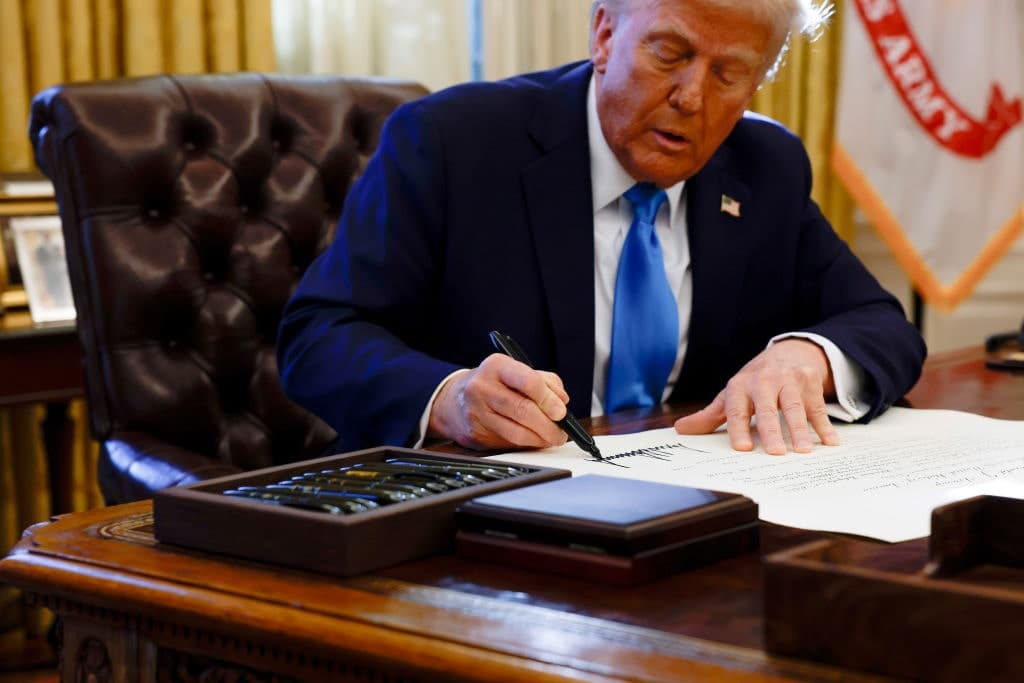
President Donald Trump, on February 1, announced tariffs on goods coming into the United States unless and until the president is satisfied that these other governments are doing their part to stop the flow of drugs and illegal immigrants over the US borders. He signed three executive orders that targeted Canada, Mexico, and China.
For the northern and southern neighbors, the orders put 25% on most imported products, and for China, it was just 10% – for now. Within one day, both Mexico and Canada had agreed to improve border security and make efforts to deal with the flow of drugs across the borders. Because of this, Trump pushed the start date of the tariffs back one month.
What Is a Tariff
A tariff is like a tax. In this case, it is applied to a product that comes from outside the United States and is directly paid by the business that is exporting its product to the country. The money is collected by the US government.
There are several reasons why any president might want to apply such tariffs.
First, tariffs could help American businesses by making them more competitive in terms of price. Imagine for example a Mexican company that sells bicycles. Because the cost of labor and parts are likely cheaper in Mexico, it can sell the bike for less than a US company might be able to afford. A tariff of 25% on the Mexican bikes means that the US company has a better chance of making a sale. But isn’t this a bad deal for the customer?
Not necessarily.
Some foreign companies might choose to add the tariff price on to the cost of the product, meaning that Americans can’t get the cheaper bikes. But then, if the bikes cost roughly the same, the customer will make the choice based on quality rather than price. If the American company sells more of its product, this can lead to a reduction in the cost of making it in the first place.
Other foreign companies might choose to pay the tariff out of their own profits to make sure they keep as many customers as possible. However, the tariffs that Donald Trump put in place were not designed to create a more competitive marketplace.
Leverage
Every year, millions of people illegally cross US borders. Some of these people are criminals, like human traffickers, gang members, or drug smugglers. Because of the huge amount, the US Customs and Border Protection (CBP) can’t stop everyone. Many get away undetected. In the past, neither Mexico nor Canada has shown interest in stopping illegal crossings into the US.
As soon as the president said that he would be adding tariffs, both countries offered to do what Trump had been asking. Mexico agreed to send 10,000 of its own military to be permanently stationed at the border and Canada agreed to spend over one billion dollars to stop the flow of drugs.
Something similar happened last week when the Colombian government refused to take back its own citizens who were being deported from the US. Initially, President Gustavo Petro said that he would not accept them. Then Trump said he would impose major tariffs. Shortly after, Petro sent a presidential plane to collect the deportees.
Because the US is the largest economy in the world, any threat of tariffs will do more harm to the other country. It seems that President Trump does not necessarily want to use tariffs to make more cash for the government, but rather to encourage other countries to stop allowing illegal activity that harms Americans.
Test Your Knowledge – Take the Quiz
Try a quiz based on this article
On February 1, President Trump signed three executive orders regarding tariffs on imported goods from Canada, Mexico, and:
Show the answer
China.
Trump plans to execute these tariffs unless and until his demands for protecting American borders are met.
Show the answer
True.
The tariffs for Mexico and Canada are:
Show the answer
25%.
A tariff is a type of ____ applied to products that are imported to the US from overseas.
Show the answer
Tax.
Tariffs can help American companies by making the price of imported goods more comparable to that of American-made products.
Show the answer
True.
When choosing to apply tariffs on imported goods, President Trump’s primary concern was creating:
Show the answer
Safe and secure borders.
In immediate response to the added tariffs, Mexico agreed to send ______Mexican troops to help secure the southern border.
Show the answer
10,000.
What South American country first refused to accept its citizens back who had illegally entered the US?
Show the answer
Colombia.