
★ In this story 02
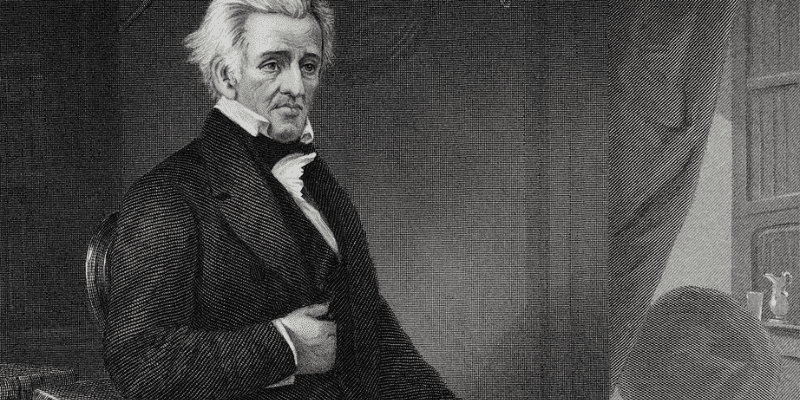
Andrew Jackson (1767-1845) was the seventh president of the United States. He was born on March 15, 1767, in the Waxhaws region on the border of North and South Carolina. No one knows the exact location of his birth, so both states have claimed him as one of their own. Jackson, however, saw South Carolina as his home.
As a teen, Jackson read law and achieved the bar in 1787, later moving to what would become Tennessee to work as a prosecuting attorney. He married Rachel (Donelson) Robards, the daughter of a local colonel, and built a mansion. His wealth had grown enough to allow him to buy slaves.

Jackson was elected to the U.S. House of Representatives in 1796, and then the U.S. Senate the following year. After he resigned a year later, he was elected judge of Tennessee’s superior court. Later, he became the head of the state militia.
Andrew Jackson the Soldier
During the war of 1812, Jackson commanded forces in a five-month campaign against the Creek Indians, who were allies of the British. After winning that war, he led another victory over the British in the Battle of New Orleans in January 1815, giving him the status of a national hero.
The Jackson Presidency
In 1824, Jackson ran for president and although he won the popular vote, for the first time in history no candidate had received a majority of electoral votes. The House of Representatives had to make the decision between the three leading candidates: Jackson, John Quincy Adams, and Secretary of the Treasury William H. Crawford. Speaker of the House Henry Clay supported Adams, who later made Clay his secretary of state. This caused a huge uproar among Jackson’s supporters about a “corrupt bargain” between Adams and Clay. As a result, Jackson resigned from the Senate.
Four years later, Jackson won the presidency and his wife died shortly after that. Jackson and his supporters formed the Democrat Party (formerly part of the Democrat-Republicans), while those against the new president were known as the Whig Party. He was a strong leader and not afraid to use his presidential veto power whenever it suited him, which earned Jackson the new nickname, “King Andrew I.” Jackson also opposed any laws that would outlaw slavery.
Jackson died at his home from heart failure on June 8, 1845, at the age of 78.
Test Your Knowledge – Take the Quiz
Try a quiz based on this article
Andrew Jackson was the _______ president of the United States.
Show the answer
Seventh.
Jackson was born in 1767 on the border of what two states?
Show the answer
North and South Carolina.
At age 20, Jackson passed the bar and became a:
Show the answer
Prosecuting attorney.
In 1796, Jackson was elected to the US House of Representatives.
Show the answer
True.
Jackson commanded forces in a five-month campaign against the Creek Indians during what war?
Show the answer
The War of 1812.
Jackson ran for president in 1824 against John Quincy Adams and:
Show the answer
William H. Crawford.
Four years later, in 1828, Jackson won the presidency and formed the:
Show the answer
Democratic Party.
Those against Jackson were part of the Whig Party.
Show the answer
True.
Because he was a strong leader and often used his power to veto legislation, Jackson earned the nickname:
Show the answer
King Andrew I.
Andrew Jackson died on June 8, 1845, from:
Show the answer
Heart failure.