
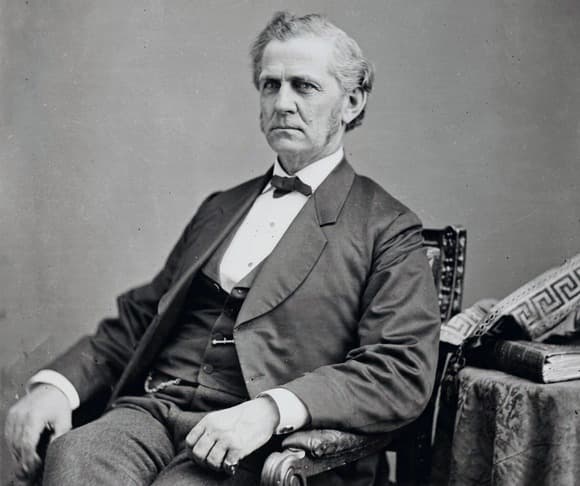
In 1829, he was elected alderman in Greeneville, Tennessee. Andrew Jackson was elected president that same year, a man who Johnson shared many ideals with, such as defending the common man.
For the next several years, Johnson continued his political career. He became mayor of Greeneville in 1834, was later elected to the Tennessee state legislature, and then the U.S. House of Representatives in 1843.
As the issue of slavery became more heated, Johnson, a slave owner himself, believed individuals had a right to own slaves. However, he was also adamantly for preserving the Union and as some Southern states started advocating for secession, he tried to discourage them.
Abraham Lincoln was elected president in November 1860. Shortly after that, South Carolina – followed by other Southern states – seceded from the Union. April 12, 1860, the Civil War broke out and Johnson’s home state of Tennessee voted to secede as well. He was the only senator from the South to remain loyal to the Union even after secession. As a result, he resigned from the Senate in 1862 after Lincoln appointed him as the military governor for Tennessee.
When Lincoln ran for re-election in 1864, Johnson was his running mate for vice president. The pair were sworn into office on March 4, 1865. The Civil War ended just a month later, on April 9, 1865, when General Robert E. Lee of the Confederate Army surrendered to Union General Ulysses S. Grant. Just five days later, on April 14, Lincoln was assassinated by Confederate sympathizer John Wilkes Booth. The assassin’s plan targeted Johnson and Secretary of State William Seward too; Seward was injured, but lucky for him, Johnson’s attacker backed out.
Johnson’s support of slavery and the Southern states led to his impeachment. His approach to the Reconstruction favored the South, granting amnesty for former Confederates and allowing the states to elect new governments did not go over well with the North. In 1866, he vetoed the Freedmen’s Bureau Bill and the Civil Rights legislation, which were proposed to protect blacks. Later that year, the 14th Amendment was passed that granted citizenship to blacks, but Johnson encouraged the Southern states not to ratify it. This, and more, led to the House of Representatives vote to impeach him in February 1868. Eleven charges had been brought against him but the Senate acquitted Johnson of all the charges just by one single vote.
Although he didn’t run for re-election, Johnson still kept busy in politics. In 1875, he won an election to the senate – the only ex-president to ever do so. However, just two years later, on July 31, 1875, the former president suffered a stroke while visiting family and passed away. He was buried in Greenville with the American flag and a copy of the Constitution.
Try a quiz based on this article
Andrew Johnson was America’s 17th president and the first ever to be:
Show the answer
Impeached.
With what former president did Andrew Johnson share many ideals?
Show the answer
Andrew Jackson.
In what year was Johnson elected to the US House of Representatives?
Show the answer
1843.
While Johnson was a slave owner, he tried to discourage states interested in seceding from the Union.
Show the answer
True.
Johnson was the running mate and the vice president to:
Show the answer
Abraham Lincoln.
The Civil War began on April 12, 1860, and ended on:
Show the answer
April 9, 1865.
What led to Johnson’s impeachment?
Show the answer
His support for slavery.
In 1866, Johnson vetoed the Freedman’s Bureau Bill and other civil rights legislation.
Show the answer
True.
The 14th Amendment grants citizenship and protects the rights of:
Show the answer
All people born or naturalized in the United States.
When Andrew Johnson died, he was buried with an American flag and:
Show the answer
A copy of the US Constitution.