
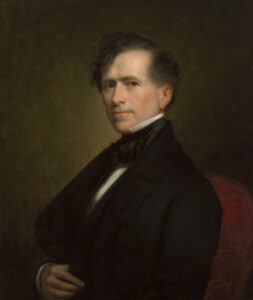
Franklin Pierce (1804-1869) was born in Hillsborough, New Hampshire, on November 23, 1804. He was elected to the New Hampshire state legislature at the young age of 24, and then at 26, he became the body’s speaker.
Pierce was a strong member of the Democratic Party and an avid supporter of President Andrew Jackson. In 1833, Pierce started his terms in Congress, serving twice in the House of Representatives. He also served one term, from 1837 to 1842, in the Senate. In 1834, he married Jane Appleton, whose father had been the president of Bowdoin University, where Pierce had studied.
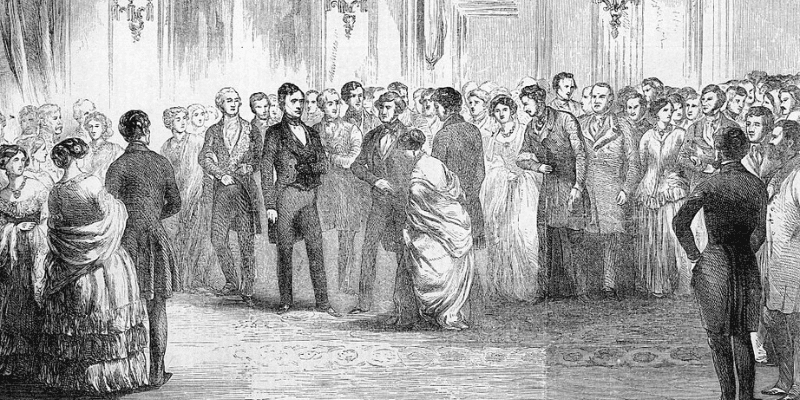
Pierce took office in 1853. During his inaugural address, Pierce said, “I fervently hope that the [slavery] issue is at rest,” and then went on to explain his desire to expand the nation’s border. This idea did not go over well, since many in the North feared this would just open up the doors to more slavery territory. Far from being resolved, the issue of slavery became one of the president’s greatest downfalls.
The Kansas-Nebraska Act, proposed in 1854 by Senator Stephen Douglas, made Kansas and Nebraska territories and repealed the ban on slavery in the former. The legislation made it so that citizens of the territory, and not Congress, could choose whether to allow slavery. Pierce’s support for slavery led to the establishment of a new opposition group, the Republican Party, made up of Free Soilers, former Whigs, and even some anti-slavery Democrats.
Fighting between pro- and anti-slavery citizens began breaking out across the territory. The conflict became so volatile that it reached even into Washington, when Preston Brooks, a South Carolina representative, assaulted abolitionist Senator Charles Sumner on the Senate floor in May 1856. “Bleeding Kansas,” as the clash became known, was the downfall of Pierce’s presidency and prevented him from winning the Democratic nomination for the next election.

Civil War broke out in 1861, and, since Pierce supported the southerners so-called right to own slaves, he said Abraham Lincoln and the Republicans had been reckless. He condemned Lincoln’s Emancipation Act of 1863, and, during a Democratic rally on July 4, he said the war was “fearful, fruitless, [and] fatal.” After news of the Union victory at Gettysburg, Pierce retreated from the spotlight. Jane died that same year, and the former president passed on in 1869.
Test Your Knowledge – Take the Quiz
Try a quiz based on this article
Former US President Franklin Pierce was a strong Democrat and an avid supporter of:
Show the answer
President Andrew Jackson.
Pierce was born in 1804 in what US state?
Show the answer
New Hampshire.
Jane Appleton, the woman Pierce married, was the daughter of the president of which university?
Show the answer
Bowdoin College.
In what year was Pierce inaugurated as the country’s 14th president?
Show the answer
1853.
The handling of the issue of ______ was one of Pierce’s greatest downfalls.
Show the answer
Slavery.
In 1854, which senator proposed the Kansas-Nebraska Act?
Show the answer
Stephen Douglas.
As the fighting continued over ending slavery, an assault took place on the Senate floor when a South Carolina representative attacked an abolitionist. This confrontation, among others, became known as:
Show the answer
“Bleeding Kansas”.
In response to the turmoil surrounding slavery, a new opposition group was formed known as the:
Show the answer
Republican Party.
Eventually, in 1861, a war broke out between the North and South that was called:
Show the answer
The Civil War.
After the Union victory at Gettysburg, Pierce retreated from the spotlight and eventually passed away in:
Show the answer
1869.