
★ In this story 02
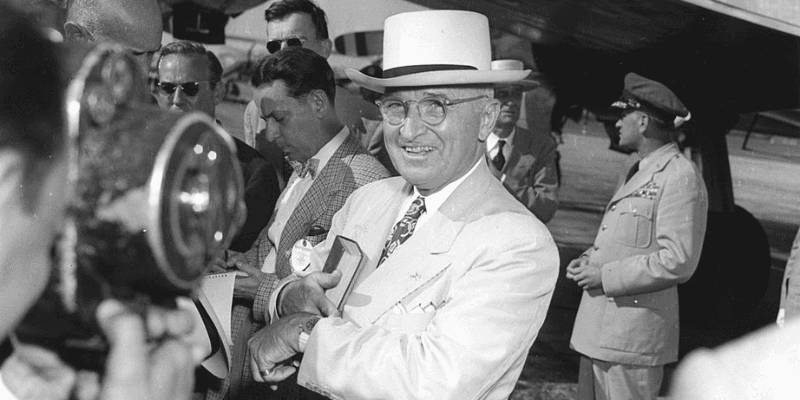
Harry S. Truman was the 33rd president of the United States. Working to put himself through college, he became the commander in chief during a difficult time in our nation’s history. Truman had been vice president to Franklin Roosevelt only 82 days when Roosevelt died and he took over, inheriting World War II and all that came with it.
Early Years
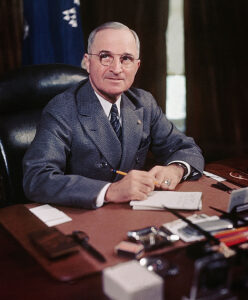
Truman was born on May 8, 1884, in Lamar, Missouri. His parents could not afford to pay for him to go to college, so he worked as a bank clerk and did other odd jobs. In 1906, he began working on the family’s 600-acre farm, where he stayed for more than ten years. During this time, he also served in the Missouri National Guard.
When World War I began in 1917, Truman re-enlisted in the National Guard and was sent to France. In 1922, Truman was elected district judge in Jackson County, Missouri, and in 1926, he won the election as the county’s presiding judge. Remaining in the political field, he was then elected to the Senate in 1934, where he supported President Franklin Roosevelt’s New Deal programs that were geared towards helping the nation get through the Great Depression.
Between 1941 and 1944, Truman headed a special committee to investigate the National Defense Program. Known as the Truman Committee, it ended up saving taxpayers millions of dollars and turned the national spotlight his way. In 1944, Roosevelt ran for a fourth term. Instead of choosing his vice president, Henry Wallace, he chose Truman to run on his ticket. Roosevelt and Truman were sworn into office on January 20, 1945, and less than three months later, the president died.
The Truman Administration
Truman assumed the office during a turbulent time. He had only met with Roosevelt a few times before the former president died, so he had never been informed about the construction of the atomic bomb. During his first few months, the war in Europe ended after Nazi Germany surrendered, and the new president worked to find solutions to the postwar treatment of Germany and Great Britain. He worked with Winston Churchill and Joseph Stalin. Worried about an invasion of Japan and eager to end the war in the Pacific, Truman approved the dropping of atomic bombs on Japan in Hiroshima (August 6) and Nagasaki (August 9).
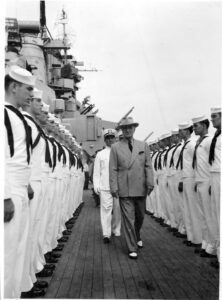
The beginning of the Cold War started in 1946. In 1947, the president introduced the Truman Doctrine to give financial help to Greece and Turkey. The president was determined to keep communism from taking hold in the United States and Europe. He believed that poorer nations were more susceptible to communism. To prevent the spread, he started the Marshall Plan, which sent billions of dollars in aid to European nations to help stimulate their economies.
Truman was sworn in for his second term in January 1949. His inauguration was the first to be nationally televised. Truman set into motion the Fair Deal, an ambitious social reform that included federal housing programs, higher minimum wages, national medical insurance, increases in Social Security, and civil rights reforms. Conservatives blocked much of his proposals, but the Housing Act of 1949, the initiative to end segregation in the military, and the proposal to prohibit discrimination in federal jobs were passed.
In 1949, Truman supported the creation of the North Atlantic Treaty Organization (NATO), appointing Dwight D. Eisenhower, who would become the next president, as its first commander. When North Korea invaded South Korea in June 1950, Truman sent troops, including planes and ships, to aid the South Koreans, helping them to keep their independence.
Truman did not run for another term, although he was eligible. Instead, he and his wife, Bess Truman, went home, where he wrote memoirs and raised funds for the Harry S. Truman Presidential Library, which opened in 1957. At the age of 88, Truman died after suffering from lung congestion, kidney blockages, digestive system failure, and heart irregularity on December 26, 1972. He was buried in the courtyard of the Truman Library.