
★ In this story 03
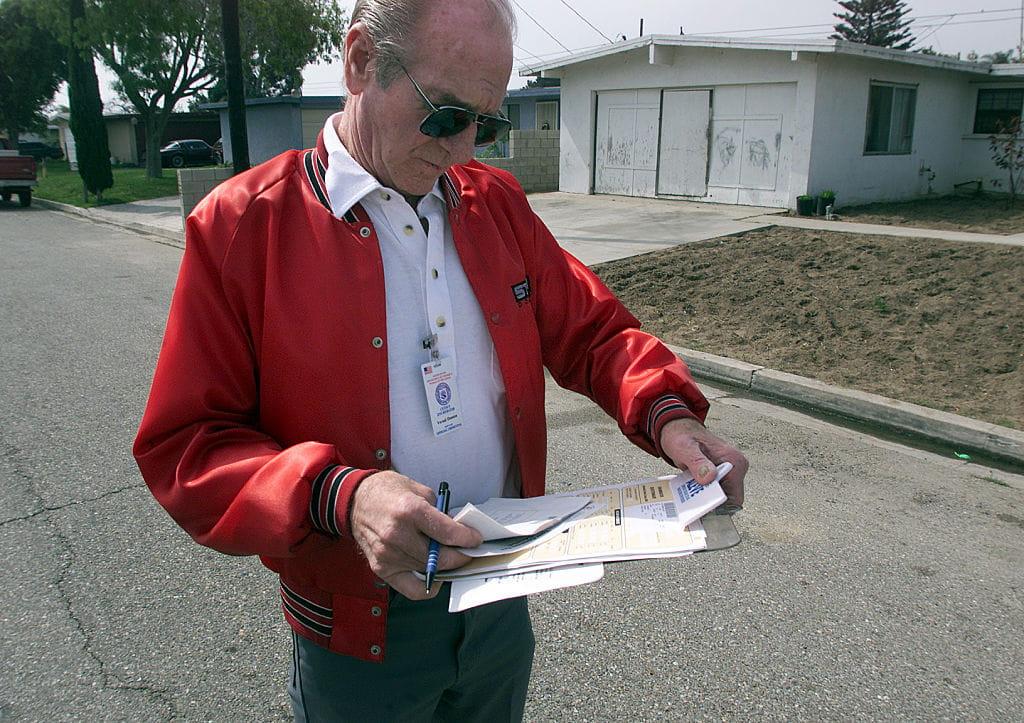
If you saw this man going door to door with a clipboard, would you know what’s going on? Is he selling candy bars? Promoting a political candidate or maybe even collecting signatures for a ballot issue? Sure, any of those things could be what’s going on. But in this case, the man is checking the neighborhood to help complete the US Census.
The US Census is a nationwide headcount that happens every ten years. While it may sound simple, the US Census is an enormous task, but it is necessary. Article I, Section 2 of the US Constitution requires a census every ten years. This is because the number of representatives sent to the House is based on population; the more people, the more representatives for the state they live in. Section 2 of the 14th Amendment later changed the rules for apportioning representatives among the states, making it so that everyone is counted as a whole person, rather than slaves being only counted as three-fifths of a person.
Typical census questions include how many people live in a household and each resident’s age, sex, race, and ethnicity. They also ask whether the home is rented or owned. The idea is to obtain the needed information from residents without intruding into their personal lives any more than necessary.
Why Does the Census Matter?
Dealing with the Census may seem like a chore – but it is necessary. If you aren’t counted, you might not get represented in Congress. The results are used to apportion seats in the US House of Representatives. Every state gets at least one seat, but the greater the state’s population, the more representation it will have in the House. The whole idea is that every state and the people who reside there are fairly represented in the federal government.
But another reason it’s so important is money. Census Bureau data help decide federal funding for states, communities, tribal governments, and other recipients. A Census Bureau report estimated that more than $2.8 trillion in federal funds was distributed in fiscal year 2021 using data from the 2020 Census and other related programs, including the American Community Survey and population estimates. The money is used to repair and build roads, support schools and hospitals, and fund resources such as libraries, emergency services, and community programs. An accurate census count is important for a community to receive the money it needs to function.
You may be wondering who gets counted. The census aims to count everyone living in the United States once, generally where they live and sleep most of the time. Residents are counted regardless of age, citizenship, immigration status, race, or income.
How in the World Do They Count Everybody?
Back in the day, counting the population meant visiting households and recording information by hand. For the first US Census in 1790, US marshals and their assistants were responsible for the count. The law required every household to be visited, workers recorded the information on paper schedules, and each district’s totals were sent to the president.
As time passed, methods became more sophisticated and expanded the ways households could respond. During the 2020 Census, people could complete their questionnaire online, by mail, or by phone. Offering different ways to respond helps the Census Bureau reach more people, although obtaining a complete and accurate count remains a challenge.
Census workers, like the man in the photo, still make home visits. Those who have not yet filled out the questionnaire are the ones primarily visited by door-to-door workers, though they may follow up with households that already responded to check the accuracy of the information they provided.
Finding and counting everyone can be difficult when people have complicated living arrangements or are easy to miss. These groups include college students living away from home, children under five, people who move frequently, those in rural areas, and the homeless population.
Each Census provides a snapshot of America at a specific moment in time. Historians and researchers use these statistics to study population changes and how communities have changed. Genealogists also use older records to learn about their ancestors, though public access is restricted for 72 years after a Census.
Not Old Enough to Vote?
You may think that because you’re not old enough to vote, the Census doesn’t affect you. But children and teenagers count, too. Census data help determine funding and planning decisions that affect schools, playgrounds, transportation systems, and community services. An accurate count helps decision-makers understand the people who use those resources.
Remember: The Census is so much more than just a survey. It helps to ensure representation, guides funding decisions, and creates a historical record for future American generations.
4 Questions
The story, in brief
What is the US Census and why does the Constitution require it?
The US Census is a nationwide headcount that happens every ten years. Article I, Section 2 of the US Constitution requires it because seats in the House of Representatives are based on population, so counting people helps determine how many representatives each state gets.
What questions does the US Census ask households?
Typical census questions ask how many people live in a household and each resident's age, sex, race, and ethnicity. The census also asks whether the home is rented or owned, with the goal of collecting needed information without intruding into personal lives more than necessary.
Why does the US Census matter for representation and federal funding?
Census results are used to apportion seats in the US House of Representatives, which affects how states are represented in the federal government. Census Bureau data also help decide federal funding for states, communities, tribal governments, and other recipients, including money for roads, schools, hospitals, libraries, emergency services, and community programs.
How does the Census Bureau count people who do not respond?
During the 2020 Census, people could respond online, by mail, or by phone, but census workers still made home visits. Door-to-door workers mainly visited households that had not filled out the questionnaire, and they could also follow up with households that had already responded to check the accuracy of the information.

Kirsten Brooker
Culture Correspondent for Liberty Nation and Generation Liberty. Kirsten loves to write about culture from the point of view of an everyday American who lives deep in the heart of the Midwest. She is the mother of two adorable girls, likes classic rock, and humbly wears the crown of a former Homecoming Queen with grace and style.