
★ In this story 03
Exactly 406 years ago, on Nov. 11, 1620, the Pilgrims arrived in New England on the famous ship known as the Mayflower after a more than 60-day voyage across the Atlantic Ocean. Their journey embodied the spirit of exploration, resilience, and self-reliance that would become defining characteristics of American culture. That same spirit was alive and well more than 240 years after the Pilgrims landed in the New World when Congress passed the Homestead Act: legislation that incentivized Americans to settle the western United States.
The Homestead Act
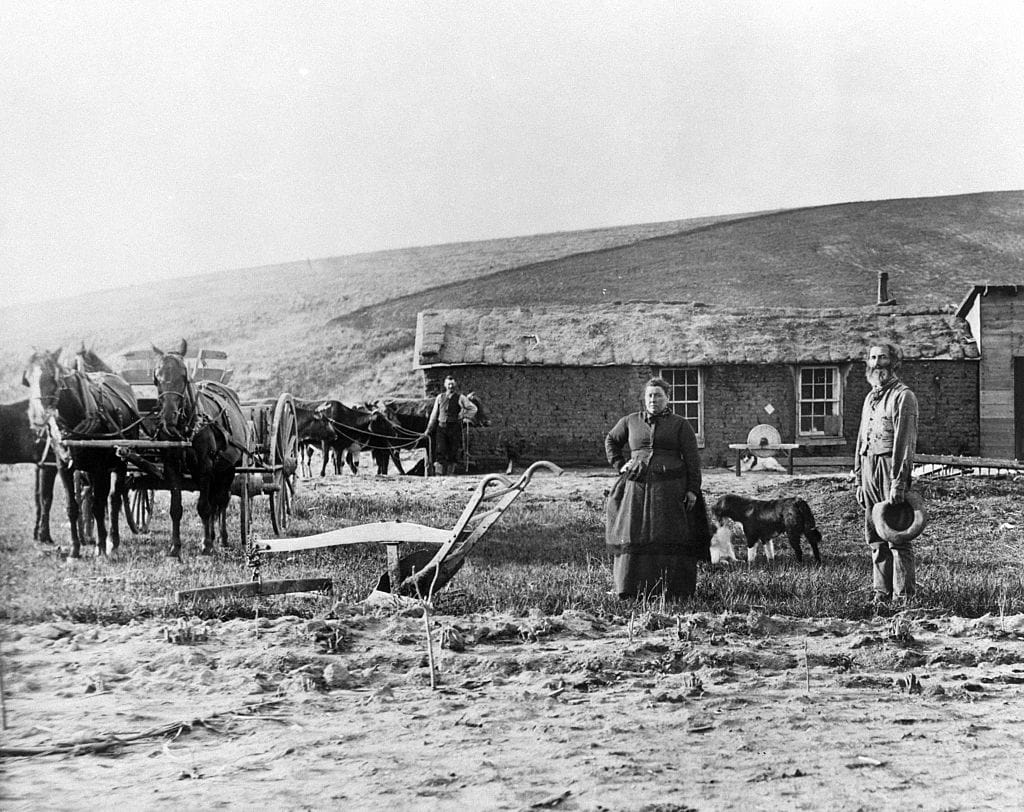
The Homestead Act, signed into law by President Abraham Lincoln on May 20, 1862, granted 160 acres of surveyed public land to adult heads of families who agreed to pay a small filing fee and live on the land for at least five years.
Because the act was passed in the midst of the Civil War, only those who had never fought against the US government were allowed to receive the land. Homesteaders were also required to make improvements to the land, such as growing crops or building a home.
After five years, the land officially belonged to them — although settlers could also buy the land for $1.25 per acre after making improvements over the course of just six months. After the Civil War, Union soldiers could count the time they spent serving in the military toward the years they were required to live on the land.
Who Got the Land?
The Homestead Act was part of the 1860 Republican Party platform. According to the National Archives: “Most of the land went to speculators, cattle owners, miners, loggers, and railroads. Of some 500 million acres dispersed by the General Land Office between 1862 and 1904, only 80 million acres went to homesteaders.”
Unfortunately, many poor laborers and farmers could not take advantage of the legislation because of the cost of building a homestead. “Indeed, small farmers acquired more land under the Homestead Act in the 20th century than in the 19th,” the Archives noted.
Most people who claimed land under the Homestead Act didn’t travel very far. Instead, they moved from nearby states, like Iowa to Nebraska or Minnesota to South Dakota.
Presidents on the Homestead Act
During a speech in Cincinnati, OH, Abraham Lincoln praised the Homestead Act, which he called the “Homestead Law,” as a way for average Americans to improve their lives: “I think it worthy of consideration, and that the wild lands of the country should be distributed so that every man should have the means and opportunity of benefitting his condition.”
Shortly after taking office in the wake of Lincoln’s assassination, President Andrew Johnson echoed his predecessor’s opinion of the Homestead Act, arguing “experience proves its wisdom.” He continued: “The lands in the hands of industrious settlers, whose labor creates wealth and contributes to the public resources, are worth more to the United States than if they had been reserved as a solitude for future purchasers.”
In 1987, President Ronald Reagan said, “[O]ne of the mainsprings of our own liberty has been the widespread ownership of property.” He added, “Thomas Jefferson dreamed of a land of small farmers, of shop owners, and merchants. Abraham Lincoln signed into law the Homestead Act that ensured that the great western prairies of America would be the realm of independent, property-owning citizens — a mightier guarantee of freedom is difficult to imagine.”
American presidents have long understood that the United States is a nation of settlers: men and women who were willing to brave the unknown for a better life. Few pieces of legislation have embodied that spirit better than the Homestead Act.
4 Questions
The story, in brief
What did the Homestead Act of 1862 give settlers?
The Homestead Act granted 160 acres of surveyed public land to adult heads of families. To receive it, they had to pay a small filing fee, live on the land for at least five years, and make improvements such as growing crops or building a home.
Who was allowed to claim land under the Homestead Act?
Because the law was passed during the Civil War, only people who had never fought against the United States government could receive the land. After the Civil War, Union soldiers could count their military service toward the years they were required to live on the land.
Why did many Americans not benefit from the Homestead Act?
Many poor laborers and farmers could not take advantage of the law because building a homestead cost too much. The National Archives also says most of the land went to speculators, cattle owners, miners, loggers, and railroads, and only 80 million of about 500 million acres dispersed went to homesteaders.
How did presidents describe the Homestead Act's purpose and impact?
Abraham Lincoln praised the law as a way for average Americans to improve their condition by giving them access to land. Andrew Johnson said experience proved its wisdom, and Ronald Reagan later said widespread property ownership and the Homestead Act helped make the western prairies the realm of independent, property-owning citizens.