
★ In this story 02
The Artemis I launch was successful. And though no humans were on this flight, the countdown to the day people are at home on the moon has begun. We may not have to wait very long, either. “Certainly this decade, we’re going to have people living [on the moon],” Howard Hu, the program manager for the Orion spacecraft on the Artemis I flight, told the BBC. However, “it’s more than living,” he added. “It’s really about science.”
The First Step
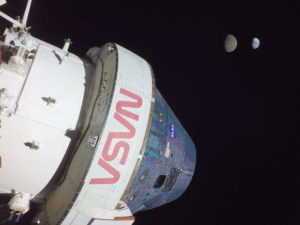
We still have some first steps before the dream of a human home on the moon can come true, however. Enter the Artemis I and II missions. Phase I of the program, the unmanned flight, launched at 1:47 a.m. Eastern Standard Time (EST) on November 16. About nine hours later, Artemis sent back a photo of Earth from space and an image of the spacecraft’s interior. The capsule was more than 57,000 miles away from Earth at the time – about one-fifth of the way to the moon. Monday, November 28, was Flight Day 13, and Orion, the spacecraft used in the Artemis I mission, was as far from Earth as it will get before its return. At that point, it was 268,563 miles from Earth. At the Tuesday midday update, it was 265,769 miles from the planet, 44,949 miles away from the moon, and was traveling at 1,753 miles per hour (mph). A photo sent Tuesday shows the view from the capsule looking home.
The plan is for Artemis II to launch in 2024, carrying humans farther into space than ever before. The four-person crew will fly Orion almost 4,600 miles beyond the dark side of the moon. That mission is expected to last between eight and ten days and is – just like the current unmanned flight – primarily about gathering information and figuring out the safest and most efficient way to put people on the moon.
Home on the Moon
The Artemis III mission will land people on the moon for the first time in decades, and those astronauts will land at the lunar South Pole, where no humans have ever been before. Aside from simply being a historical place to land, the South Pole is an ideal place to build Artemis Base Camp, where people will live on the moon long term. In the beginning, that camp will be very basic – for a space colony, anyway. According to NASA, the human landing system will double as lunar lodging on the first few missions. In the future, though, NASA plans to build a fixed habitat that can house up to four astronauts for a month-long stay.
“On each new trip, astronauts are going to have an increasing level of comfort with the capabilities to explore and study more of the Moon than ever before,” explains Kathy Lueders, associate administrator for human spaceflight at NASA Headquarters in Washington.
An April 2020 report on the Artemis Base Camp concept gives some examples of what a long-term habitat might include. A lunar terrain vehicle, or LTV, would transport crew around the landing zone, and a habitable mobility platform – a sort of moon motorhome – would enable astronauts to take trips across the surface that last up to 45 days. In addition to the surface station, there will also be a lunar outpost, called the Gateway, that orbits the moon. It will serve as a command and control module for surface expeditions and an office and home for astronauts when they’re away from Earth. Eventually, NASA and its international partners plan to add to the Gateway a large-volume deep space habitation element that would let astronauts test capabilities for longer missions farther away from home.
The purpose of America’s last trips to the moon – the Apollo missions – was to land people on the lunar surface. The Artemis missions will do this, too, but that’s just a step along the way. The true goal of this more modern endeavor is to launch humanity farther into space – to Mars in the short term, and even farther as time goes on.
Try a quiz based on this article
There were humans on the Artemis I flight that launched on November 16, 2022.
Show the answer
False.
It is believed that there will be humans living on the moon within the next ten years.
Show the answer
True.
After nine hours, the spacecraft was approximately 57,000 miles away from Earth, about ___ of the way to the moon.
Show the answer
1/5.
The capsule was traveling at ______ miles per hour.
Show the answer
1,753.
Artemis II is scheduled to launch in 2025.
Show the answer
False.
The Artemis III mission will land people on the moon’s ________, where no humans have been before.
Show the answer
South Pole.
The Artemis Base Camp will be very basic in the beginning.
Show the answer
True.
For the first few missions, the spacecraft’s landing system will also be the astronauts’ _________.
Show the answer
Living quarters.
What is an LTV?
Show the answer
A lunar terrain vehicle – means of transportation around the moon.
The Gateway is a lunar outpost that serves as a control center, office, and home for the astronauts.
Show the answer
True.