
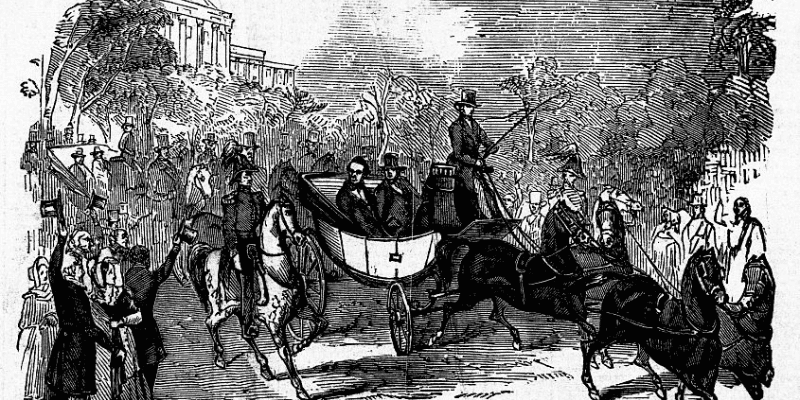
James Knox Polk was born on November 2, 1795 in a log cabin in Mecklenburg, North Carolina. As a young boy, he moved with his family to Columbia, Tennessee. In 1818, Polk graduated from the University of North Carolina. He was admitted to the bar in 1820 and opened his own law practice. In 1823, he was elected to the Tennessee House of Representatives.
Polk married Sarah Childress in 1824. She played an important role in her husband’s career when he became president, acting as a close advisor. As first lady, she was a popular hostess even though she banned hard liquor from the White House and wasn’t in favor of dancing, horse races, or the theater.
In 1825, Polk was elected to the U.S. House of Representatives and served as speaker of the House from 1835 to 1839. His politics followed closely to that of former president Andrew Jackson, a fellow Democrat from Tennessee. Polk believed in state’s rights and dismantling the Bank of the United States and replacing it with a decentralized government banking system. Jackson’s nickname was “Old Hickory,” a reference to his toughness, and Polk earned the nickname “Young Hickory” since Jackson was his mentor. Polk was a short man, but he was also an impressive speaker, and so he also earned the nickname “Napoleon of the Stump.”
At the age of 49, Polk was the youngest to be elected president. By 1845, the U.S. had completed its annexation of Texas which led to unrest with Mexico. Troops were sent to the border region and the Mexican-American War (1846-48) broke out. Mexico relinquished claims to Texas, recognized the Rio Grande as America’s southern border, and for $15 million, ceded the lands that today make up Arizona, California, Colorado, Nevada, New Mexico, Utah, and Wyoming. The Oregon Treaty of 1846 with Britain gained the U.S. the present-day states of Idaho, Oregon, Washington, and parts of Montana and Wyoming. By the end of Polk’s term, the nation extended from the Atlantic Ocean to the Pacific Ocean for the first time.
During his presidency, Polk reduced tariffs and created an independent U.S. Treasury. Before then, federal funds had been deposited in private or state banks. The U.S. Naval Academy, Smithsonian Institution, and the Department of Interior were established. Iowa and Wisconsin joined the Union.
In 1849, Polk left the White House, but the stress of running the nation had taken its toll. He died that same year on June 15 at the age of 53.
Test Your Knowledge – Take the Quiz
Try a quiz based on this article
How many terms did James Polk serve as the US president?
Show the answer
One.
James Polk was the 12th president of the United States.
Show the answer
False.
Polk was born in North Carolina but moved as a young child with his family to what state?
Show the answer
Tennessee.
What did Polk’s wife, Sarah, ban from the White House?
Show the answer
Hard liquor.
From 1835 to 1839, Polk served as the:
Show the answer
Speaker of the House.
Which former president did Polk’s politics closely follow?
Show the answer
Andrew Jackson.
What nickname did Polk eventually earn?
Show the answer
Young Hickory.
Polk was the ________ to be elected president.
Show the answer
Youngest.
After completing the annexation of Texas, what war broke out?
Show the answer
The Mexican-American War.
By the end of Polk’s term, the United States extended from the Atlantic Ocean to the Pacific Ocean for the first time.
Show the answer
True.