
Was there ever life on Mars? Could it be humanity’s next celestial destination? For thousands of years, Earth’s little red neighbor has inspired questions and legends alike.
Mars – Bringer of War
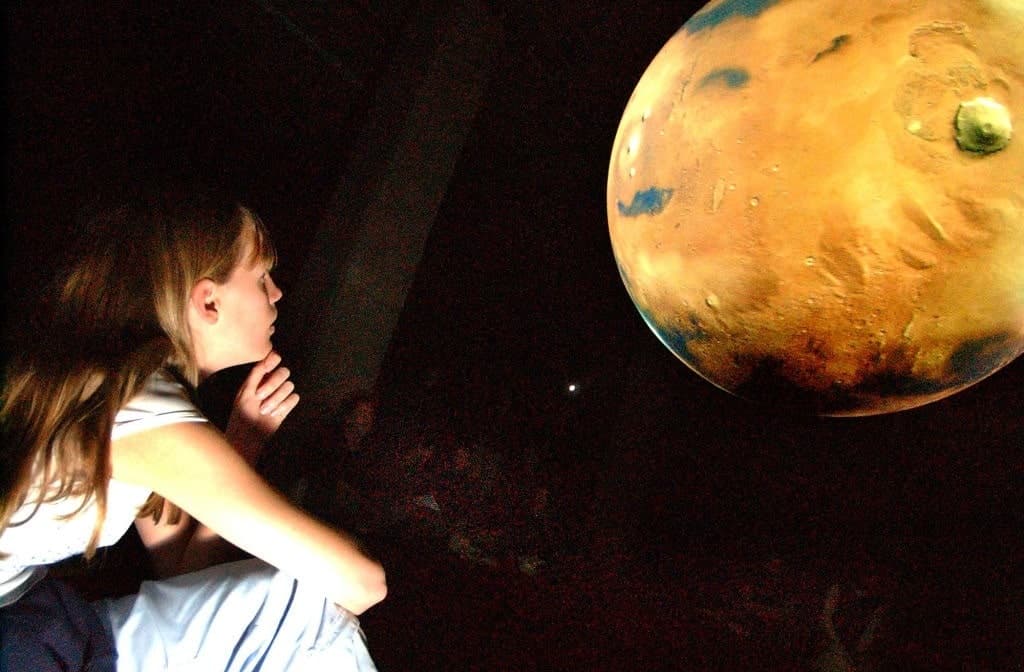
Mars, the fourth planet from the sun, is one of five in our solar system that can be seen by the naked eye in the night sky. As such, its discovery is a tale lost to the ages – but ancient Egyptians, Babylonians, and Chinese all knew of it. It’s about 142 million miles from the sun. Depending on where they are in their orbits, Mars and Earth range from just 34 million miles apart to more than 250 million!
Throughout history, people have observed the little red dot among the stars and could tell it was unique. So it should come as no surprise that legends grew up around it. The rusty red color calls to mind the image of blood, leading the Greeks and Romans to revere it as Ares and Mars, respectively, the two cultures’ gods of war.
In keeping with that tradition, English composer Gustav Theodore Holst dubbed it Mars, the Bringer of War, which is also what he titled the musical passage he composed in its honor. In 1914, there were only eight known planets including Earth. Mars took center stage as the first in a much larger arrangement dedicated to those seven by Holst called The Planets. It’s loud, powerful, and dramatic music – just as one might expect for a piece dedicated to the god of war. When listening to “Mars, the Bringer of War,” one can easily imagine armies on the march.
A World as Violent as Its Namesake
Though people knew of Mars long before, it was in 1609 that Galileo Galilei peered at the red planet through his newly developed telescope and discovered it was round, just like Earth. As time passed and telescopes became more advanced, we discovered polar ice caps and dust storms. Mars’ two moons, Phobos and Deimos, were found. When we began sending probes and robots out into space, Mars was one of our first goals. Rovers have roamed its surface and satellites have orbited it, revealing a rocky surface covered in dust. There is ice at the poles, but no liquid water anywhere to be found – though there are what appear to be signs of flowing water in the distant past.
Could there have ever been life on Mars? Perhaps! Today, however, the planet is empty – and inhospitable. The air is thin, less than 1% of Earth’s atmosphere, and made mostly of carbon dioxide. Surface temperatures often drop to as low as -80 degrees Fahrenheit (-62 Celsius), and dust storms rage for months on end.
The red planet is believed to have formed roughly the same time as Earth, about 4.6 billion years ago. As the giant spinning disk of gas and dust rotated around the young sun, bits stuck together over time until Mars grew into the planet it is today. It’s only about half as wide as Earth, however, and has just about one-tenth of the mass. Also, Mars’ moons are not like ours. Both are more potato-shaped, and they’re much smaller. Some believe they were actually asteroids captured and trapped in orbit by the planet’s gravity.
Eyes on the Future
Mars has been and remains today the solar system’s most studied planet aside from Earth. More probes and rovers have been deployed there than anywhere else in the system, and both private corporations and space agencies around the world are working on plans to send astronauts to Mars.
Whether life ever existed there remains to be discovered – but it seems quite likely Mars will be the next planet on which humans set foot. Some experts expect those first explorers will arrive on the red planet in the 2040s or even 2030s.
Test Your Knowledge – Take the Quiz
Try a quiz based on this article
Mars is the _____ planet from the sun.
Show the answer
Fourth.
Depending on where they are in their orbits, Earth and Mars can be as far as 250 million miles apart.
Show the answer
True.
What color is Mars?
Show the answer
Red.
The Greeks referred to the planet Mars as Ares, their:
Show the answer
God of War.
Which English music composer named one of his musical pieces “Mars, the Bringer of War”?
Show the answer
Gustav Theodore Holst.
What are the names of Mars’ two moons?
Show the answer
Phobos and Deimos.
Rovers on Mars discovered a rocky surface covered in:
Show the answer
Dust.
Surface temperatures on Mars can reach as low as -80 degrees Fahrenheit.
Show the answer
False.
Compared to Earth’s moon, the moons on Mars are:
Show the answer
Potato-shaped and smaller.
Researchers have determined that at some point in history, there was life on Mars.
Show the answer
False.