
★ In this story 02
On this trek through time, we land on a much more familiar planet than in the previous eons. It’s an ancient and still alien Earth, but over the course of about two billion years, the world went through extreme changes, growing each time closer to the Earth we know and love today.
The Transiting World
The Proterozoic Eon is believed to have run from about 2.5 billion years ago to just 541 million years ago. That end year might seem like a long time – and it certainly is – but compared to the previous eons, it’s practically yesterday. In that time, continents drifted and collided into each other, the atmosphere transformed into the breathable air that allows complex animal life, and the planet’s surface froze and thawed multiple times.
Over its vast span, the Proterozoic Eon is divided into three eras: The Paleoproterozoic, Mesoproterozoic, and Neoproterozoic. Each brought its own geologic and biological changes.
Plate tectonics played a major role in reshaping the Earth – quite literally. Early in the eon, one of the earliest supercontinents formed. It has been called either Nuna or Columbia, and it later broke apart to form other supercontinents, like Rodinia. The formation and destruction of these supercontinents influenced ocean currents, cycled nutrients, and affected the climate.
Speaking of climate, this eon – especially the Neoproterozoic Era – was marked by extreme climate change. There was even a time known to modern researchers as “Snowball Earth,” during which it’s believed that glaciers may have reached as far as the equator, enveloping much of the planet in ice for millions of years.
But the most significant event was probably the Great Oxygenation. It was in this eon that the Cyanobacteria began releasing enough oxygen through photosynthesis that the fundamental chemistry of our oceans and atmosphere transformed. This newly oxygenated Earth – at least when not mostly frozen – was prime for the explosion of plant and animal life that followed.
The Proterozoic Eon, Earth’s ‘Former Life’
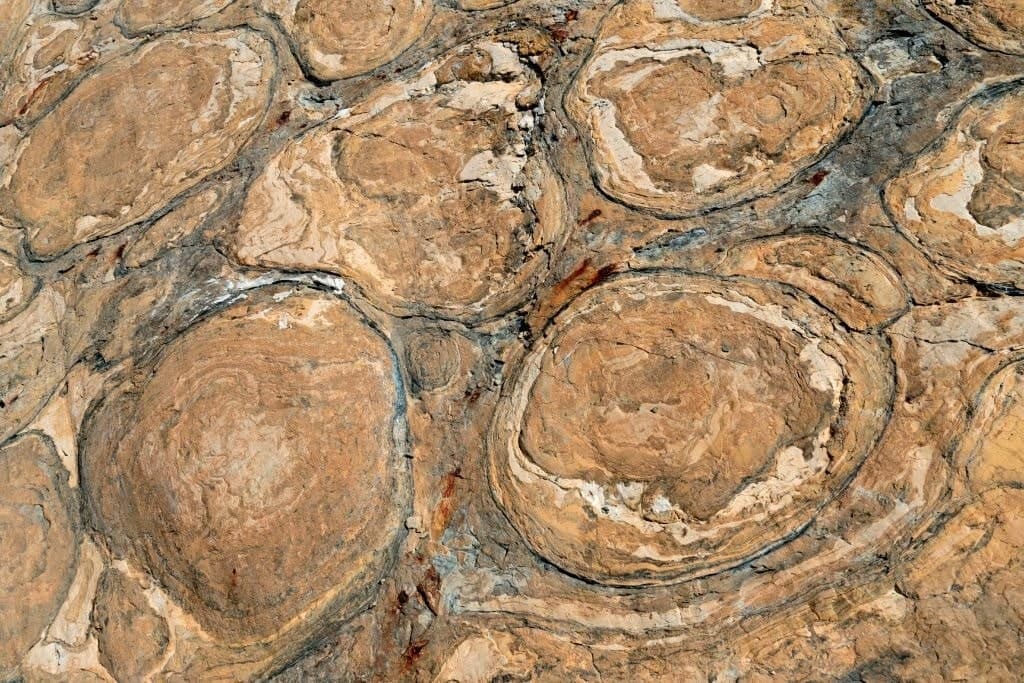
Early in the eon, during the Paleoproterozoic Era, life continued to be the single-celled cyanobacteria that emerged during the Archean. But as oxygen levels rose, more complex forms of life developed. It was during this time that the first eukaryotic cells emerged. These single-celled organisms featured a centralized nucleus and other structures, called organelles, that were more specialized than those which came before. This eventually allowed for the development of the first multi-cellular organisms.
Fossil evidence from this eon suggests there were early forms of algae, fungi, plants, and even animals. In fact, toward the end of the Neoproterozoic Era, it is believed that multi-cellular animals were living in the water. These creatures, called Ediacaran biota by scientists, had soft bodies and may have grown as large as several feet in length. They represent the earliest forms of actual animal life – and foreshadow the coming explosion of complex life in the eon to come.
The Proterozoic Eon is the final of the three in what is informally called the Precambrian Period or Precambrian Eon, which is simply what we get if we lump the Hadean, Archean, and Proterozoic Eons together. What follows is called the Cambrian Explosion, which marks the beginning of the Phanerozoic Eon – the one we’re in right now! But that is a story for another trip back in time.
Test Your Knowledge – Take the Quiz
Try a quiz based on this article
How many eras is the Proterozoic eon divided into?
Show the answer
Three.
One of the earliest supercontinents that formed is called either Nuna or:
Show the answer
Columbia.
Which era in the Proterozoic Eon was marked by extreme climate change?
Show the answer
Neoproterozoic Era.
What name did scientists give to the time in which nearly all of the Earth was enveloped by ice glaciers?
Show the answer
“Snowball Earth”.
The Great Oxygenation describes the time when oxygen began being released by cyanobacteria and plant and animal life began to exist.
Show the answer
True.
What is the name for single-celled organisms that featured a centralized nucleus and were more specialized than the ones before them?
Show the answer
Eukaryotic cells.
Creatures called Ediacaran biota were the first multi-cellular animals living:
Show the answer
In water.
What marks the beginning of the Phanerozoic Eon?
Show the answer
The Cambrian Explosion.