
★ In this story 02
It requires no time travel to experience the Phanerozoic Eon – we’re in it right now! Still, the present eon began an estimated 541 million years ago, so things that happened in the beginning would seem pretty wild to the average person today.
Cambrian Explosion in the Phanerozoic Eon
The Phanerozoic Eon is split into three eras: the Paleozoic, the Mesozoic, and the Cenozoic.
The Paleozoic, which means “ancient life,” came first, and it’s the one that saw what scientists call the Cambrian Explosion. The fossil record seems to show that, over a 20–30-million-year span, as the previous eon ended and this one began, the world saw an explosion of life. Complex animal life rapidly diversified and spread through the oceans. In the Paleozoic Era, the first land plants, insects, and amphibians evolved. It’s believed that this rapid development happened because of the oxygenation of the late Proterozoic Eon coinciding with the end of an ice age. The Paleozoic Era ended with the largest mass extinction event in Earth’s history, the Permian-Triassic Extinction, when more than 90% of all life on Earth died. It’s believed to have been triggered by massive volcanic eruptions that led to rapid global warming.
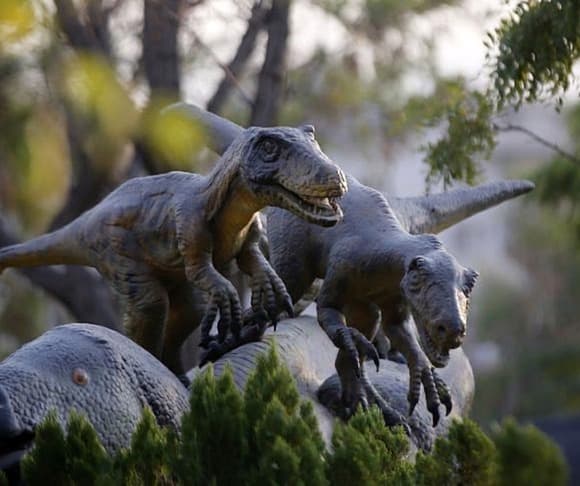
The Mesozoic Era, which means “middle life,” is – as the name suggests – in the middle. This is also known as the “Age of Reptiles” or “Age of Dinosaurs.” The dinosaurs were the dominant creatures throughout this era, but the first mammals, birds, and flowering plants appeared as well. The Mesozoic ended with the Cretaceous-Paleogene extinction event, which wiped out most of the dinosaurs. This was caused by an asteroid impact about 66 million years ago. After the Chicxulub asteroid, which left a crater somewhere between 110 and 125 miles wide, Earth experienced what’s called “impact winter.” Dust and debris blocked the sunlight for years, acid rain fell, and massive tsunamis wrecked the Earth.
The Modern Eras and Ages
The last of the supercontinents also broke up during the Mesozoic and, by the end of the era, settled more or less into the continents as we know them today. And so the current era – the Cenozoic, which means “new life” – began. After the world rebounded from the devastation of the asteroid impact, birds and mammals became the dominant animals on land. Indeed, it’s also often called the “Age of Mammals.” Even then, the rise of what we’d call modern man today wasn’t until much later. The Cenozoic had three periods: the Paleogene, the Neogene, and the Quaternary. The last of those was split into two epochs, the Pleistocene and the Holocene. Only in the Holocene – roughly the last 10,000 to 12,000 years – did human civilization emerge. Today, we’re the Meghalayan Age of the Holocene Epoch, which started about 4,200 years ago with a two-century-long extreme drought!
Try a quiz based on this article
The Hadean Eon got its name from the Greek translation of the Hebrew word “hell” and also from what Greek god that represents death?
Show the answer
Hades.
The Hadean is the only eon that is:
Show the answer
Not divided into eras.
Scientists believe that the Hadean Eon ran from about 4.6 billion years ago to 4 billion years ago.
Show the answer
True.
What word describes how the Earth’s crust was pushed back into the mantle by the movement of the plates?
Show the answer
Subducted.
Though scientists are not sure, many believe that the Earth’s atmosphere, at the beginning, was made up of:
Show the answer
Hydrogen and helium.
The continual impacts of bodies in space are called:
Show the answer
Planetesimals.
The moon is thought to have formed during the Archean Eon.
Show the answer
False.
The Hadean Eon was a time of cosmic dust to oceans of:
Show the answer
Molten rock.
One scientific theory suggests that an object roughly the size of Mars collided with Earth, with some of the debris becoming part of the Earth, and the other going into orbit and forming:
Show the answer
The moon.
After the Earth’s crust had cooled and the atmosphere had formed, the Earth was primarily made up of:
Show the answer
Water.